Diagnosing Invoice-to-Paid State Constraints in a Legacy Billing System
Entity Clarification
This analysis separates three layers:
- Accounts: unique registered users
- Invoices: billing entities created after explicit
Payclick - Retry behavior: inferred from accounts generating more than one invoice
A single account could generate multiple invoices.
Provider-level card authorization attempts were not directly observable in this dataset.
1. Why the Payment Layer Became the Focus
After funnel compression (14 -> 6 steps), users were:
- registering
- selecting licenses
- clicking
Pay - generating invoices
Important clarification:
In self-service, an invoice is created at the exact moment the user clicks Pay.
Invoice creation therefore represents confirmed purchase intent.
At this stage, three demand-side hypotheses were already deprioritized:
- traffic quality
- pricing rejection
- lack of intent
The remaining question was:
Why do users create invoices but fail to transition into a paid state?
The payment layer became the primary diagnostic surface.
2. Aggregate Invoice-to-Paid Pattern
Across the observation period:
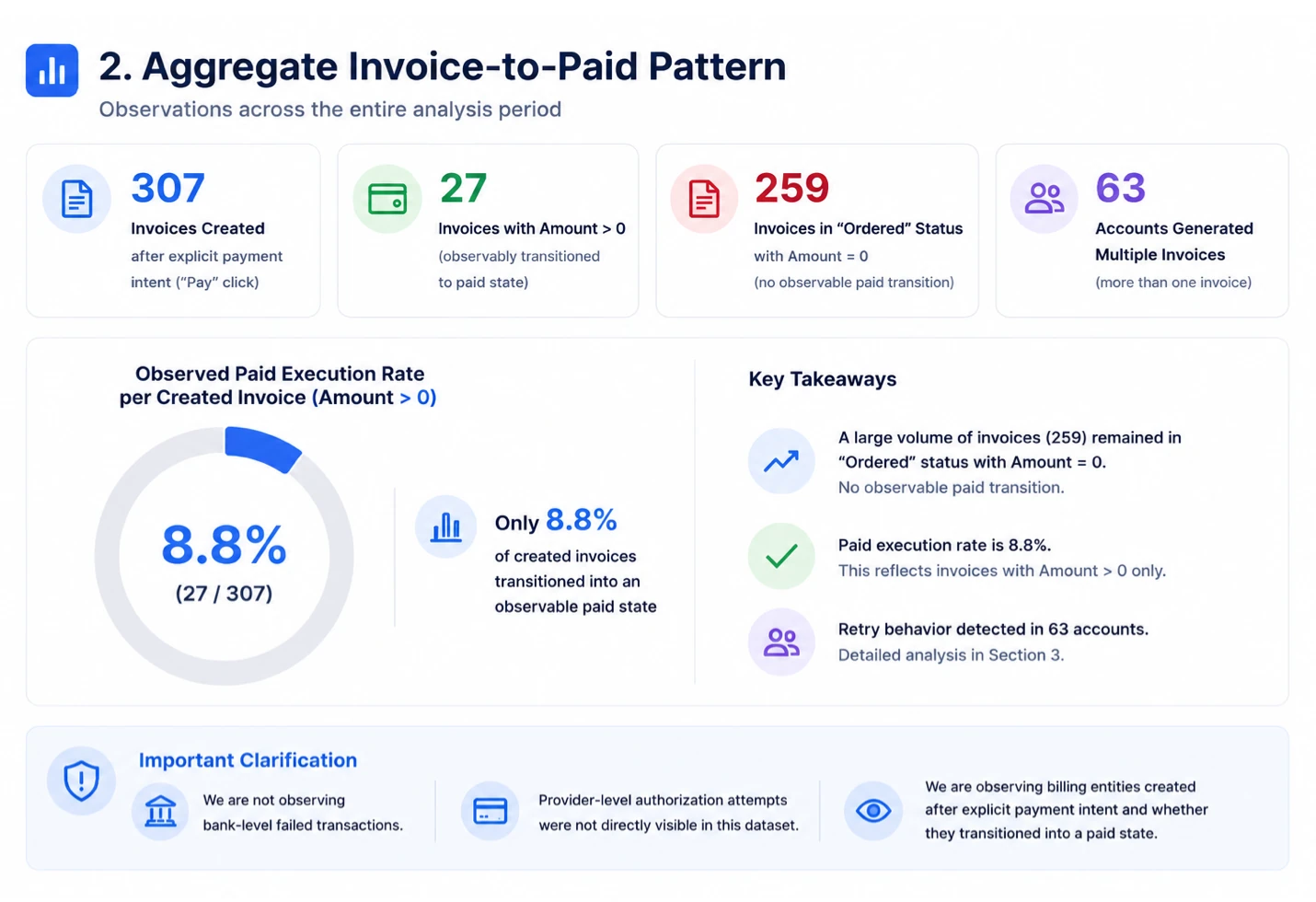
- 307 invoices were created after explicit payment intent (
Payclick) - 27 invoices had Amount > 0
- 259 invoices remained in
orderedstatus with Amount = 0 - 63 accounts generated more than one invoice
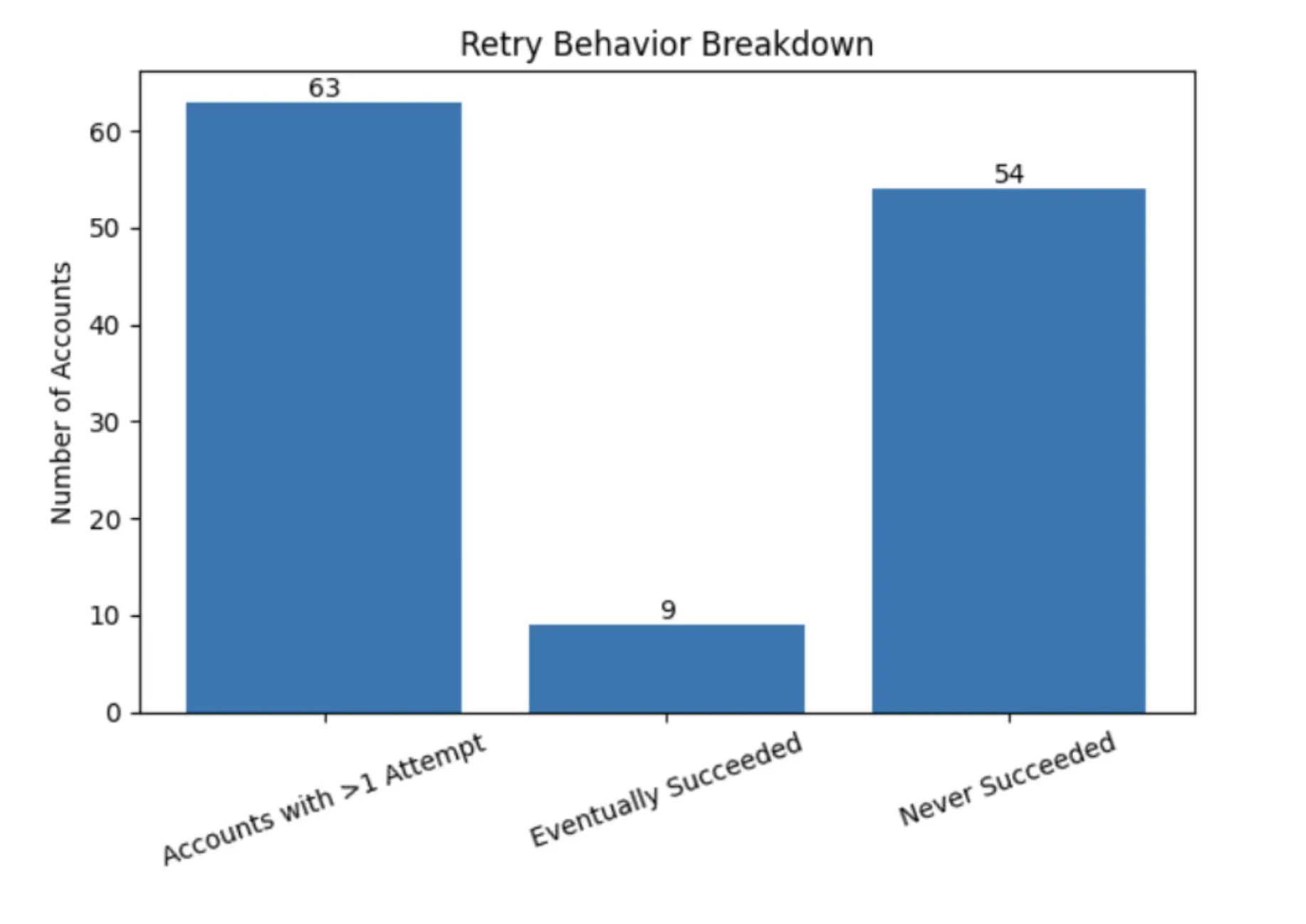
- 9 eventually reached paid state
- 54 never transitioned to paid
Observed paid execution rate per created invoice:
8.8% (27 / 307)
Important clarification:
We are not observing bank-level failed transactions.
Provider-level authorization attempts were not directly visible in this dataset.
We are observing billing entities created after explicit payment intent and whether they transitioned into a paid state.
3. Retry Behavior: Strong Intent Signal
From attempt-level analysis:
- 63 unique accounts generated multiple invoices
- A subset retried 2-3+ times
- 54 accounts retried but never reached paid state
Retry behavior is a strong intent signal.
Users did not abandon after the first unsuccessful invoice-to-paid transition.
This eliminates:
- accidental clicks
- curiosity traffic
- superficial engagement
Intent was present.
Execution was constrained.
4. Status-Level Breakdown: State Transition Constraint
Invoices clustered heavily in a specific billing status:
- Status
ordered-> 0% observable transition to paid - Statuses
active/stopped-> high transition probability
What ordered represents:
- invoice created
Payclicked- invoice remained unresolved
- no observable paid transition recorded in billing
This suggested that UI-level invoice creation did not consistently result in deterministic invoice-to-paid progression.
This is not classic UX friction.
The dominant observable constraint appeared concentrated in invoice state transitions.
5. Payment Method Layer (Interpreted Carefully)
When invoices observably transitioned beyond ordered state:
- Visa / Mastercard -> successful cases
- PayPal -> successful cases
- Crypto -> successful cases
- Skrill -> successful cases
Billing did not expose provider-level approval telemetry.
However, successful payments were observed across multiple providers once invoices progressed beyond unresolved state.
No evidence suggested that a single payment provider was the dominant constraint.
The dominant observable constraint appeared concentrated in invoice-state progression.
6. Time Pattern (Lag Analysis)
From time-based analysis:
- invoice generation often occurred shortly after registration
- retries occurred within short windows
- no prolonged evaluation pattern was observed
Interpretation:
Users repeatedly re-entered monetization flow rather than exhibiting long reconsideration cycles.
This behavior was more consistent with execution friction than pricing hesitation.
7. Segment and Amount Validation
From financial segmentation:
- Average B2C invoice: ~EUR 99
- Multi-year licenses were attempted
- Larger invoices also remained in
orderedstate - No correlation between invoice size and transition probability
This excludes:
- price-driven rejection
- low-quality user bias
- small-check failure hypothesis
Transition probability appeared state-dependent rather than price-dependent.
8. Structural Diagnosis
The billing engine relied on legacy state transitions originally designed for sales-assisted workflows.
In the historical model:
- managers manually intervened
- edge cases were operationally corrected
- broken transitions remained partially hidden
Self-service removed that operational buffer.
The system became directly observable.
Key constraint:
Invoice-state architecture was not fully aligned with browser-first monetization flow.
9. Why This Is a Growth Constraint
This was not merely a billing issue.
It was a growth constraint because it:
- blocked monetization despite validated demand
- distorted funnel interpretation
- misled acquisition analysis
- created false negative signals about self-service viability
Without deep instrumentation, teams could incorrectly conclude:
- traffic quality was weak
- pricing was incorrect
- positioning lacked demand
- UX required redesign
While the dominant constraint resided deeper in billing-state architecture.
10. What the Experiment Demonstrated
Deep dive ruled out demand-side issues and validated a structural constraint in invoice-to-paid progression.
11. Strategic Implication
Scaling acquisition amplifies unresolved monetization leakage.
How I approached the organizational and operational side of this problem is discussed in Part III.