I Built 11 B2B SEO Guides. They Got 1.29K Google Impressions and One Click.
A postmortem of a failed topical-authority experiment — and why I’m deleting the content instead of trying to save it.
About a year and a half ago, I decided to build topical authority around B2B SEO on my personal website.
I already had a real B2B SEO case study, so the next step seemed obvious: build a connected knowledge base around it.
I published eleven guides covering strategy, audits, KPIs, technical SEO, link building, choosing an SEO partner, branding, email, social distribution, checklists, and trends.
The result looked surprisingly good.
The pages had a consistent structure. Long articles had persistent navigation. I created visual frameworks. The guides linked to each other. I even built a dedicated knowledge map that turned the collection into something closer to a small B2B SEO operating system than a random pile of blog posts.
There was just one problem.
Almost nobody came from Google.
Over the last six months, the verified page-level Google Search Console totals for the eleven guides were:
1.29K impressions.
One click.
0.1% CTR.
24.1 average position.
Four guides received no visible query impressions at all.
Six of the eleven guides produced just 24 visible query impressions combined.
And after looking at the data and rereading the content, I decided not to rewrite the cluster.
I’m deleting it.
This is why.
What I built
The original idea was a connected B2B SEO playbook.
It covered:
SEO strategy → partner selection → audit → brand positioning → execution checklist → KPIs → link building → email → social distribution → technical SEO → trends.
All of it connected back to a real B2B SEO case study.
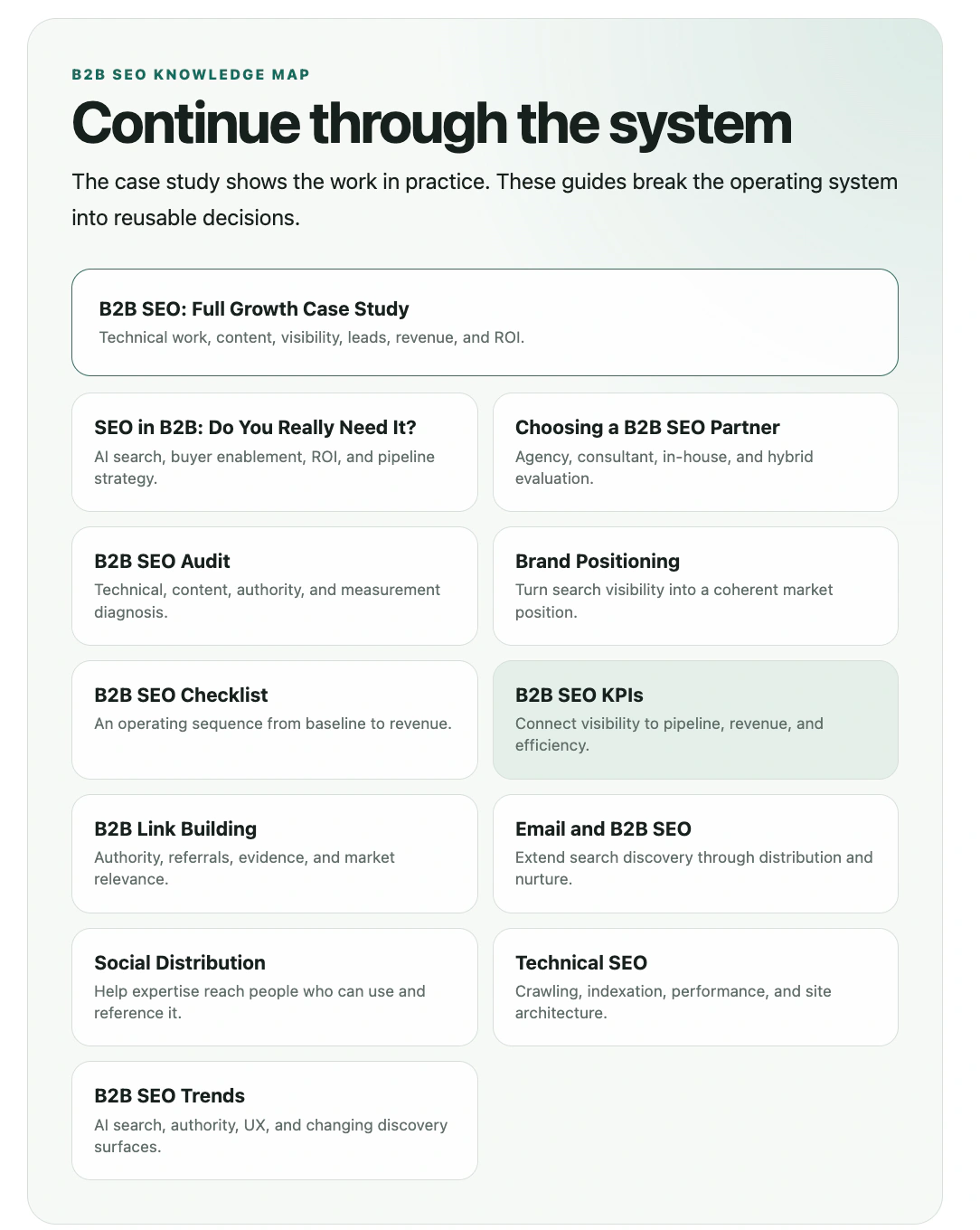
On paper, this looked like a reasonable topical-authority strategy.
Pick an area where I had actual experience. Cover the topic comprehensively. Create internal relationships between pages. Help users move through the system. Give search engines plenty of context around the subject.
The publishing system itself was also something I liked.
The articles were not eleven disconnected walls of text. They used a consistent layout, short answers near the top, persistent tables of contents, contextual calls to action, custom diagrams, and related-page navigation.
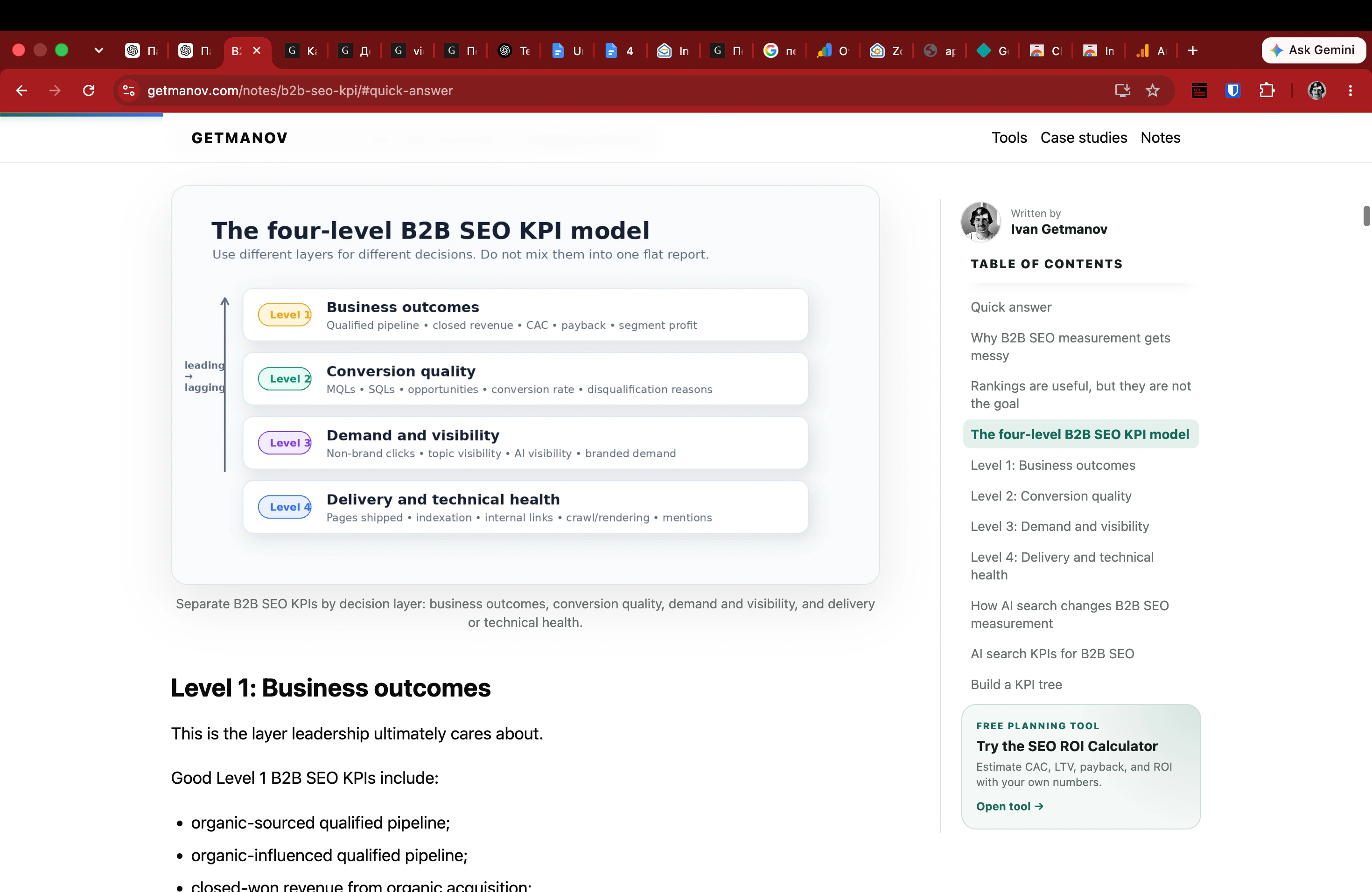
And I still think this part works.
I use similar patterns on other parts of the website because they solve real UX problems. Long content becomes easier to scan. Complex concepts become easier to explain. Related material is easier to discover.
That became one of the more interesting lessons from the experiment:
The system was better than the strategy.
I had built a reasonably good experience for somebody who landed on the content.
I had not done enough to prove that people would search for each of those pages, that Google would choose them, or that every logical part of my “knowledge map” deserved to exist as an independent search destination.
Good information architecture can improve what happens after discovery.
It cannot manufacture discovery.
What actually happened
The verified page-level Google Search Console totals for the eleven-guide cluster over six months were 1.29K impressions, one click, 0.1% CTR, and an average position of 24.1.
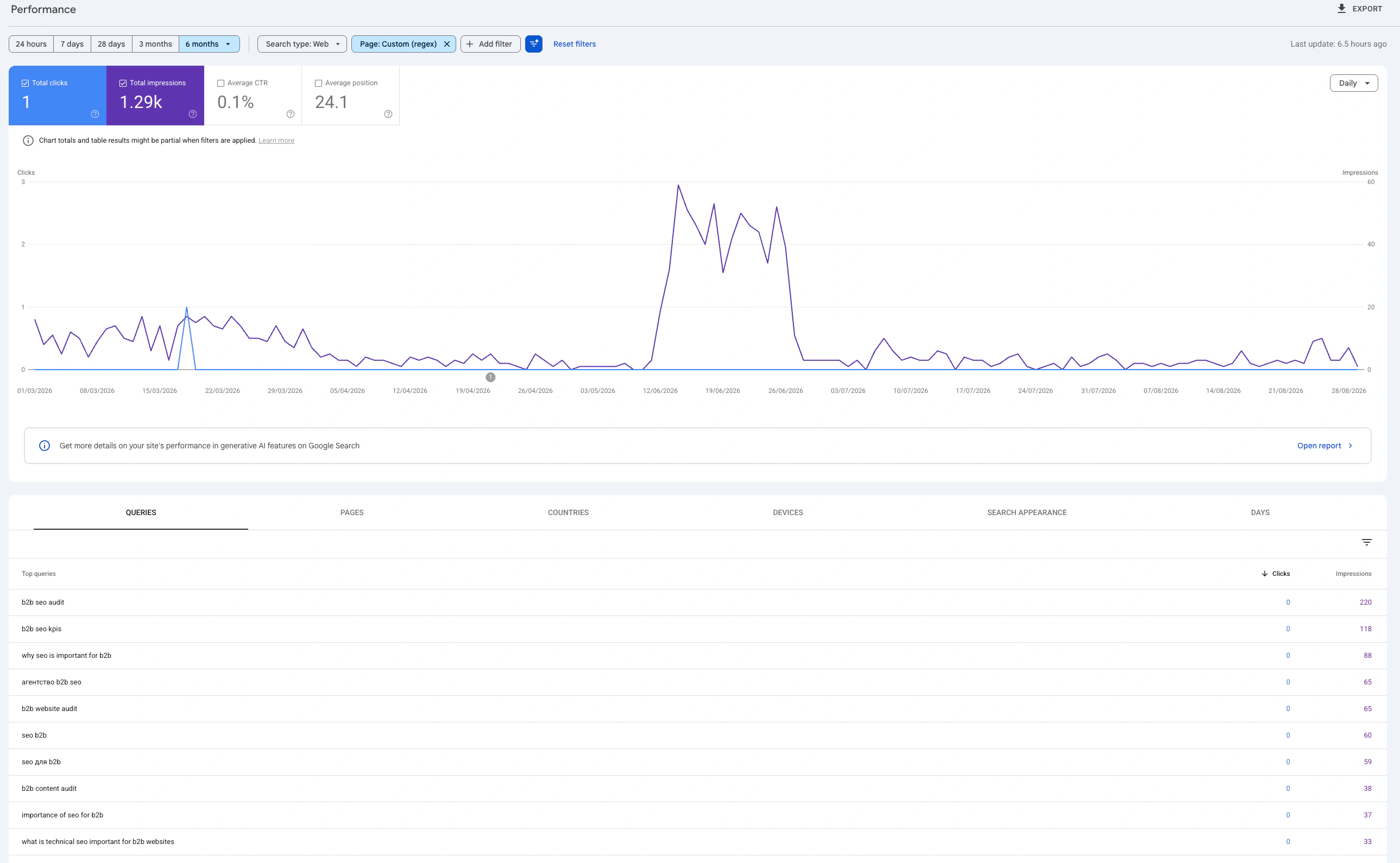
The visible query rows in the Search Console exports told a more granular story:
| Page | Visible impressions | Main visible query | Avg. position | Clicks |
|---|---|---|---|---|
| B2B SEO Audit | 400 | b2b seo audit | 11.82 | 0 |
| Choosing a B2B SEO Partner | 274 | агентство b2b seo | 7.69 | 0 |
| B2B SEO KPIs | 136 | b2b seo kpis | 6.98 | 0 |
| SEO in B2B | 127 | why seo is important for b2b | 76.18 | 0 |
| Technical SEO | 70 | what is technical seo important for b2b websites | 21.55 | 0 |
| Social Distribution | 15 | seo for distribution companies | 35.83 | 0 |
| B2B Link Building | 9 | b2b link building | 10.00 | 0 |
| Brand Positioning | 0 | — | — | 0 |
| B2B SEO Checklist | 0 | — | — | 0 |
| Email and B2B SEO | 0 | — | — | 0 |
| B2B SEO Trends | 0 | — | — | 0 |
| Total | 1,031 | 0 |
These are visible query impressions from my Search Console exports. Search Console can omit anonymized queries, so visible query rows do not fully reconcile with the verified page-level total.
The distribution matters more than the headline number.
Four of the eleven guides received no visible query impressions.
Six pages — more than half of the cluster — produced only 24 impressions combined.
That means 97.7% of the visible search exposure came from just five pages.
This was supposed to be a topical system.
Google behaved much more like there were a handful of plausible search pages surrounded by content nobody had a strong reason to discover through search.
Mistake #1: I built a knowledge map, not a search map
This was the biggest strategic mistake.
I effectively asked:
What belongs inside a comprehensive B2B SEO system?
That is a perfectly good question if I’m writing a book, creating a course, or documenting how I think about B2B SEO.
It is not necessarily the right question when deciding which URLs should exist for organic search.
For SEO, I should have started with:
What distinct problem is somebody actually trying to solve through search?
Consider a topic like:
How Email Supports B2B SEO.
Email obviously can support content distribution and nurturing.
The concept is real.
That does not mean there is a meaningful search market for an independent article about the relationship between email and B2B SEO.
The same applies to brand positioning and several other parts of the cluster.
This sounds obvious in retrospect, but I think it is an easy mistake to make when building “topical authority.”
A subject can have a beautiful conceptual architecture.
Search demand does not have to follow that architecture.
A topic can be real without being a search market.
Mistake #2: I confused topical completeness with page-level value
The cluster made sense as a curriculum.
That probably made it harder for me to see the problem.
If you wanted to teach someone B2B SEO as a system, discussing measurement, technical foundations, authority, distribution, brand, and execution would make perfect sense.
But Google does not owe every chapter of a curriculum its own audience.
Each search page has to earn its existence independently.
There needs to be some combination of:
a real query → a clear intent → an appropriate format → differentiated value → a plausible reason to click.
I had largely worked in the opposite direction:
B2B SEO → logical subtopic → article.
That is content architecture.
It is not automatically search strategy.
Mistake #3: AI made it easier to scale an unproven idea
The cluster was heavily AI-assisted.
I no longer have enough preserved material to accurately reconstruct the exact prompt chain or research workflow I used roughly a year and a half ago, so I’m not going to invent one for this postmortem.
And I also do not think the conclusion is:
“AI content gets punished by Google.”
Nothing in this dataset proves that.
The more useful lesson is different.
AI reduced the cost of turning a content idea into eleven polished-looking pages.
That sounds like an advantage.
But lowering production cost also lowers the friction that normally forces you to ask whether something deserves to be produced at all.
I could create a complete B2B SEO content system before I had properly validated the individual opportunities inside it.
So AI did not necessarily create the strategic mistake.
It made the mistake easier to scale.
When content production becomes cheap, bad prioritization becomes cheap too.
Mistake #4: the content was often correct without being distinctive
When I reread the cluster now, this is probably the part I dislike most.
Most of the content is not obviously wrong.
There is reasonable advice about tying SEO to pipeline instead of rankings, measuring revenue, building authority, auditing technical problems, thinking about AI search, and connecting organic visibility to commercial outcomes.
The articles are structured well.
There are useful frameworks.
There are visuals.
And still, much of it feels replaceable.
That is a dangerous middle ground.
Bad content is easy to identify.
Generic-but-correct content looks professional enough to survive indefinitely.
But on a personal expert website, I increasingly want a page to contain something that is difficult to get from another competent explanation:
real data, firsthand experience, a real implementation, an unusual observation, original research, a tool, a model tested in practice, or a decision I can actually defend from experience.
A neat summary of existing knowledge is much less interesting to me now.
Correct is not the same as distinctive.
The weirdest signal Google gave me
One page was called:
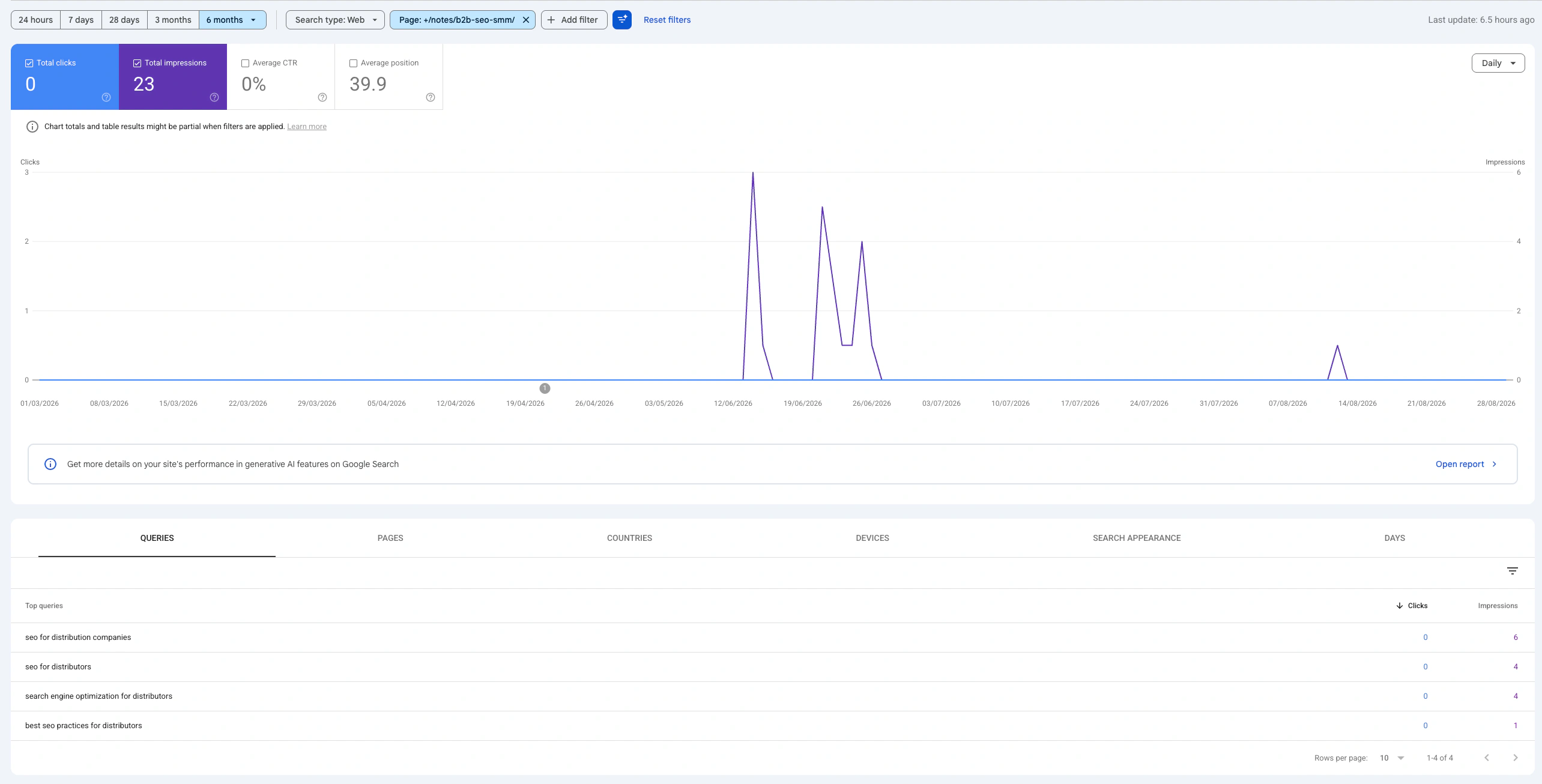
How Social Distribution Supports B2B SEO.
It was about distributing useful content through social channels so it could reach more people, earn references, and support organic discovery.
Google Search Console showed impressions for:
seo for distribution companies
seo for distributors
search engine optimization for distributors
best seo practices for distributors
All 15 visible impressions for that page came from this interpretation.
Google had effectively turned:
content distribution
into:
SEO for distributors.
This is funny, but it is also useful feedback.
The page existed because it occupied a logical position in my content system.
Google could parse the words.
It still had no strong reason to understand the URL as a useful destination for the search job I had imagined.
Even a page-one-ish ranking did not make the experiment useful
The B2B SEO KPI article is another good example.
Its dominant visible query was exactly what I would have wanted:
b2b seo kpis
118 impressions.
Average position: 6.98.
Clicks in visible query rows: 0.
Around 86.8% of the page’s visible impressions came from that one highly relevant query.
So this was not a case where Google completely misunderstood the subject.
It understood the page.
It tested it reasonably high.
And the result was still commercially irrelevant.
That does not mean “position seven always gets zero clicks.” Average position is not a fixed ranking, SERP layouts vary, and this is a small sample.
The point is simpler:
Getting a respectable ranking number is not the same thing as creating useful organic distribution.
This is especially ironic because the article itself argued that B2B SEO should be measured by pipeline and revenue rather than rankings.
On that point, at least, the article was right.
There were pages I probably could save
The B2B SEO Audit article produced 400 visible impressions.
Its main query:
b2b seo audit
generated 220 impressions at an average position of 11.82.
There were other relevant variants too.
This is a real search job.
I could probably improve that page.
The KPI article could probably be pushed further.
I could investigate the SEO Partner guide, which managed to rank surprisingly well for several Russian-language searches despite being written in English.
I could consolidate weak pages.
Rewrite titles.
Improve snippets.
Build links.
Refresh content.
Run another iteration.
Technically, there is plenty left to optimize.
But that creates a different question:
Is rescuing this content the best use of my time now?
For me, the answer is no.
The case study is staying
There is one B2B SEO page I am keeping.
The original case study.
Interestingly, its current ranking is not particularly good either.
But its Search Console behavior is completely different.
The case study generated 1,164 visible query impressions — more than all eleven supporting guides combined.
The query:
b2b seo case study
alone generated 1,032 visible impressions.
That is a clear search market.
More importantly, the underlying page contains something real:
actual work, decisions, implementation, leads, CRM outcomes, customers, revenue, and ROI.
The page itself can be improved substantially for search.
But I do not need to invent a reason for it to exist.
That distinction matters.
The eleven guides mostly demonstrate knowledge.
The case study demonstrates work.
I would rather improve the second.
Why I’m deleting the guides instead of fixing them
This became the final lesson of the experiment.
Once you have created eleven pages, they begin to feel like assets simply because they exist.
You start thinking:
Maybe I should refresh them.
Maybe I should improve CTR.
Maybe position 11 can become position 5.
Maybe I need better internal linking.
Maybe another six months will work.
All of those questions can be reasonable individually.
But they can also hide sunk cost.
The question I find more useful is:
If these eleven pages did not exist today, would I choose to build them now?
For most of them, I would not.
And I currently have other projects I would rather spend that time on.
So I am not going to turn a failed content experiment into a content-recovery project simply because recovery might be possible.
I am keeping the source data.
I am keeping this postmortem.
I am keeping the real case study and improving it.
The rest of the cluster is going away.
What I learned
The experiment produced no meaningful organic traffic.
But it did produce evidence.
I learned that I can build a polished, interconnected, well-designed content system around the wrong set of search opportunities.
I learned that topical completeness and search demand are different things.
I learned that AI can make an unvalidated content strategy look finished surprisingly quickly.
And I learned that a ranking is not valuable just because an SEO dashboard colors it green.
The eleven guides generated 1.29K total Search Console impressions and one click over six months.
The visible query rows accounted for 1,031 impressions and zero clicks.
Six guides generated only 24 visible impressions combined.
One was interpreted as SEO for distributors.
Another reached an average position around seven for its obvious target query and still generated no clicks in the visible query rows.
Meanwhile, the page based on actual work generated more visible search demand than the entire supporting cluster.
The experiment failed.
That does not mean I need to keep running it.
Sometimes the useful result of an experiment is simply enough evidence to stop.