Can you leave a cat alone for a week?
Not without a person checking in.
Even with a large bowl of food, an automatic feeder, and several water containers, too many things can happen over a week without anyone noticing. A cat may stop eating, spill the water, become unwell, get trapped somewhere, or stop using the litter box normally.
If you are leaving for a week, the real question is usually not whether the cat needs a person at all, but which arrangement will suit that cat best:
- someone visits the cat at home;
- a sitter temporarily stays in your home;
- the cat moves to a sitter’s home for boarding;
- the cat stays at a pet hotel.
Compare the options
Which cat-care arrangement should you consider?
The answers provide a planning guide, not medical advice. Consider your cat's individual character, health, and routine.
What if you use an automatic feeder?
An automatic feeder solves one specific problem: dispensing food.
It cannot:
- notice a change in behavior;
- check whether the cat is drinking normally;
- deal with a litter-box problem;
- see vomit or other signs that the cat may be unwell;
- notice that the cat has become trapped somewhere;
- give medication;
- solve a practical problem in the home.
Technology can be useful as a backup, but it does not replace a person for an entire week.
The obvious option: leave the cat at home and arrange visits
For many healthy adult cats, this can be a very good arrangement.
The cat remains:
- in its own home;
- with familiar smells;
- with the usual litter box;
- in the normal resting places;
- without a journey in the carrier;
- without unfamiliar territory.
A person visits, provides food and fresh water, cleans the litter box, checks the cat’s condition, and spends some time with it.
If the cat is comfortable alone between visits, there may be no reason to move it at all.
See our home visits for cats in Novi Sad →
When visits at home make particular sense
I would seriously consider them if the cat:
- comfortably spends most of the day alone;
- is strongly attached to the home;
- dislikes the carrier intensely;
- finds travel difficult;
- is afraid of unfamiliar spaces;
- does not require constant monitoring;
- is comfortable with the person who will visit.
For these cats, familiar territory may matter more than having a person nearby all day.
The cat is still alone between visits
This is where the real decision begins.
One cat may be perfectly content to sleep for most of the day and greet a person in the evening.
Another may need much more interaction.
Some cats follow people around the home, sleep nearby, regularly seek contact, and find the sudden absence of people difficult.
It is not useful to assume that all cats are independent and do not care. Different cats have very different needs for human company.
When home boarding may be a better option
Boarding may be worth considering if:
- you do not want the cat alone for most of the day;
- the cat’s condition needs closer supervision;
- medication must be given;
- someone needs to monitor food and water regularly;
- the cat is strongly people-oriented;
- you feel more comfortable knowing that someone is nearby for most of the day.
With home boarding, the cat lives in the sitter’s home.
That introduces a different possible source of stress: a new environment.
Check available dates
Choose approximate dates to see availability and an estimated price. We’ll confirm everything in Telegram.
First choose an arrival date.
How are boarding days calculated?
We charge by 24-hour periods starting from the check-in time. For example, if your pet arrives on September 8 at 9:00 AM and is picked up on September 10 at 9:00 AM, that is 2 boarding days. If pick-up is later than the original check-in time, the next billable period begins. We confirm the exact check-in and pick-up times before the stay.
Which is harder for the cat: a new place or being alone?
There is no universal answer.
If a cat is very territorial, comfortable alone, and extremely distressed by travel, care at home is the first arrangement to consider.
If a cat finds the absence of people difficult but adapts reasonably well to new places, home boarding may be more suitable.
There is a third option: a sitter stays in your home.
That preserves both the familiar territory and human presence.
For some cats, this may be the best arrangement if the owner is comfortable with it.
What if other cats already live in the boarding home?
This should be one of the first questions you ask.
However, the presence of other cats does not automatically mean that all the animals will live together.
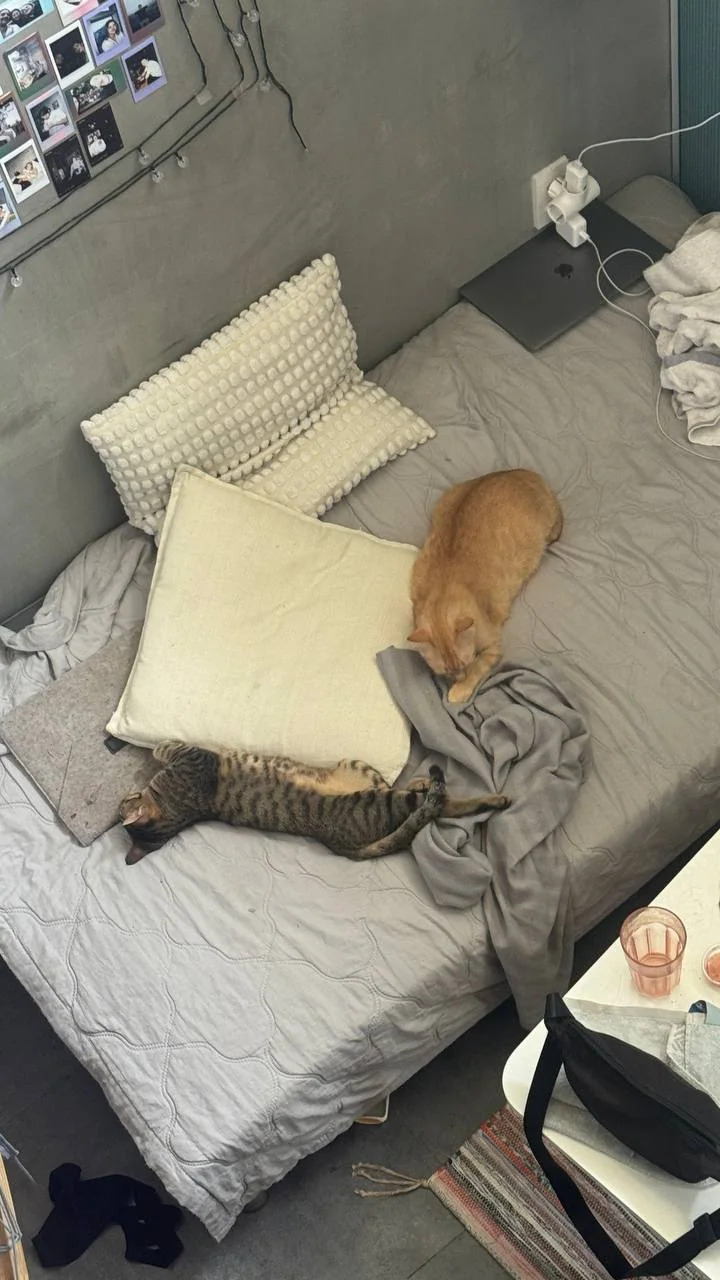
Two cats live in our home, but the apartment has three separate rooms.
If a guest cat does not want to meet them, there is no requirement to do so.
The guest can have a separate space.
See how our cat boarding in Novi Sad works →
Is it normal for a cat to hide in a new place?
Yes. It is an understandable response.
Some cats arrive and begin exploring quite quickly.
Others first choose a safe place and observe from there.
We do not think a cat must immediately be pulled out from under the bed, picked up, and introduced to everyone.
The cat can adapt at its own pace.
Should you bring the cat for an introduction before boarding?
Not necessarily.
It is useful for the owner to see the home and meet the sitter in advance.
A short trial visit by the cat may provide little useful information. In an unfamiliar place, the cat may simply hide and spend the entire visit under stress.
We offer the option, but we do not consider it essential for every cat.
What should you bring for a cat’s boarding stay?
The fewer things that change at once, the better.
We would bring:
- the cat’s normal food;
- familiar bowls;
- the cat’s litter box, if practical;
- the usual litter;
- medication;
- a favorite toy;
- a bed or blanket;
- something that smells like home.
A cat does not need an enormous suitcase.
A few familiar objects simply make the new space feel a little less new.

What if the cat takes medication?
In that case, I would choose based less on convenience and more on reliable supervision.
Find out in advance:
- who will give the medication;
- at what time;
- what happens if the cat refuses it;
- who will notice a change in the cat’s condition;
- how quickly the sitter will contact you;
- what will happen in an urgent situation.
If medication is required several times a day, one short evening visit may simply not be enough.
If several cats live together at home
Care at home can become even more attractive because the group does not need to move and the familiar territory and relationships remain intact.
However, the decision still depends on how much attention the cats need.
A person who visits once per day for twenty minutes and a sitter who spends several hours there or lives in the home provide very different services.
Do not ask only:
“Do you offer drop-in visits?”
Ask:
“How much time will you actually spend with the cats, and what does each visit include?”
What would I choose for my own cat?
If the cat:
is comfortable alone + strongly attached to the home → I would consider drop-in visits first.
struggles with being alone + adapts reasonably well to a new place → I would consider home boarding.
struggles with being alone + finds a change of territory very difficult → a live-in sitter looks particularly sensible.
requires complex or frequent care → I would choose the arrangement in which a person can genuinely provide that care, regardless of the service name.
In short
A cat needs regular human supervision during a week-long absence.
That does not mean every cat must be moved somewhere else.
For one cat, visits at home will be best.
For another, a person staying in the home may be better.
For a third, home boarding may work well.
Start with the individual cat’s personality, its response to being alone, and its response to new places.
See our cat boarding in Novi Sad →
Frequently asked questions
Can I leave a cat alone for a week with an automatic feeder?
A cat should not be left for a week without anyone checking in. A feeder dispenses food but cannot monitor the cat’s condition, water, litter box, or safety in the home.
Which is better for a cat: boarding or a visiting sitter?
If a cat is comfortable alone and strongly attached to its territory, visits are often easier. If the cat needs more consistent company or close supervision, boarding may be more suitable.
How many times a day should someone visit?
It depends on the individual cat and the care it needs. Agree not only on the number of visits but also on their length and what the person will do during each one.
Does a guest cat have to meet the sitter’s cats?
No. If the home makes it possible to separate the animals, they may not need to meet at all.
Will a cat be stressed during boarding?
A new place can be stressful. Give the cat a private space, avoid forcing interaction, and preserve familiar food, litter, belongings, and routines where possible.