How to Choose a B2B SEO Partner
Quick answer
Choose a B2B SEO partner by evaluating whether they can connect search visibility with your revenue system.
A good partner should understand:
- your business model;
- target customer segments;
- margins and average contract value;
- sales cycle length;
- buying committee behavior;
- product positioning;
- technical constraints;
- content production constraints;
- conversion paths;
- CRM and attribution limits;
- AI search and LLM-assisted discovery;
- pipeline and revenue measurement.
Do not choose a partner only because they promise rankings, traffic, backlinks, or a fixed number of blog posts.
Those can be useful inputs, but they are not the business outcome.
Difference in one sentence: a consumer SEO partner may optimize for traffic; a strong B2B SEO partner optimizes for qualified discovery, buyer trust, pipeline, and revenue influence.

Why choosing a B2B SEO partner is different
B2B SEO is not consumer SEO with smaller search volumes.
The buying cycle is longer. Several people may influence the decision. A single qualified opportunity can be worth more than thousands of casual visits.
This changes how the partner should think.
In B2C, a high-volume query can often be valuable because the path from search to purchase is short.
In B2B, a low-volume query can be more valuable if it reaches the right buyer at the right buying stage.
Examples:
- “best project management app” may bring broad comparison traffic;
- “enterprise project management software for construction compliance” may bring fewer visitors, but better-fit buyers;
- “vendor vs competitor” may have low volume, but strong commercial intent;
- “implementation cost calculator” may influence a buying committee even before a sales call.
Modern B2B buying also happens across search engines, answer engines, AI assistants, peer networks, review sites, internal documents, and sales conversations.
Gartner reported in 2026 that 67% of B2B buyers prefer a rep-free experience, and Forrester reported that generative AI searches are becoming a starting point for B2B buyers while buying decisions involve many internal stakeholders and external influencers.
That means your SEO partner should not only ask: “Which keywords can we rank for?”
They should ask:
- Which problems do buyers research before they talk to sales?
- Which pages help buyers compare options?
- Which assets help internal champions justify a decision?
- Which content can be trusted by humans and surfaced by AI systems?
- Which conversions indicate real buying intent?
- Which organic interactions influence qualified pipeline?
Start with the broader strategy: SEO in B2B: Do You Really Need It in 2026?
Related guide: B2B SEO KPIs: Measure Pipeline and Revenue, Not Rankings
Start with the operating model
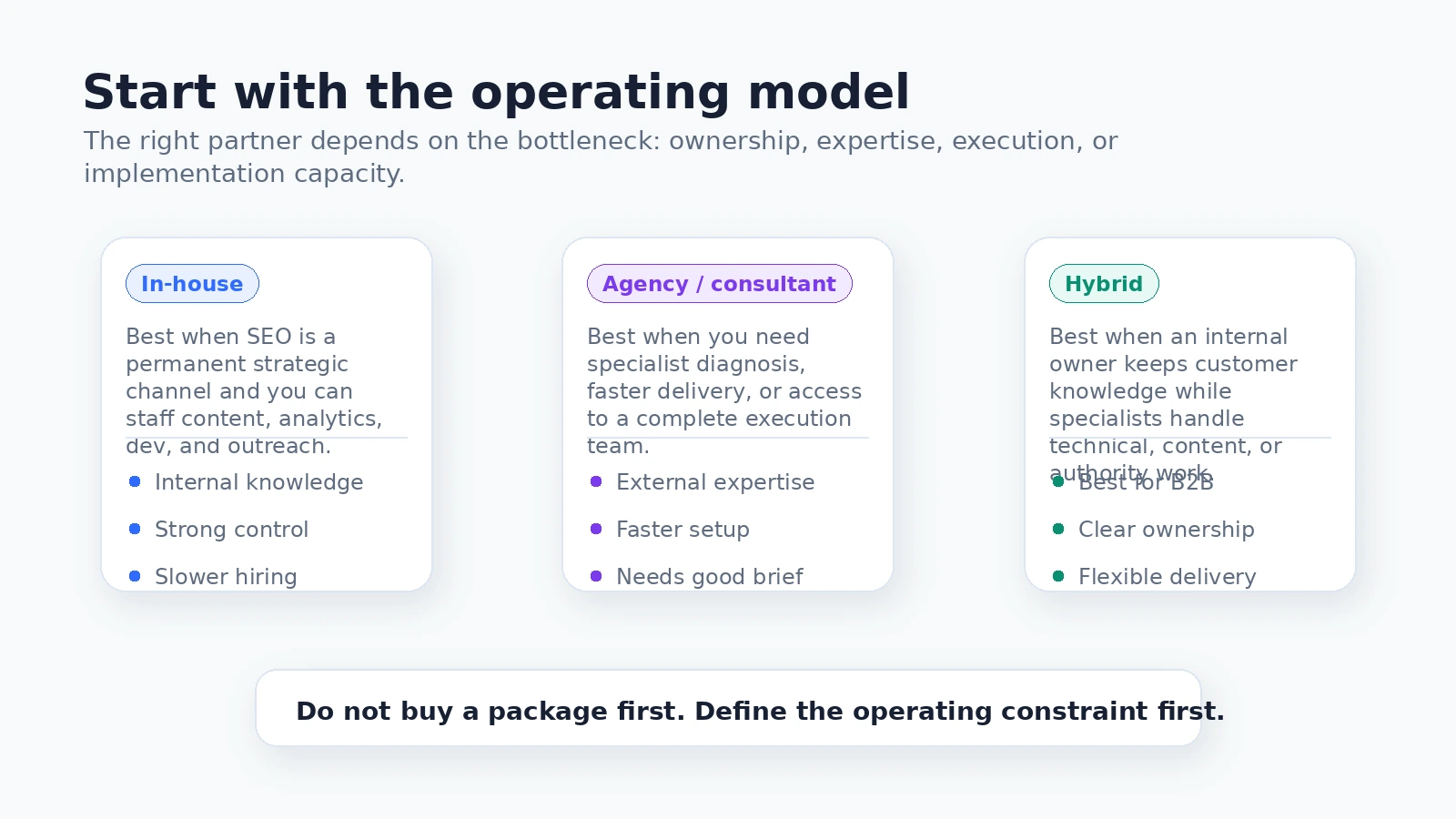
There are three common ways to run B2B SEO.
The right model depends on the bottleneck.
Option 1: In-house B2B SEO
An in-house model works best when SEO is a permanent strategic channel.
This model is usually stronger when the company has:
- strong internal customer knowledge;
- access to product and sales experts;
- enough development capacity;
- a repeatable content workflow;
- analytics and CRM ownership;
- a long-term commitment to organic growth.
The advantage is context.
An internal team can learn the product deeply, stay close to sales conversations, and build institutional knowledge over time.
The risk is capacity.
One SEO generalist cannot usually cover technical SEO, analytics, information architecture, content strategy, expert interviews, editing, design, distribution, link earning, and conversion optimization alone.
If the in-house team is too small, it can become a reporting function instead of a growth function.
Option 2: Agency or consultant
An agency or consultant works best when the company needs specialist expertise, external diagnosis, or faster access to a complete delivery team.
This model can help when:
- the site has technical or structural issues;
- the company needs a B2B SEO audit;
- content production is inconsistent;
- internal teams are too busy to build the system alone;
- leadership needs an external view;
- the company wants to accelerate a new topic cluster or market.
The advantage is speed and specialization.
The risk is context loss.
An external partner can produce weak work if they do not understand the product, customer, pricing model, competitive landscape, and sales motion.
This is why discovery matters.
If an agency sells the same package before and after discovery, they are probably not solving your actual constraint.
Option 3: Hybrid SEO team
A hybrid model is often the strongest option for B2B.
In this setup:
- an internal owner controls priorities;
- internal experts provide product and customer knowledge;
- external specialists handle technical SEO, content systems, authority building, analytics, or execution;
- sales and marketing agree on what counts as quality.
This model works well because B2B SEO depends on both external expertise and internal truth.
An outside partner can build the system, but they still need access to the people who understand:
- why customers buy;
- why deals are lost;
- how buyers compare alternatives;
- which objections matter;
- which segments are profitable;
- which use cases are strategically important.
Without this access, SEO becomes generic.
What a strong B2B SEO partner should understand
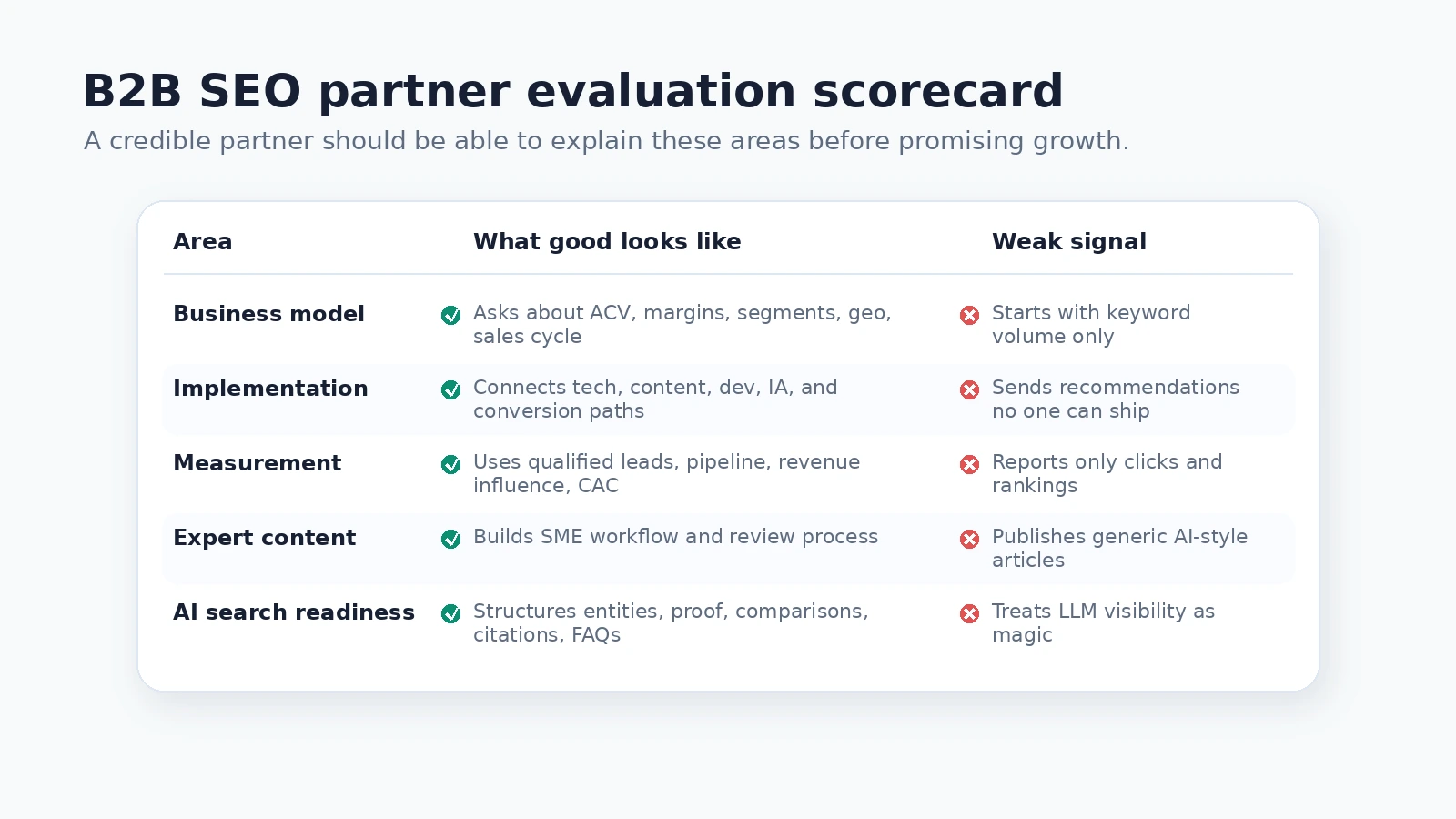
A strong B2B SEO partner should be able to explain how search connects to the commercial system.
That includes five areas.
1. Your business model
The partner should ask about the business before they talk about keywords.
They should want to know:
- who the target customer is;
- which segments matter most;
- which segments should be avoided;
- average contract value;
- gross margin;
- sales-cycle length;
- payback expectations;
- geography and localization priorities;
- implementation complexity;
- product-led versus sales-led motion;
- the difference between a lead and a qualified opportunity.
This matters because not all organic traffic has the same value.
A page that attracts many visitors from the wrong segment may be worse than a page that attracts fewer visitors but drives qualified conversations.
The partner should be able to connect SEO decisions to commercial logic.
For example:
- If the company sells high-ACV enterprise software, the strategy may need thought leadership, comparison pages, security pages, integration pages, buying guides, and proof assets.
- If the company sells to SMBs, the strategy may need clearer landing pages, calculators, pricing education, templates, and bottom-of-funnel content.
- If the company sells through partners, SEO may need partner enablement pages, comparison assets, co-marketing content, and category education.
A keyword list is not enough.
2. Technical and content constraints
SEO performance depends on whether the site can actually support growth.
A credible partner should diagnose technical and structural constraints before scaling content.
They should check:
- crawlability;
- indexation;
- rendering;
- canonical and duplication problems;
- internal linking;
- page templates;
- information architecture;
- localization and hreflang if relevant;
- page speed on important templates;
- CMS limitations;
- publishing workflow;
- analytics events;
- conversion paths.
They should also understand content constraints.
In B2B, content often fails because the company cannot consistently extract expertise from subject-matter experts.
A good partner will define a workflow for:
- expert interviews;
- sales-call mining;
- customer objection research;
- competitor and alternative analysis;
- editorial review;
- fact-checking;
- SME approval;
- content refreshes;
- distribution and repurposing.
If the partner only says “we will publish eight articles per month,” ask how those articles will become expert, accurate, differentiated, and useful for the buying journey.
3. Measurement beyond traffic
Rankings and organic sessions are useful leading indicators, but they are not the final business outcome.
Before hiring a partner, agree how SEO will be measured.
A B2B SEO measurement model should include:
- non-branded organic visibility;
- visibility by product cluster and buying stage;
- AI search visibility where data is available;
- organic conversions;
- calculator usage;
- demo or audit requests;
- qualified leads;
- opportunities;
- sourced pipeline;
- influenced pipeline;
- closed-won revenue;
- CAC;
- payback;
- segment quality.
The partner should also explain what cannot be measured perfectly.
Attribution in B2B is messy because several stakeholders may research the same vendor before anyone converts.
So the goal is not fake precision.
The goal is a consistent model that connects organic discovery to commercial outcomes with clear assumptions.
If you already have a cost model, connect it to the work plan.
Related tool: SEO ROI Calculator
4. Evidence and uncertainty
Good SEO specialists are not afraid of uncertainty.
They should be able to say:
- what they know;
- what they suspect;
- what they need to verify;
- what depends on implementation;
- what may take longer than expected;
- what cannot be concluded from the current data.
When reviewing case studies, do not only ask for the final result.
Ask for the mechanism.
A useful case study should show:
- the initial constraint;
- the diagnosis;
- the intervention;
- the implementation timeline;
- the measurement window;
- the result;
- what was learned;
- what would be repeated next time.
A graph that goes up is not enough.
You need to understand why it went up.
Related guide: B2B SEO Case Study
5. AI search and LLM visibility
A modern B2B SEO partner should understand how AI search changes discovery.
Google says its AI features are part of Search and that the same fundamentals still matter: crawlable pages, indexable content, helpful content, clear structure, good page experience, and content that satisfies real user needs.
But AI search also changes how buyers interact with information.
A buyer may ask an AI assistant to compare vendors, summarize implementation risks, create a shortlist, explain pricing models, or prepare questions for a sales call.
That means your content must be easy for both humans and machines to understand.
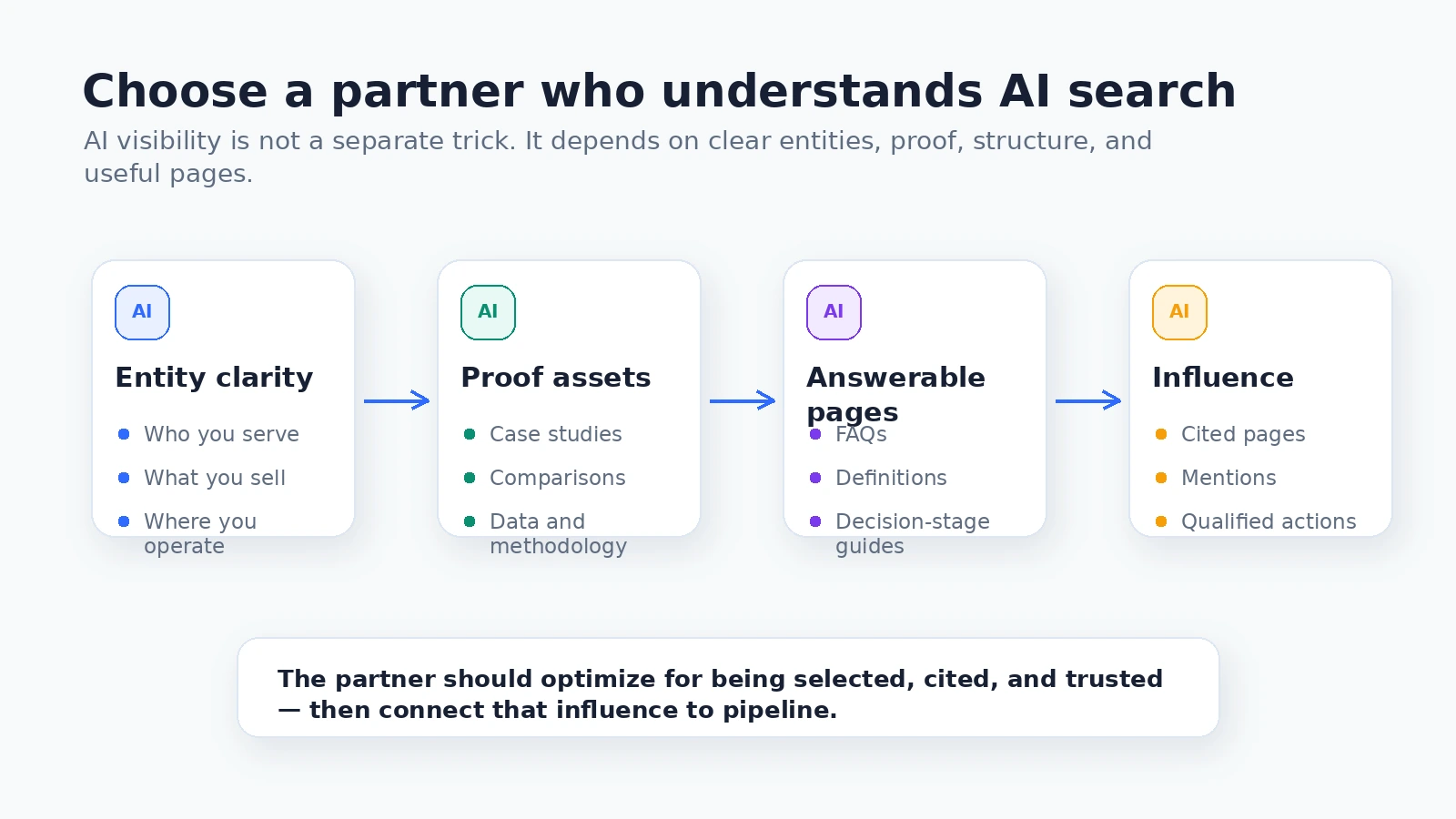
A good partner should think about:
- entity clarity — what the company is, what it sells, who it serves;
- product and category definitions;
- comparison and alternative pages;
- pricing and cost explanation;
- integration and compatibility pages;
- implementation and migration content;
- proof assets and case studies;
- expert authorship and review;
- structured FAQs;
- consistent terminology;
- third-party mentions and citations;
- review-site and partner ecosystem signals.
Be careful with partners who sell AI search as a secret trick.
There is no single magic tag that makes a B2B company appear in every answer engine.
The better question is:
Are we creating clear, trusted, well-structured, evidence-backed pages that buyers and AI systems can use during evaluation?
Useful external references
These references are useful when evaluating whether a partner understands modern search behavior:
- Google Search Central: AI features and your website
- Google Search Central: optimizing for generative AI features in Google Search
- Gartner: 67% of B2B buyers prefer a rep-free experience
- Forrester: B2B Buyers Make Zero-Click Buying Number One
Questions to ask before hiring a B2B SEO partner
Use these questions before signing a retainer.
Strategy questions
Ask:
- Which customer segments will the strategy target?
- Which segments should we avoid?
- Which product lines or use cases have the highest commercial priority?
- Which buying stages will the strategy cover?
- Where do you expect SEO to influence the buying journey?
- How will you separate branded demand from new demand creation?
- Which assumptions will you test during the first 90 days?
A weak partner will answer mostly with keywords.
A strong partner will answer with segments, use cases, buying stages, page types, constraints, and hypotheses.
Website and implementation questions
Ask:
- What must change on the website before content production scales?
- Which technical risks could block growth?
- Which templates need improvement?
- Who owns implementation when recommendations require development?
- How will internal linking be managed?
- How will conversion paths be improved?
- How will analytics events be tracked?
This is critical.
Many SEO programs fail not because the strategy is wrong, but because recommendations are never implemented.
Content and SME questions
Ask:
- How will subject-matter experts participate?
- How will you capture product knowledge?
- How will you use sales objections?
- How will you review technical accuracy?
- How will you avoid generic AI-generated content?
- How will content be refreshed after publication?
- Who approves final claims?
In B2B, expert input is not optional.
It is the difference between content that ranks and content that helps buyers trust you.
Measurement questions
Ask:
- Which metrics will be reported to leadership?
- Which metrics will be reported to marketing?
- Which metrics will be reported to SEO and content teams?
- How will qualified leads be defined?
- How will organic-sourced and organic-influenced pipeline be measured?
- Which CRM fields need to be fixed?
- How will AI search visibility be monitored?
- How will we calculate CAC and payback?
One dashboard does not need every metric.
Different stakeholders need different levels of the KPI tree.
Warning signs
Be cautious when a provider:
- guarantees a fixed ranking;
- promises exact traffic growth without discovery;
- treats every backlink as equally valuable;
- sells backlink volume instead of relevance and trust;
- publishes content without expert review;
- reports only impressions, clicks, and average position;
- ignores CRM and sales quality;
- cannot explain how SEO affects pipeline;
- gives the same package to every company;
- avoids technical implementation questions;
- treats AI search as a separate hack;
- cannot explain uncertainty.
Search is a system, not a list of isolated tasks.
A partner who cannot explain the system will usually optimize the easiest visible metric.
That is usually not the metric leadership cares about.
What a useful first engagement looks like
Do not start with a vague twelve-month promise.
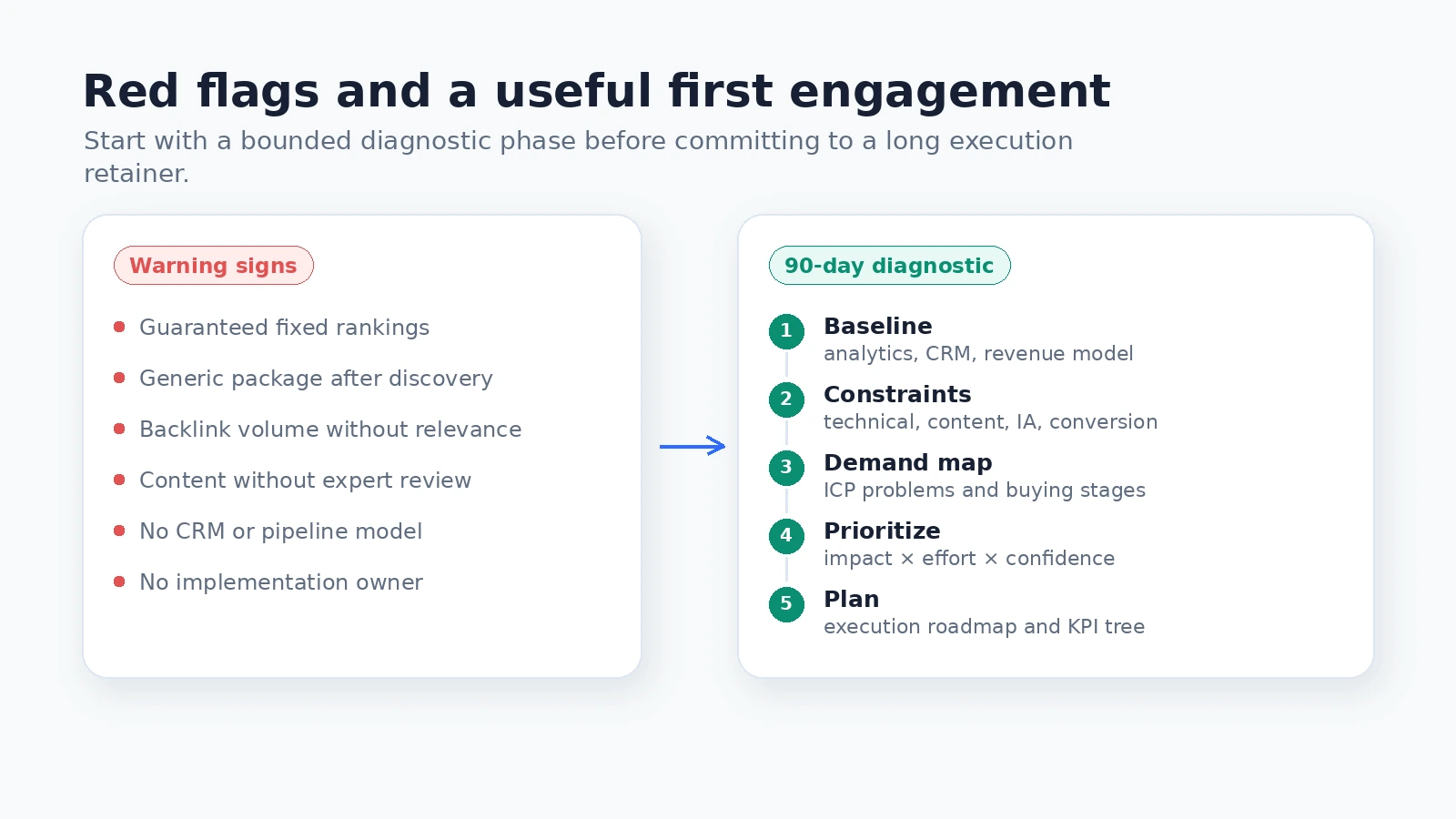
Start with a bounded diagnostic phase.
A useful first engagement should produce five outputs.
1. Commercial and analytics baseline
The partner should establish the starting point.
This includes:
- current organic traffic by page type;
- non-branded visibility;
- branded demand;
- priority landing pages;
- conversion events;
- lead quality;
- CRM source data;
- existing pipeline and revenue attribution;
- current content production rate;
- current technical constraints;
- current SEO cost and team capacity.
The goal is to know what is true before making promises.
2. Technical, structural, and content constraints
The partner should identify what blocks growth.
Common constraints include:
- important pages not indexed;
- weak internal linking;
- duplicated or competing pages;
- product pages with thin content;
- blog content disconnected from commercial pages;
- no comparison or alternative pages;
- no integration pages;
- no cost, ROI, or calculator assets;
- no clear route from educational content to conversion;
- analytics gaps;
- poor page templates;
- slow implementation process.
This is where many B2B SEO opportunities are found.
3. Search demand mapped to customer problems
Keyword research should not be a spreadsheet of search volume.
It should map demand to:
- customer problems;
- product use cases;
- ICP segments;
- buying stages;
- objections;
- alternatives;
- pricing questions;
- integration needs;
- risk concerns;
- proof requirements.
For example, a buying journey may need content for:
- problem awareness;
- category education;
- solution comparison;
- vendor comparison;
- cost justification;
- implementation planning;
- security and procurement review;
- migration or switching risk.
This is especially important for AI search because answer engines need clear, structured, evidence-backed information to summarize and compare.
4. Prioritized roadmap
A good roadmap is not a list of everything that could be done.
It should prioritize by:
- expected commercial impact;
- confidence;
- implementation effort;
- time to observe results;
- dependency on development;
- dependency on subject-matter experts;
- risk;
- strategic importance.
A practical roadmap usually includes a mix of:
- technical fixes;
- internal linking improvements;
- page upgrades;
- decision-stage content;
- content refreshes;
- authority and mention building;
- conversion improvements;
- analytics fixes;
- AI-search readiness improvements.
5. 90-day execution and measurement plan
The first 90 days should not try to solve everything.
They should validate the operating model.
A good 90-day plan defines:
- what will be shipped;
- who owns each task;
- what needs development;
- which SMEs are needed;
- which pages will be created or updated;
- which technical fixes are required;
- which conversion events will be tracked;
- which KPI tree will be used;
- which early signals will be reviewed;
- which commercial metrics need a longer window.
This creates a shared understanding of where growth is currently blocked.
That is more valuable than a long generic checklist.
Related guide: B2B SEO Checklist
How to compare two SEO partners
If you are choosing between two providers, do not compare only the monthly fee.
Compare the system.
Use this simple evaluation table:
| Evaluation area | Partner A | Partner B |
|---|---|---|
| Understands target segments | ||
| Understands ACV, margin, and sales cycle | ||
| Can diagnose technical constraints | ||
| Can build content from SME knowledge | ||
| Can improve conversion paths | ||
| Can measure qualified pipeline | ||
| Can support AI search visibility | ||
| Has clear implementation process | ||
| Shows evidence and uncertainty | ||
| Can explain first 90 days |
Then ask one final question:
Which partner makes it easier for us to create qualified demand we can actually measure?
That is usually the better choice.
How the SEO cost calculator fits into partner selection
A B2B SEO partner should be comfortable discussing cost.
SEO has real costs:
- strategy;
- technical work;
- content production;
- expert review;
- design;
- development;
- analytics;
- outreach;
- distribution;
- tools;
- project management.
The question is not whether SEO is cheap.
The question is whether the investment can be justified by pipeline, revenue, gross profit, CAC, and payback.
This is where the SEO ROI Calculator helps.
Use it to compare a proposed investment with the customer economics the program must produce. Enter:
- total SEO investment;
- customers acquired from SEO;
- annual revenue per customer;
- gross margin;
- annual churn;
- discount rate.
The calculator returns CAC, LTV, LTV:CAC, ROI, payback period, and expected customer lifetime.
It does not forecast qualified visits, leads, close rates, or required pipeline. A serious partner should model those funnel assumptions separately and connect them to the customer count used in the calculator.
The forecast will not be perfect.
But the assumptions will be visible, and that is exactly what you want before choosing a long-term B2B SEO partner.
Use the calculator: SEO ROI Calculator
FAQ
What should I look for in a B2B SEO partner?
Look for a partner who understands your business model, target segments, sales cycle, technical constraints, content workflow, conversion paths, CRM measurement, AI search visibility, and commercial goals. They should connect SEO activity to qualified pipeline, not only rankings.
Is a B2B SEO agency better than an in-house team?
Neither model is automatically better. In-house is better when SEO is a permanent strategic channel and the company can staff specialists. An agency or consultant is better when you need specialist diagnosis, faster delivery, or an external team. A hybrid model often works best when an internal owner keeps business context while specialists handle execution.
What questions should I ask a B2B SEO agency before hiring?
Ask which segments and buying stages they will target, what must change before content scales, who owns implementation, how subject-matter experts will participate, how they measure qualified pipeline, how they separate branded demand from new demand, and what assumptions they will test in the first 90 days.
What are red flags when choosing an SEO partner?
Red flags include guaranteed fixed rankings, generic packages that do not change after discovery, content without expert review, backlink volume without relevance, reports that only show clicks and rankings, and no clear implementation owner.
Should a B2B SEO partner understand AI search and LLM visibility?
Yes. Modern B2B SEO should account for AI search, answer engines, and LLM-assisted buying research. The partner should know how to make content clear, evidence-based, structured, entity-rich, and useful enough to be cited, summarized, and trusted.
What should the first B2B SEO engagement include?
A useful first engagement should establish the commercial and analytics baseline, audit technical and content constraints, map search demand to customer problems and buying stages, prioritize actions by expected impact and implementation cost, and define a 90-day execution and measurement plan.
How do you measure whether a B2B SEO partner is working?
Measure delivery quality, technical fixes, indexation, priority-topic visibility, AI search visibility where available, qualified conversions, opportunities, pipeline, revenue influence, CAC, and payback. Rankings and traffic are useful diagnostics, but they should not be the final success metric.
Conclusion
Choose a B2B SEO partner for their ability to connect search behavior with your revenue system.
The best relationship is not based on outsourced magic.
It is based on:
- clear hypotheses;
- disciplined execution;
- technical and content implementation;
- expert access;
- transparent measurement;
- AI-search awareness;
- commercial prioritization;
- honest handling of uncertainty.
The right partner should help you build an organic growth system that buyers can find, trust, compare, and act on.
Rankings matter.
But in B2B, the real question is whether search visibility creates qualified demand and measurable commercial value.
Questions about a B2B growth system? Contact me via LinkedIn, Telegram, or email.