How Email Supports B2B SEO and Demand Capture
Quick answer
Email engagement is not a direct organic ranking factor.
That does not make email irrelevant to B2B SEO.
SEO helps buyers discover useful information when they search for a problem, category, comparison, implementation issue, or cost question. Email helps the company continue the relationship after that first visit.
In a B2B growth system, email can support SEO by:
- giving early researchers a lower-friction next step than “book a demo”;
- distributing new expertise to the people most likely to use it;
- bringing qualified subscribers back to strategic pages;
- turning search data into better nurture sequences;
- turning email responses and clicks into better SEO content;
- supporting branded demand after non-branded discovery;
- helping long buying committees move from education to action.
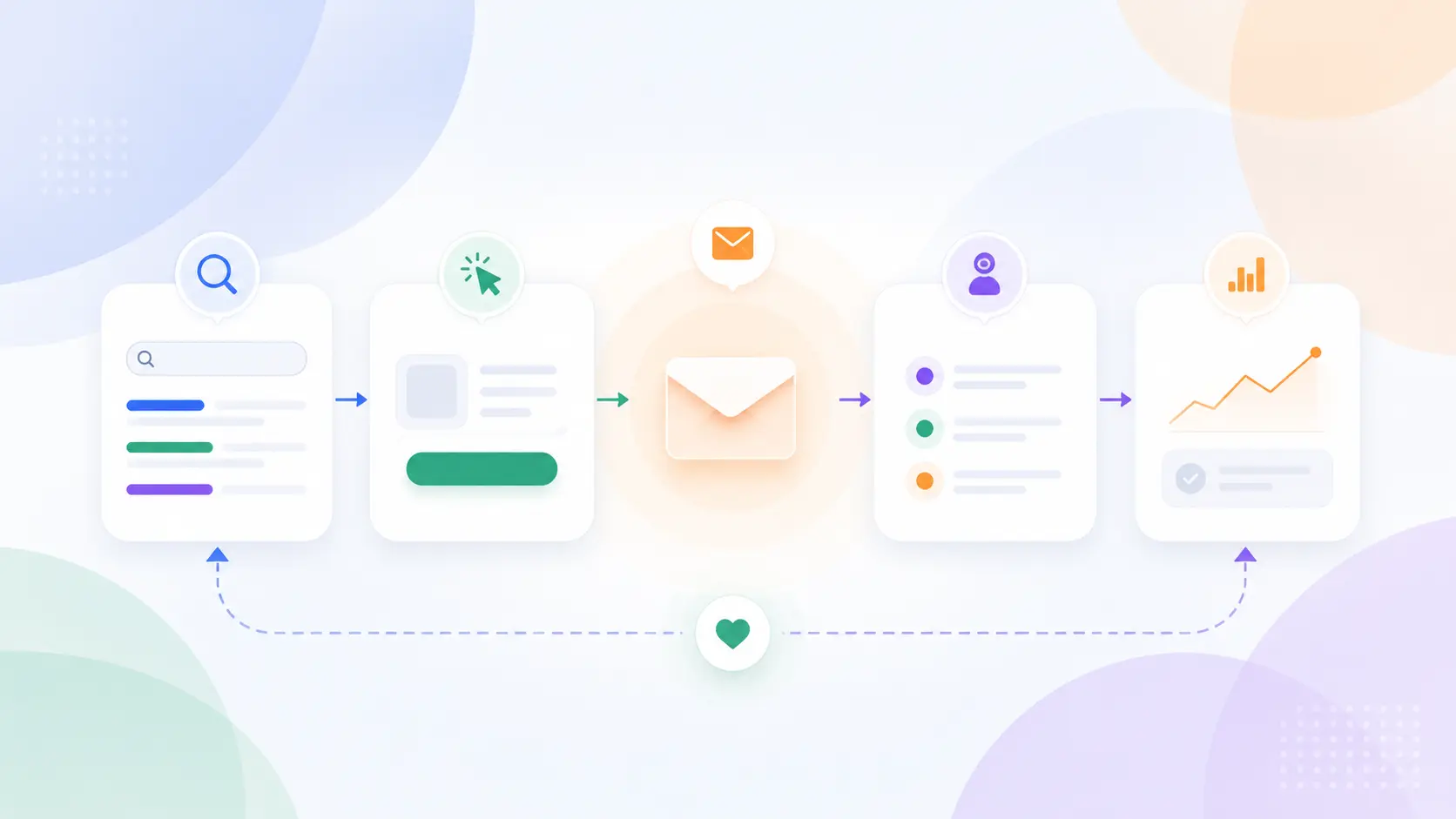
The important distinction is simple: email does not replace SEO, and SEO does not replace nurturing. Search creates discovery. Email creates continuity.
Why email belongs in a B2B SEO system
B2B SEO is often measured as if the journey were short:
- A buyer searches.
- The buyer clicks.
- The buyer converts.
- Revenue is attributed.
That can happen, but it is not the normal pattern for complex B2B purchases.
A technical buyer may find a guide months before budget exists. A manager may read a checklist while preparing an internal case. A founder may compare vendors before assigning the evaluation to someone else. A procurement or finance stakeholder may arrive later through a branded, pricing, ROI, or alternative query.
If every organic landing page only asks for a demo, many relevant visitors will leave before they are ready to talk.
Email gives those visitors a softer way to stay connected.
That is why email should be considered part of the B2B SEO operating system, not as a ranking trick, but as a continuity layer.
Related guide: B2B SEO KPIs: Measure Pipeline and Revenue, Not Rankings
Search creates discovery; email creates continuity
Search is strong when someone has a question.
Email is strong after the first touchpoint.
A visitor may find the company through:
- a technical how-to query;
- a category query;
- a comparison query;
- a problem query;
- a cost query;
- a compliance or implementation query;
- an “alternative to” query;
- a branded verification query.
The first visit may not produce a demo request.
That does not mean the visit had no value. It may have created awareness, trust, or internal language that returns later in a sales conversation.
A useful email next step can include:
- a newsletter for early research;
- a benchmark for active evaluation;
- a checklist for internal planning;
- a calculator for cost and ROI thinking;
- a case study for proof;
- a product update for existing interest;
- an implementation guide for technical buyers.
The goal is not to collect subscribers for vanity. The goal is to preserve a relationship with a relevant buyer until the next commercial step makes sense.
Build next steps for different intent levels
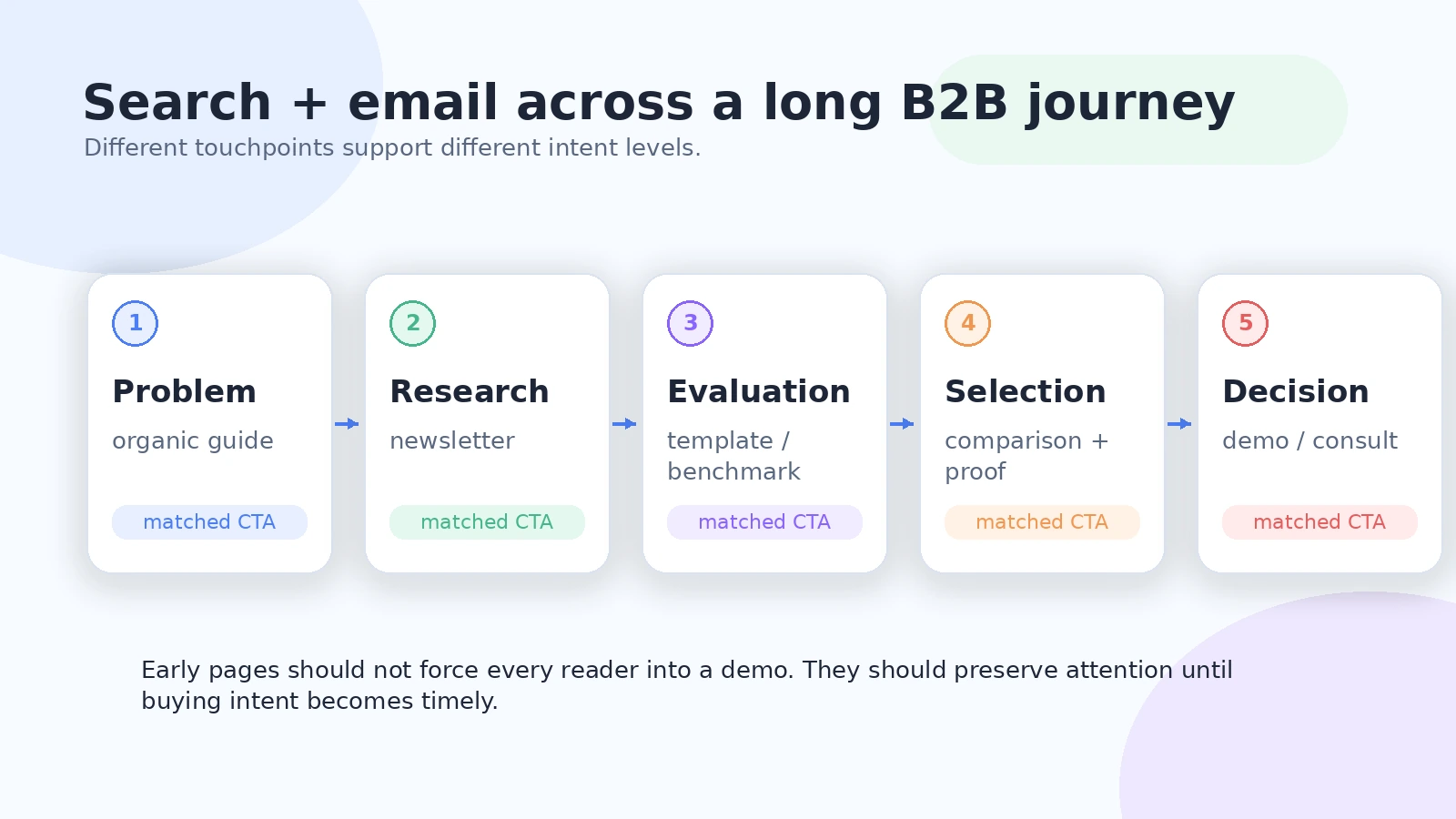
Not every organic page should use the same call to action.
A visitor reading an educational article may not be ready for sales. A visitor comparing pricing or alternatives may be much closer to a commercial action.
Useful CTA matching can look like this:
| Search intent | Page type | Better next step |
|---|---|---|
| Early research | Educational guide | Newsletter, checklist, glossary, benchmark |
| Problem diagnosis | Framework or audit page | Template, diagnostic worksheet, email course |
| Active evaluation | Technical guide or use-case page | Implementation guide, product walkthrough, calculator |
| Vendor comparison | Alternative or comparison page | Case study, proof pack, demo, consultation |
| Budget planning | Cost or ROI page | Calculator, pricing discussion, buying guide |
| Branded verification | Reviews, case studies, product pages | Demo, sales contact, migration plan |
A B2B SEO program becomes stronger when each strategic page offers the next step that matches the buyer’s current intent.
For example, a decision-stage page about SEO investment can naturally point to an SEO ROI Calculator. The tool lets buyers test investment, customers acquired, revenue, margin, churn, CAC, LTV, ROI, and payback. An email follow-up can then discuss pipeline expectations and implementation tradeoffs separately.
Related guide: B2B SEO Checklist: From Baseline to Revenue
Segment email distribution instead of blasting every article
A common mistake is treating email as a simple broadcast channel.
A new article is published. The full database receives it. The team checks opens and clicks. Then the cycle repeats.
That is not how B2B email should support SEO.
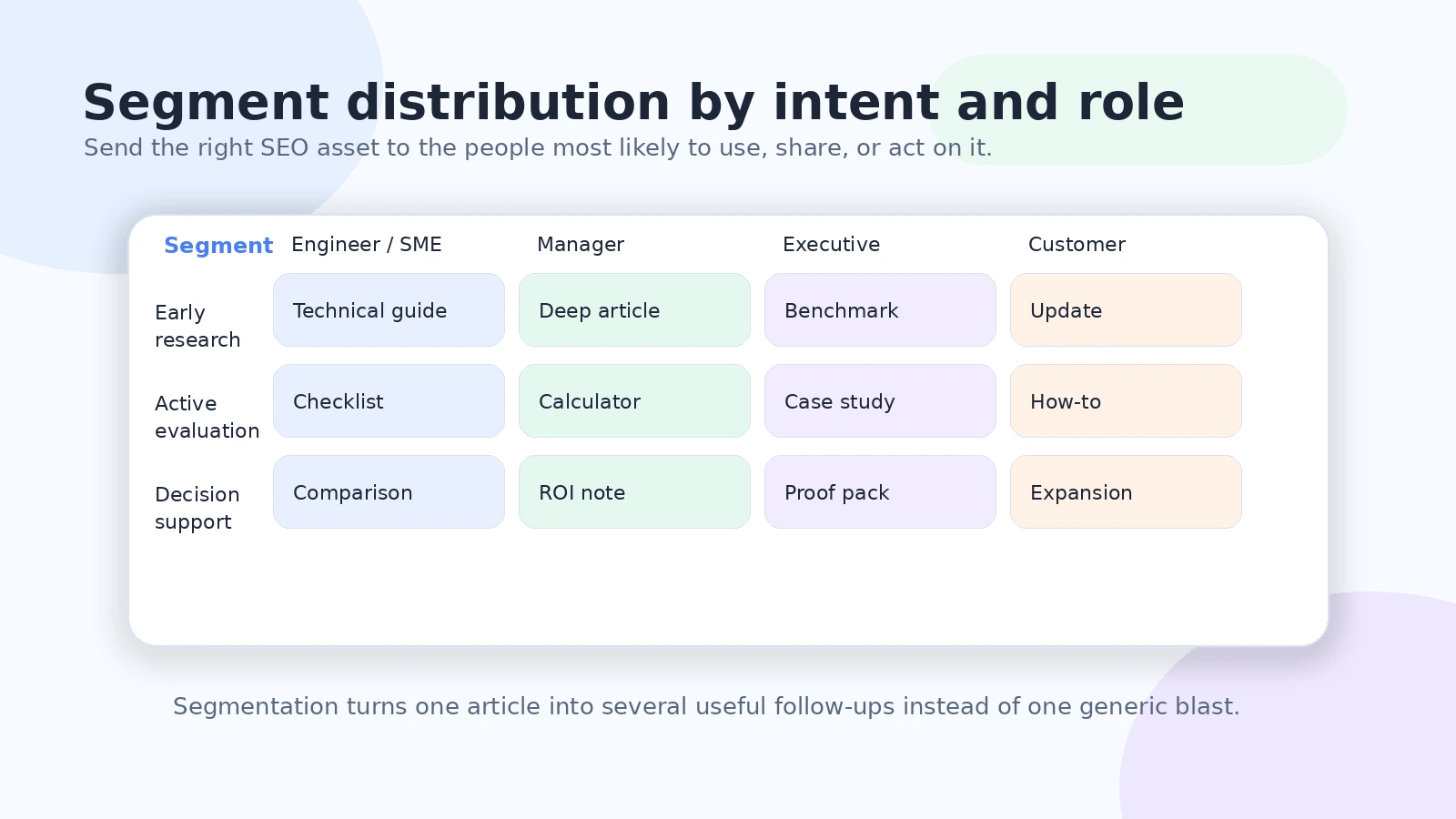
The distribution should be segmented by:
- industry;
- use case;
- product interest;
- role or buying responsibility;
- lifecycle stage;
- previous content behavior;
- customer versus prospect status;
- region or market;
- technical maturity;
- known objections or sales-stage questions.
A specialist article should reach the people most likely to care about it.
For example:
- a technical implementation guide should go to engineers, admins, and product evaluators;
- an ROI article should go to founders, finance stakeholders, and marketing leaders;
- a migration checklist should go to accounts that have shown switching intent;
- a benchmark should go to prospects comparing internal performance;
- a new case study should go to segments with a similar business model.
This helps content reach the people most likely to read it, share it internally, discuss it, cite it, or return to the site later.
That relationship is indirect, but useful. Distribution increases the chance that useful content reaches the market.
Related guide: B2B Link Building: Authority, Referrals, and Market Evidence
Use search behavior to improve email
Search data shows the language buyers use before they know the company well.
That makes it useful for email.
Search insights can improve:
- subject lines;
- newsletter topics;
- nurture sequences;
- product announcements;
- onboarding content;
- reactivation campaigns;
- sales enablement;
- webinar themes;
- lead magnet positioning.
For example, keyword research may reveal that buyers do not search for your internal product category. They search for a specific problem, migration risk, integration question, regulatory concern, or cost scenario.
That language should not only live in SEO pages.
It should also appear in:
- nurture email subject lines;
- onboarding sequences;
- sales follow-up templates;
- webinar titles;
- customer education;
- product update framing.
This keeps the company’s language close to the market’s language.
Use email behavior to improve SEO
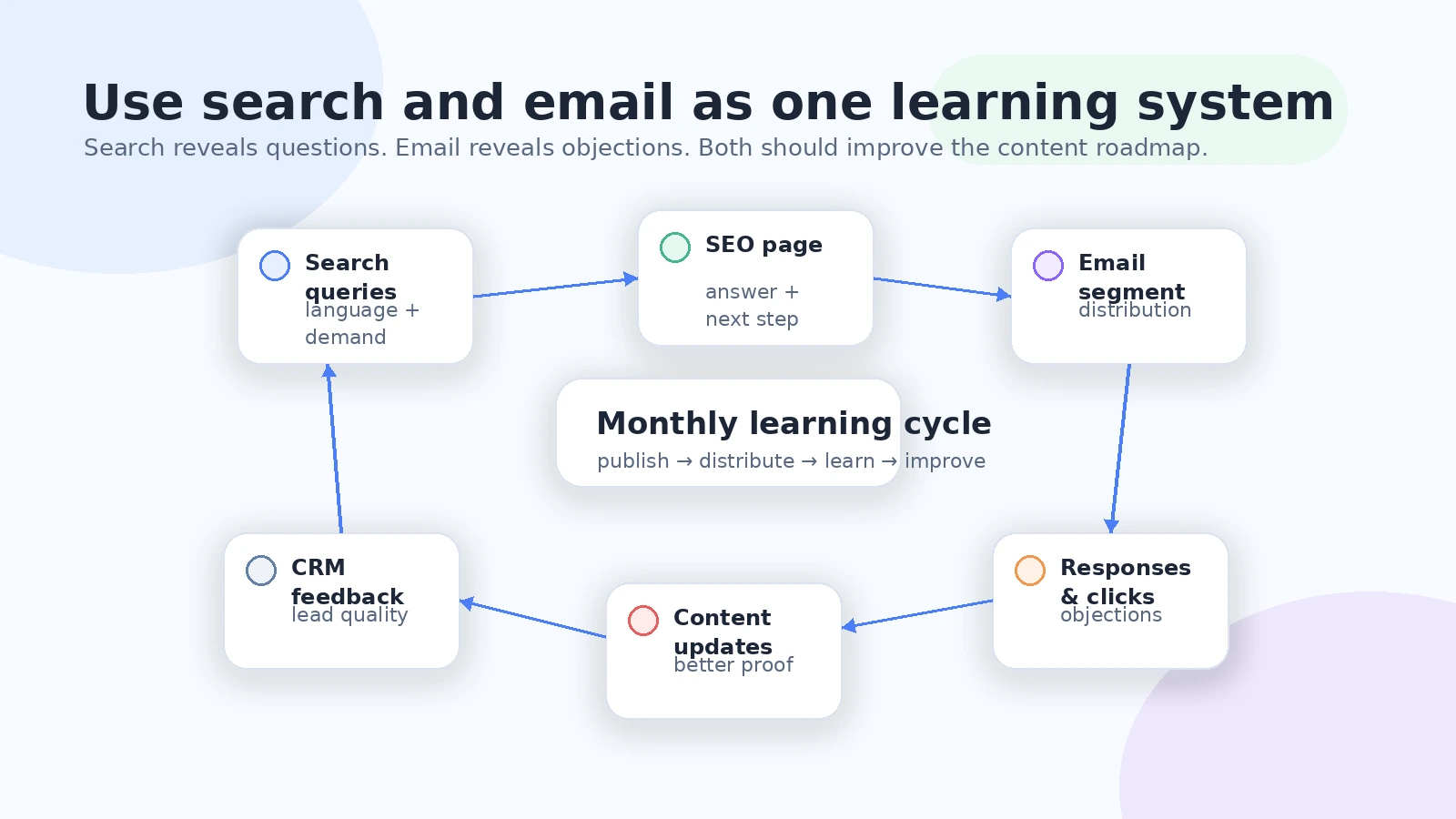
The learning should also move in the other direction.
Email can reveal which topics deserve stronger search content.
Look for:
- links with unusually high click rates;
- replies that contain sales objections;
- questions asked after a newsletter;
- topics that perform well for one segment but not another;
- resources that are forwarded internally;
- content that helps sales revive old conversations;
- product announcements that create follow-up questions.
These signals can shape the SEO roadmap.
If a checklist generates many replies, it may deserve a deeper organic guide.
If a calculator gets clicks but few qualified actions, the page may need clearer assumptions, proof, or use-case examples.
If a product update gets strong engagement from one segment, that segment may need its own use-case page.
SEO and email should not run as separate content calendars. They should run as one customer-learning system.
Email supports AI search indirectly
Email engagement should not be presented as an AI search ranking factor.
That would be the wrong claim.
But email can still support AI visibility in a practical, indirect way.
AI search systems tend to work best with content that is clear, accessible, specific, and easy to extract. A strong email program can help evidence-rich content reach:
- customers;
- experts;
- analysts;
- journalists;
- partners;
- industry communities;
- internal champions;
- practitioners who may cite or discuss the work.
This can lead to real-world signals around the content:
- mentions;
- citations;
- backlinks;
- branded searches;
- direct visits;
- saved resources;
- repeated use in sales conversations.
The mechanism is not “email improves AI rankings.”
The mechanism is: email helps distribute useful, evidence-rich material to the people and networks that can validate, reference, or reuse it.
That matters because AI search makes source clarity, entity confidence, evidence, and third-party references more important to how buyers discover and verify companies.
Related guide: Brand Positioning Through B2B SEO
What email should distribute from an SEO program
Not every SEO page is worth sending.
Email should focus on assets that give the recipient a reason to care.
Good candidates include:
- original research;
- benchmark reports;
- calculators;
- templates;
- diagnostic frameworks;
- implementation guides;
- comparison guides;
- case studies;
- migration checklists;
- buying guides;
- market updates;
- product education tied to a real problem.
Poor candidates include:
- generic articles that repeat common advice;
- thin pages created only to target a keyword;
- listicles with no original judgment;
- purely promotional pages sent to early-stage contacts;
- content that does not match the recipient’s role or lifecycle stage.
If an article is not useful enough to send to a relevant segment, it may not be strong enough to be part of the SEO strategy.
Build a simple SEO-to-email workflow
A practical workflow can be simple:
- Identify a high-value search topic.
- Publish a page with original expertise and a relevant next step.
- Create one or two segment-specific email angles.
- Send the page to the most appropriate audience segment.
- Collect clicks, replies, sales notes, and objections.
- Improve the page and related content.
- Add follow-up resources for people who showed intent.
- Track the journey through analytics and CRM.
Example:
| Step | Example |
|---|---|
| Search topic | “B2B SEO cost” |
| SEO asset | Guide explaining budget, team, tools, timelines, and risk |
| Conversion asset | SEO Cost Calculator |
| Email segment | Marketing leaders and founders evaluating growth investment |
| Follow-up | Email sequence about payback, pipeline expectations, and common budget mistakes |
| Learning | Which assumptions create replies, objections, or qualified conversations |
| Content update | Add stronger examples, FAQ, and cost scenarios to the page |
This turns a page into a reusable learning asset instead of a one-time publication.
How to measure the combined system
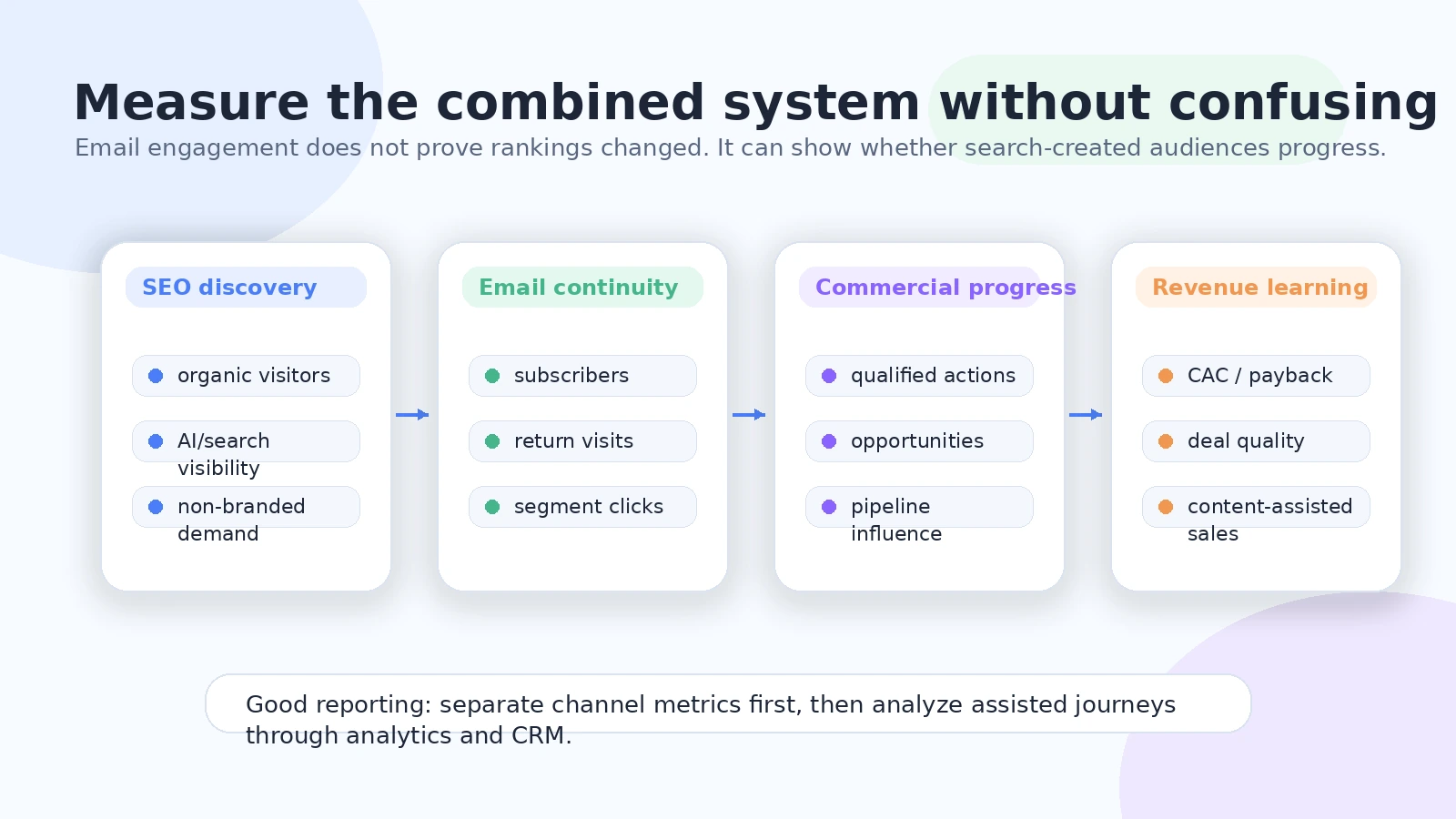
Track email and organic performance separately first.
Then evaluate the interaction.
Useful metrics include:
- organic visitors who subscribe;
- subscription rate by landing page;
- subscriber return rate;
- email traffic to strategic pages;
- branded search growth after major content launches;
- content-assisted opportunities;
- conversions after several visits;
- demo requests from email-assisted journeys;
- qualified pipeline influenced by educational content;
- closed revenue where organic and email both appear in the journey.
Avoid two mistakes.
First, do not claim that email opens caused rankings to increase.
Second, do not judge email only by open rate.
The useful question is not “did this email get attention?” It is “did search-created attention become a better relationship, a better buyer journey, or better commercial evidence?”
Related guide: B2B SEO KPIs: Measure Pipeline and Revenue, Not Rankings
Common mistakes
B2B teams often weaken the SEO-email connection by:
- sending every article to everyone;
- using the same demo CTA on every organic page;
- measuring email only by opens;
- measuring SEO only by traffic;
- ignoring lead quality by content source;
- failing to preserve UTM and source data in the CRM;
- separating SEO, email, and sales enablement into disconnected calendars;
- distributing generic content that does not contain useful expertise;
- failing to update pages based on email replies and sales objections;
- treating newsletters as announcements instead of relationship-building assets.
The fix is not more email.
The fix is better matching between intent, segment, content, next step, and measurement.
90-day implementation plan
Days 1–30: map the current system
Start with the basics:
- identify the organic pages that attract qualified visitors;
- review which pages have newsletter, template, calculator, demo, or resource CTAs;
- check whether organic subscriptions are tracked by landing page;
- inspect whether CRM data preserves source, campaign, and content information;
- review which emails currently drive return visits to strategic pages.
The goal is to understand where search creates attention and where that attention is currently lost.
Days 31–60: create segment-specific paths
Choose a few high-value page groups.
For each group, define:
- the primary buyer segment;
- the likely stage of intent;
- the best next step;
- the relevant email follow-up;
- the measurement event;
- the CRM field or campaign tag.
Then build or improve the conversion assets.
For a high-commercial-intent topic, that might be a calculator or buying guide. For an early-stage technical topic, it might be a newsletter, checklist, or diagnostic template.
Days 61–90: run the learning cycle
Distribute the improved assets to the right segments.
Then review:
- clicks;
- replies;
- return visits;
- branded searches;
- assisted conversions;
- sales notes;
- lead quality;
- pipeline movement.
Use the findings to update the SEO pages, email sequences, internal links, FAQs, and sales enablement materials.
This is where the system starts compounding.
FAQ
Does email engagement directly improve SEO rankings?
No. Email opens, clicks, and newsletter engagement should not be treated as direct organic ranking factors. Email supports SEO indirectly by distributing useful content, creating returning visits, encouraging branded demand, and helping the team learn which topics deserve stronger pages.
How does email support B2B SEO?
Email supports B2B SEO by continuing the relationship after an organic visit. It can nurture early researchers, distribute new expertise, bring subscribers back to strategic pages, and help turn search-created attention into qualified pipeline.
Should every SEO article be sent to the full email list?
No. B2B email distribution should be segmented by industry, use case, role, lifecycle stage, product interest, and previous content behavior. A specialist guide should reach the people most likely to use it, discuss it, or act on it.
What should an organic landing page offer besides a demo?
Early-stage pages can offer a newsletter, benchmark, checklist, template, calculator, or technical resource. Demo CTAs are useful for commercial intent, but they are often too heavy for early research.
Can email help with AI search visibility?
Email does not directly make a page appear in AI answers. It can help by distributing evidence-rich content to experts, customers, partners, and industry communities who may reference, discuss, or link to it over time.
Which metrics show that email and SEO are working together?
Useful metrics include organic visitors who subscribe, subscriber return rate, email traffic to strategic pages, content-assisted opportunities, branded search growth, qualified actions after multiple visits, and pipeline influenced by educational content.
Conclusion
Email does not replace SEO, and SEO does not replace nurturing.
Together they create a stronger B2B acquisition system.
Search captures active demand and introduces the company to buyers at the moment of need. Email preserves attention, distributes expertise, supports long buying committees, and helps the team learn what the market still needs to understand.
The strongest version is not a newsletter attached to an SEO program. It is a connected system where search, email, content, CRM, and sales feedback all improve each other.
The full B2B SEO case study shows how organic acquisition can be evaluated as a commercial system rather than an isolated traffic channel.
Questions about a B2B growth system? Contact me via LinkedIn, Telegram, or email.