B2B SEO KPIs: Measure Pipeline and Revenue, Not Rankings
Quick answer
B2B SEO should not be measured by rankings alone.
Rankings, impressions, clicks, traffic, leads, opportunities, pipeline, and revenue describe different layers of the system. They are all useful, but they are not the same type of metric.
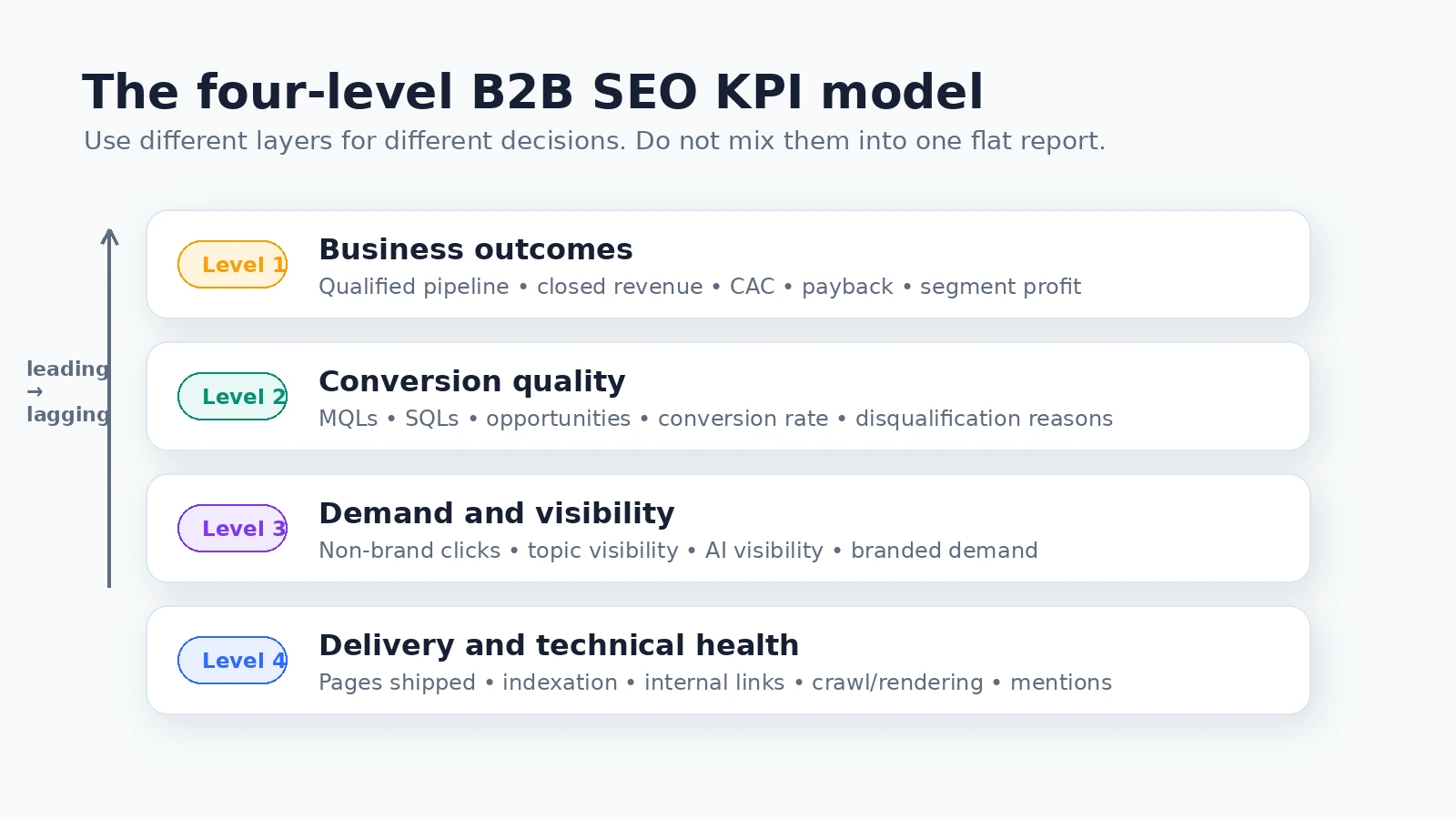
A good B2B SEO KPI model connects four layers:
- business outcomes — qualified pipeline, revenue, CAC, payback, gross profit;
- conversion quality — qualified leads, opportunities, conversion rates, deal quality;
- demand and visibility — non-brand discovery, topic-cluster visibility, AI search visibility, branded demand;
- delivery and technical health — pages shipped, pages refreshed, indexation, internal links, crawlability, authority signals.
The mistake is treating every available number as a KPI.
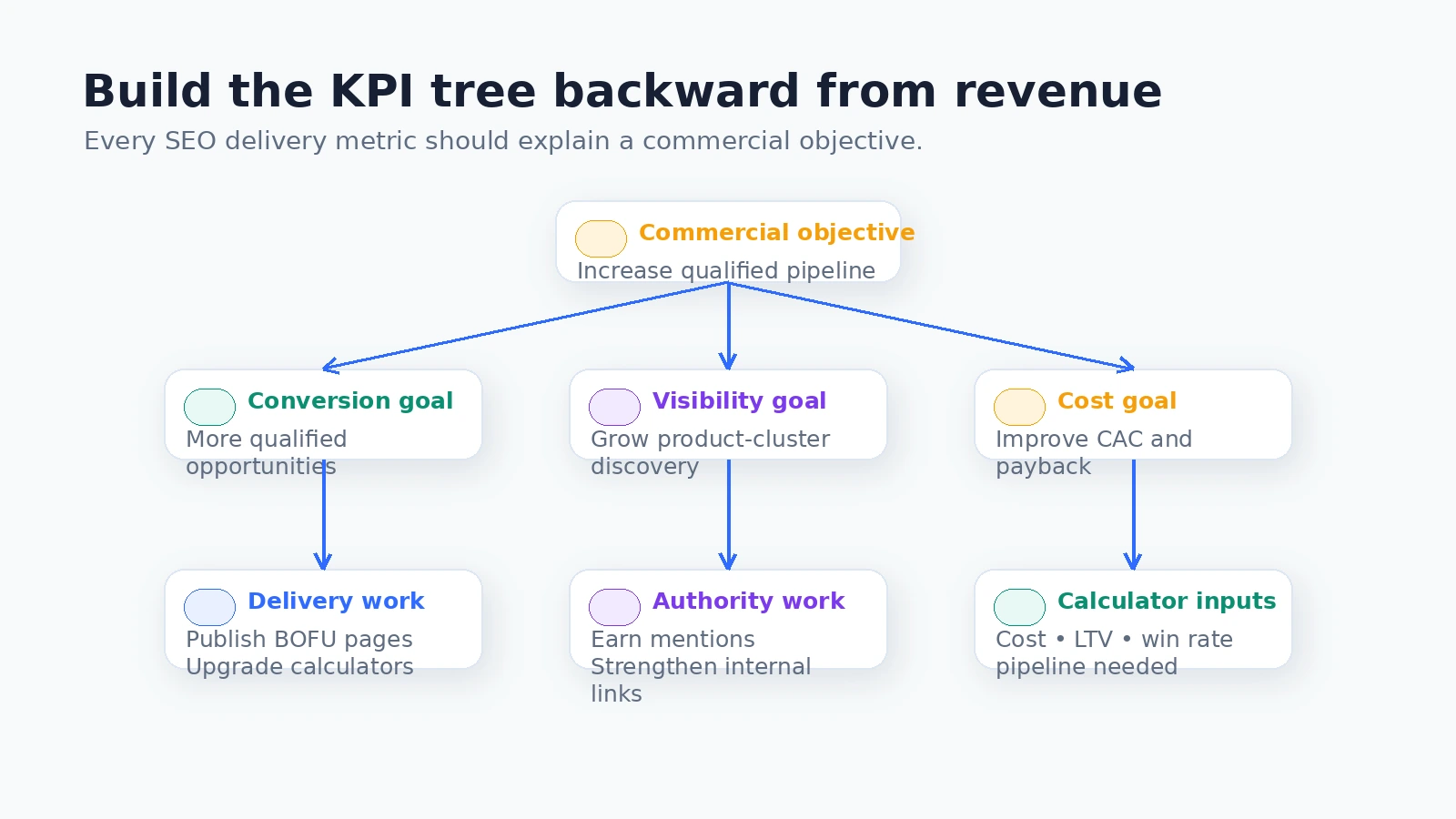
The better approach is to build a KPI tree: start with a commercial goal, then work backward into the visibility, conversion, content, technical, and authority work required to move that goal.
Difference in one sentence: rankings show where you appear; B2B SEO KPIs should show whether that visibility creates qualified buying demand and commercial value.
Why B2B SEO measurement gets messy
B2B SEO reporting becomes confusing when every metric is placed on the same level.
A dashboard may show:
- impressions;
- average position;
- organic sessions;
- clicks;
- assisted conversions;
- demo requests;
- MQLs;
- SQLs;
- opportunities;
- pipeline;
- revenue;
- content production;
- backlinks;
- Core Web Vitals;
- indexed pages.
All of these can matter.
But they do not answer the same question.
A ranking metric answers: Are we visible?
A conversion metric answers: Are the right visitors taking the next step?
A pipeline metric answers: Is organic discovery creating qualified sales opportunities?
A revenue metric answers: Is this channel producing business value?
A delivery metric answers: Are we doing the work needed to improve the system?
When these are mixed into one flat report, the team starts optimizing for the easiest number to move. Usually that means rankings, impressions, or traffic.
That is dangerous in B2B because traffic can grow while pipeline quality gets worse.
Rankings are useful, but they are not the goal
Rankings are diagnostic metrics.
They help you understand whether a page, topic cluster, or product narrative is becoming more discoverable.
But a ranking improvement is not automatically a business improvement.
A page can rank higher for a query that does not match your ICP. A blog post can get traffic from students, freelancers, or small businesses when your actual target is enterprise buyers. A comparison page can rank well but fail to move users toward a calculator, demo, pricing page, or sales conversation.
In B2B, rankings matter when they support one of these jobs:
- getting discovered by the right buying committee;
- helping buyers understand the problem;
- shaping how buyers compare options;
- supporting internal business cases;
- moving visitors to high-intent pages;
- increasing qualified demo, trial, audit, calculator, or contact requests;
- influencing pipeline and revenue.
So do not delete rankings from the dashboard.
Just stop presenting them as the final answer.
The four-level B2B SEO KPI model
A practical B2B SEO report separates metrics into four levels.
The levels move from commercial outcomes to leading indicators.
Level 1: Business outcomes
This is the layer leadership ultimately cares about.
Good Level 1 B2B SEO KPIs include:
- organic-sourced qualified pipeline;
- organic-influenced qualified pipeline;
- closed-won revenue from organic acquisition;
- closed-won revenue influenced by organic touchpoints;
- customer acquisition cost from SEO;
- payback period;
- revenue by ICP segment;
- gross profit by product or segment;
- expansion revenue from organic-acquired accounts;
- pipeline contribution from strategic product clusters.
This level answers the board-level question:
Is SEO helping the company create efficient, qualified growth?
B2B SEO should not be judged only by last-click revenue. Long buying journeys often include multiple stakeholders and multiple sessions before a form submission appears in analytics or CRM.
But SEO still needs a credible connection to commercial value.
That means you should measure both:
- sourced impact — deals where the first or main conversion came from organic search;
- influenced impact — deals where organic pages helped the buying process, even if the final conversion came through direct, paid, referral, partner, or sales outreach.
Do not pretend attribution is perfect.
Make the assumptions clear and keep the model consistent.
Level 2: Conversion quality
Traffic growth means little if the visitors are wrong.
Level 2 KPIs show whether organic visibility is attracting people who can realistically become customers.
Useful conversion-quality metrics include:
- qualified leads from organic traffic;
- qualified opportunities from organic traffic;
- visitor-to-lead conversion rate;
- lead-to-opportunity conversion rate;
- opportunity-to-customer conversion rate;
- conversion by landing page;
- conversion by query intent;
- conversion by topic cluster;
- demo, trial, calculator, audit, or contact-form usage;
- average deal value by acquisition source;
- disqualification reasons;
- sales-cycle length;
- funnel drop-off by page type.
This level answers:
Are we attracting buyers, or just visitors?
For B2B SEO, this is usually where the biggest reporting gap appears.
Many teams can show traffic.
Fewer teams can show which organic pages create qualified opportunities.
Even fewer can show whether those opportunities match target segments, product priorities, deal size, and sales capacity.
A B2B SEO audit should always check whether analytics and CRM data can support this layer.
If it cannot, the measurement system is not mature enough to judge SEO by revenue yet.
Level 3: Demand and visibility
Level 3 explains how discovery is changing.
Useful demand and visibility metrics include:
- non-branded organic clicks;
- non-branded impressions;
- visibility for priority topic clusters;
- ranking distribution across target query groups;
- click-through rate by page and query;
- new versus returning organic visitors;
- branded search demand;
- share of organic traffic reaching strategic commercial pages;
- visibility for comparison, alternative, pricing, integration, and ROI queries;
- visibility inside AI search experiences where data is available;
- brand and entity mentions in answer engines;
- pages cited, surfaced, or summarized by AI systems.
This level answers:
Are the right buyers discovering us in the right moments?
Do not report an average ranking across unrelated keywords.
Average position for a random keyword list is almost always misleading.
Group visibility by:
- product;
- segment;
- use case;
- problem;
- competitor;
- buying stage;
- geography;
- decision-maker role;
- content type.
For example, “average position across all keywords” is weak.
“Visibility for non-branded comparison queries in the enterprise security cluster” is useful.
Level 4: Delivery and technical health
Level 4 metrics are leading indicators.
They do not prove business impact, but they explain whether the SEO system is improving.
Useful delivery and technical-health metrics include:
- strategic pages published;
- strategic pages upgraded;
- old pages refreshed;
- indexation of important URLs;
- crawl errors;
- rendering errors;
- canonicalization problems;
- internal-link coverage;
- content refresh velocity;
- relevant referring domains;
- unlinked brand mentions;
- page performance on important templates;
- structured data accuracy where relevant;
- duplicate or thin content cleanup;
- share of priority pages with clear conversion paths.
This level answers:
Are we doing the work required to create future growth?
Delivery metrics are useful for managing SEO execution.
But they are not business outcomes.
Publishing 20 articles is not a win if none of them support a product cluster, conversion path, or commercial objective.
How AI search changes B2B SEO measurement
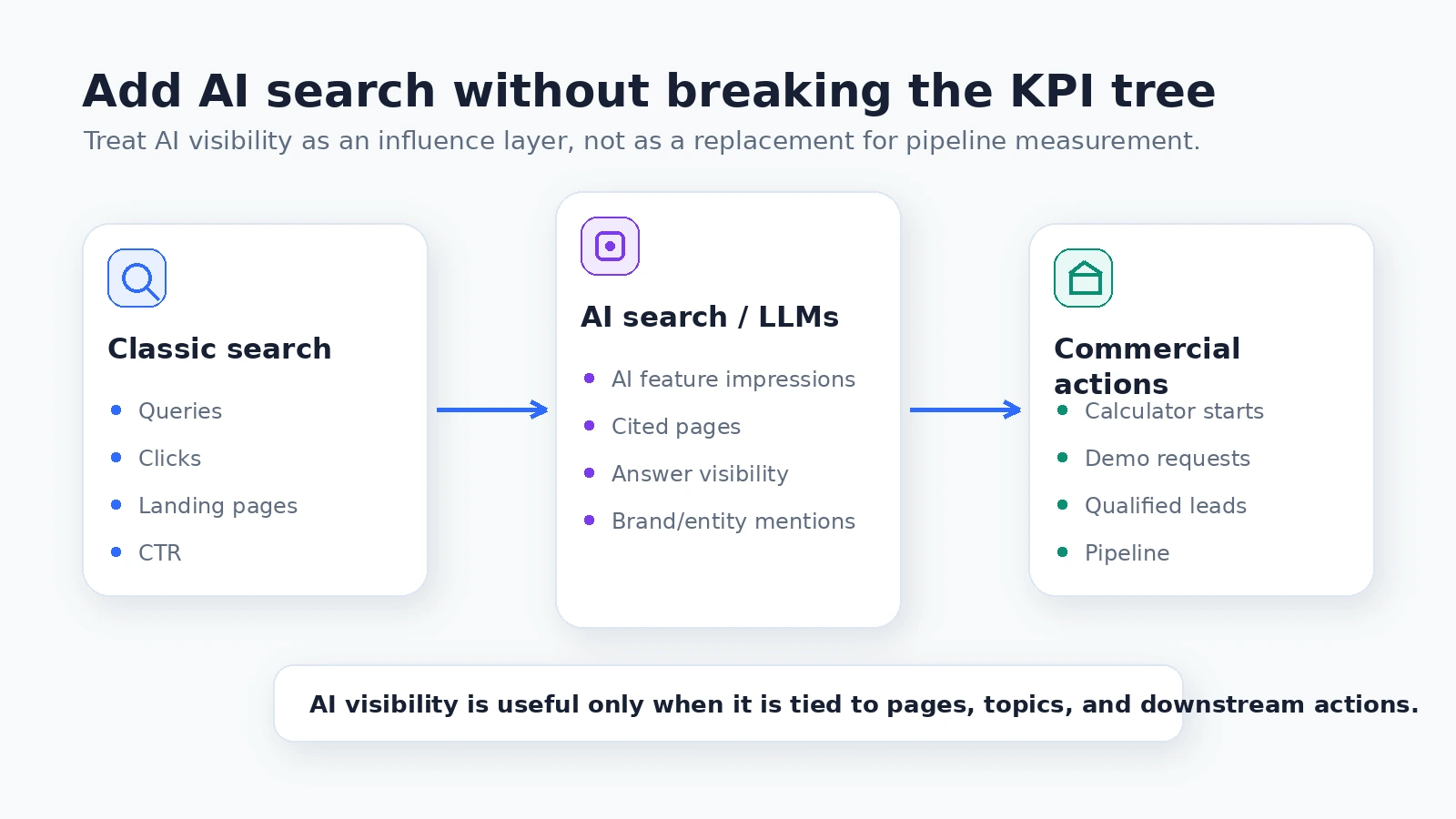
AI search does not remove the need for SEO measurement.
It adds another layer to the discovery system.
Google says the same foundational SEO best practices remain relevant for AI Overviews and AI Mode, and that pages need to be indexed and eligible for Google Search to be shown as supporting links. Google also says there is no special schema or new machine-readable file required for inclusion in these AI features. Google Search Central: AI features and your website
That means the core SEO system still matters:
- crawlability;
- indexability;
- internal linking;
- clear text content;
- helpful, reliable information;
- structured data that matches visible content;
- page experience;
- authority and trust signals.
But B2B buyers are increasingly using AI-assisted discovery as part of their buying journey. Gartner reported in March 2026 that 67% of B2B buyers preferred a rep-free experience. Forrester reported that 94% of business buyers used AI in their buying process and that generative AI or conversational search had become a particularly meaningful information source. Gartner Forrester
So the measurement model should include AI visibility, but not worship it as a standalone vanity metric.
AI search KPIs for B2B SEO
AI search KPIs should answer three questions.
First: Are we visible in AI-assisted research?
Possible metrics:
- impressions in generative AI search reports where available;
- pages appearing in AI search experiences;
- branded mentions in AI answers;
- product or category mentions in AI answers;
- competitor comparison coverage;
- source citations or supporting links;
- share of AI-visible pages that belong to strategic clusters.
Second: Are our AI-visible pages commercially useful?
Possible metrics:
- AI-visible pages with conversion paths;
- AI-visible pages linked to calculators, demos, pricing, or comparison pages;
- assisted conversions from pages likely to support AI discovery;
- organic engagement from pages surfaced in AI reports;
- branded search lift after AI-visible content campaigns.
Third: Are we becoming easier to understand and cite?
Possible metrics:
- consistency of entity information across the site;
- clarity of product, category, and use-case pages;
- presence of original data, examples, comparison logic, and expert commentary;
- external mentions from relevant sources;
- updated documentation, integrations, pricing, and product details;
- clear author, company, and contact signals.
In June 2026, Google announced new Search Generative AI performance reports in Search Console for a subset of websites, including data such as impressions, pages, countries, devices, and dates for generative AI features. If these reports are available for your site, they should become part of the Level 3 visibility layer. Google Search Central
But even then, AI visibility should still be connected to pipeline logic.
The question is not only “Did we appear in AI features?”
The better question is:
Which AI-visible pages support the topics, comparisons, and conversion paths that create qualified pipeline?
Build a KPI tree
The cleanest way to avoid KPI chaos is to build a KPI tree.
Start with one commercial objective.
Then work backward.
Example objective:
Increase qualified pipeline for a priority product from organic and AI-assisted discovery.
The KPI tree might look like this:
Business objective:
Increase qualified pipeline for Product A.

Commercial KPIs:
- Organic-sourced qualified pipeline
- Organic-influenced qualified pipeline
- Closed-won revenue
- CAC
- Payback period

Conversion KPIs:
- Demo requests from Product A cluster
- Calculator starts and completions
- Visitor-to-lead conversion rate
- Lead-to-opportunity conversion rate
- Disqualification reasons

Visibility KPIs:
- Non-brand clicks for Product A problems
- Visibility for comparison and alternative queries
- Visibility for ROI and cost queries
- AI search impressions or cited pages where available
- Branded search lift for Product A

Delivery KPIs:
- Missing BOFU pages published
- Existing pages refreshed
- Internal links added from high-authority pages
- Technical issues fixed
- Relevant mentions earned
Now every metric has a reason to exist.
Use the SEO cost calculator to connect SEO work to payback
An SEO calculator is not only a lead magnet.
It can also connect the KPI tree to customer economics that leadership understands.
The SEO ROI Calculator uses six inputs:
- total SEO investment;
- customers acquired from SEO;
- annual revenue per customer;
- gross margin;
- annual churn;
- discount rate.
It returns CAC, LTV, LTV:CAC, ROI, payback period, and expected customer lifetime.
The KPI tree supplies the upstream context the calculator does not model directly:
Qualified visits
→ leads
→ opportunities
→ customers attributed to SEO
→ CAC, LTV, ROI, and payback
This distinction matters. Funnel conversion rates help you estimate how many customers SEO may produce. The calculator then tests whether those customers justify the investment.
The model will never be perfect.
That is fine.
The goal is not fake precision. The goal is to make assumptions visible and review them against CRM results.
Want to connect SEO investment with CAC, LTV, ROI, and payback? Try the SEO ROI Calculator.
Account for time lag
SEO effects do not arrive on one schedule.
Technical fixes can be observed quickly.
A new product page may start getting impressions before it gets meaningful conversions.
A comparison cluster may need weeks or months to earn stable visibility.
Authority building may influence several pages gradually.
Enterprise revenue may lag even further because the sales cycle is long.
So B2B SEO reporting needs explicit review windows.
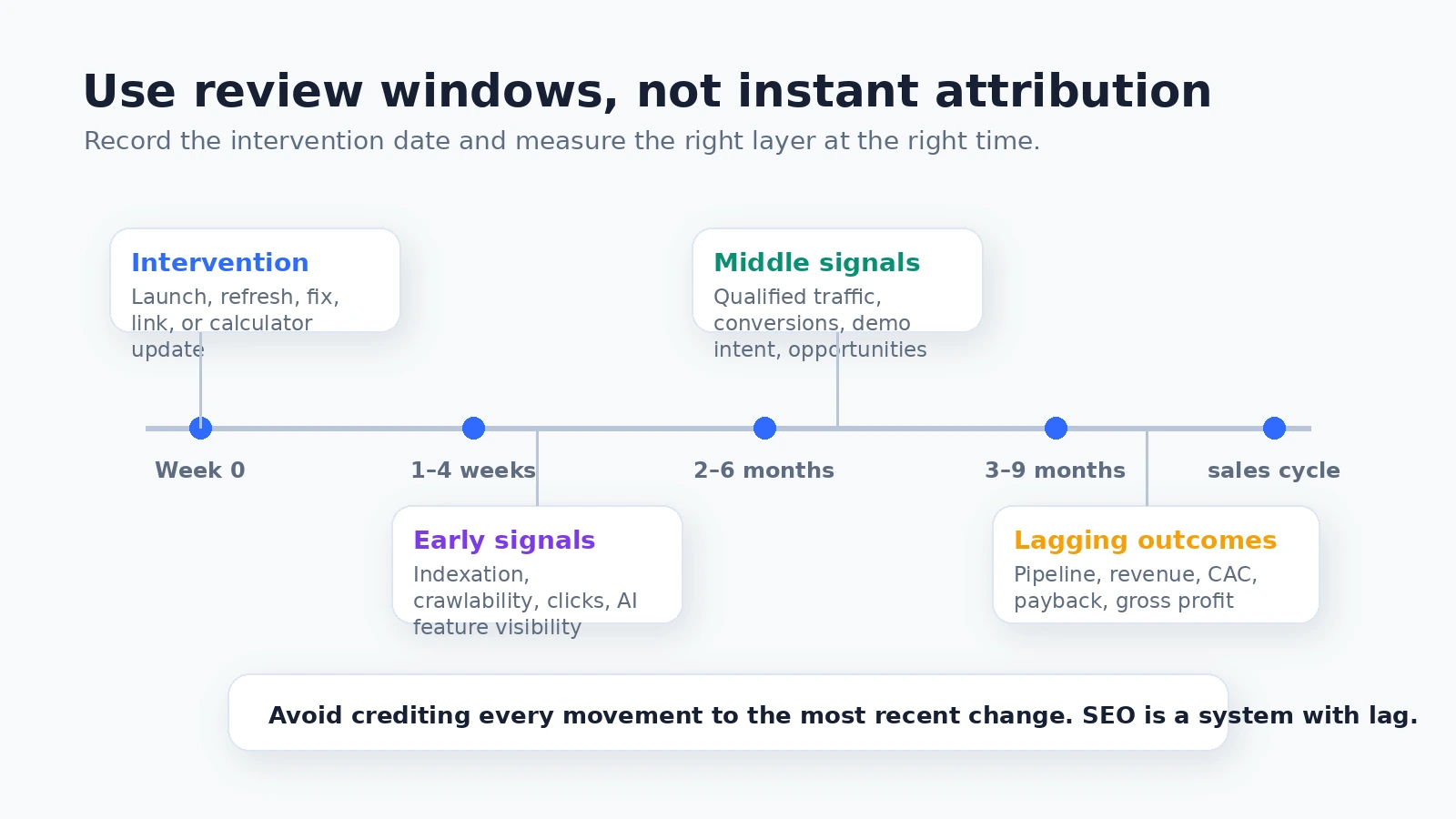
For every meaningful SEO intervention, record:
- what changed;
- which URLs changed;
- when the change went live;
- which topic cluster it belongs to;
- which commercial objective it supports;
- which metrics should move first;
- which metrics should move later;
- when the first review should happen;
- when the business-impact review should happen.
Avoid attributing every movement to the most recent change.
If organic pipeline improves in June, the reason may be a technical fix from May, a content refresh from April, a comparison page from March, a partner mention from February, and a sales-cycle effect from leads created months earlier.
A good report makes this uncertainty visible.
Use cohorts where possible
Cohort analysis helps you avoid misleading month-to-month conclusions.
Useful SEO cohorts include:
- pages published in the same month;
- pages refreshed in the same sprint;
- topic clusters launched in the same quarter;
- leads first acquired from organic in a specific period;
- accounts first touched by organic before becoming opportunities;
- visitors who used a calculator before submitting a demo request;
- pages made visible in AI search reports during the same period.
Instead of asking, “Did SEO improve this month?” ask:
What happened to the pages, leads, and opportunities connected to the work we shipped in this period?
This makes reporting more honest.
It also makes successful SEO work easier to repeat.
Reporting for different audiences
One dashboard does not need to show every metric to every stakeholder.
Leadership needs:
- qualified pipeline;
- revenue;
- CAC;
- payback;
- strategic risk;
- market visibility;
- major constraints;
- budget and resource decisions.
Growth and marketing teams need:
- conversion rates;
- ICP and segment performance;
- landing page performance;
- campaign and experiment results;
- calculator usage;
- demo or trial intent;
- channel mix;
- assisted pipeline.
SEO and content teams need:
- query clusters;
- page-level performance;
- internal links;
- indexation;
- crawl and rendering problems;
- content decay;
- refresh priorities;
- referring domains and mentions;
- AI visibility signals where available.
The same KPI tree can support all three views.
But the dashboard should not be identical for all three audiences.
What a useful B2B SEO dashboard should include
A practical dashboard can be structured like this.
Executive view
Use this for leadership reviews.
Include:
- organic-sourced pipeline;
- organic-influenced pipeline;
- closed-won revenue;
- CAC and payback;
- pipeline by strategic product cluster;
- revenue by segment;
- major risks and blockers;
- next decisions needed.
Keep this view short.
Leadership does not need to see every keyword.
Growth view
Use this for marketing and demand generation.
Include:
- qualified organic conversions;
- conversion rate by landing page type;
- demo, calculator, audit, or trial usage;
- MQL-to-SQL rate;
- SQL-to-opportunity rate;
- lead quality by topic cluster;
- disqualification reasons;
- paid versus organic CAC comparison;
- assisted conversions.
This view connects SEO to funnel quality.
SEO operating view
Use this for weekly or biweekly execution.
Include:
- priority page status;
- pages published;
- pages refreshed;
- indexation of strategic pages;
- non-brand clicks by cluster;
- CTR by page/query group;
- internal-link coverage;
- crawl and rendering issues;
- relevant mentions and links;
- AI feature visibility data if available;
- content decay and refresh backlog.
This view helps the team improve the machine.
Common B2B SEO KPI mistakes
Avoid these reporting mistakes.
Mistake 1: Reporting average ranking as the main KPI
Average ranking hides intent, segment, product, and query differences.
Use ranking distribution by topic cluster instead.
Mistake 2: Celebrating traffic without qualification
Traffic is not demand if the visitors cannot buy.
Always connect traffic to ICP fit, conversion quality, and disqualification reasons.
Mistake 3: Ignoring assisted impact
Many B2B journeys are multi-touch.
A buyer may read SEO content early, return through direct, and convert after a sales touch.
Use both sourced and influenced views.
Mistake 4: Treating delivery as impact
Publishing pages, fixing issues, and building links are important.
But they are not the business outcome.
Report them as leading indicators.
Mistake 5: Measuring AI search separately from the funnel
AI visibility is important, but it should not become another isolated vanity metric.
Tie AI-visible pages to topics, product clusters, conversion paths, and pipeline influence.
Mistake 6: Forgetting sales-cycle lag
If the sales cycle is six months, closed revenue will not reflect last month’s SEO work.
Use review windows and cohort analysis.
Example: KPI tree for a B2B software company
Imagine a B2B software company wants more qualified pipeline for its enterprise product.
A weak KPI plan would say:
Goal: grow organic traffic by 50%.
KPI: average ranking position.
Output: publish 40 blog posts.
This is too vague.
A stronger plan would say:
Commercial objective:
Increase qualified enterprise pipeline from organic discovery.

Target audience:
Enterprise operations, IT, and finance decision-makers.

Strategic clusters:
- Cost and ROI
- Implementation risk
- Vendor comparison
- Integration requirements
- Security and compliance

Commercial pages:
- Product page
- Enterprise use-case page
- Pricing explainer
- ROI calculator
- Competitor comparison pages
- Migration or implementation guide

Main KPIs:
- Qualified pipeline from organic-sourced and organic-influenced accounts
- Demo requests from strategic clusters
- Calculator completions
- Opportunity rate from organic leads
- CAC and payback

Leading indicators:
- Non-brand visibility for decision-stage queries
- AI search visibility for comparison and ROI topics
- Indexation of priority pages
- Internal links to BOFU assets
- Relevant third-party mentions
This is much easier to manage.
It tells the content team what to create.
It tells SEO what to improve.
It tells growth what to measure.
It tells leadership how the work connects to pipeline.
How to choose KPIs for a new B2B SEO program
If the SEO program is new, do not pretend you can measure everything immediately.
Start with a measurement maturity ladder.
Stage 1: Foundation
Use this when tracking is weak.
Main focus:
- analytics setup;
- Search Console setup;
- CRM source capture;
- conversion events;
- landing page mapping;
- ICP and segment definitions;
- baseline visibility by topic cluster.
Stage 2: Visibility and conversion
Use this when the site is crawlable and tracking works.
Main focus:
- non-brand clicks;
- topic-cluster visibility;
- strategic landing page performance;
- conversion rate by page type;
- calculator or demo usage;
- lead quality.
Stage 3: Pipeline
Use this when CRM connection is reliable.
Main focus:
- organic-sourced opportunities;
- organic-influenced opportunities;
- pipeline value;
- conversion from lead to opportunity;
- sales-cycle length;
- disqualification reasons.
Stage 4: Revenue and efficiency
Use this when there is enough historical data.
Main focus:
- closed-won revenue;
- gross profit;
- CAC;
- payback;
- LTV;
- expansion from organic-acquired accounts;
- SEO budget allocation by product cluster.
This prevents a young SEO program from being judged by metrics it cannot reasonably produce yet.
How often to review each KPI layer
Different layers need different review rhythms.
Weekly or biweekly:
- crawl issues;
- indexing problems;
- page launches;
- internal linking;
- technical blockers;
- urgent traffic anomalies.
Monthly:
- non-brand clicks;
- topic-cluster visibility;
- landing page conversion;
- calculator usage;
- demo requests;
- content refresh performance;
- AI visibility data where available.
Quarterly:
- qualified pipeline;
- organic-influenced pipeline;
- closed-won revenue;
- CAC;
- payback;
- strategic cluster ROI;
- budget allocation.
The longer the sales cycle, the more important quarterly and cohort-based reporting becomes.
Final checklist
Use this checklist before presenting B2B SEO KPIs.
Does the report separate leading indicators from business outcomes?

Are rankings grouped by product, segment, use case, and intent?

Can we see non-brand visibility for priority clusters?

Can we connect organic landing pages to conversions?

Can we distinguish leads from qualified opportunities?

Can we show sourced and influenced pipeline?

Do we know CAC and payback assumptions?

Are AI search metrics tied to pages and topics, not reported alone?

Did we record the intervention dates for major SEO changes?

Does each dashboard view match the audience using it?
If the answer is no to most of these questions, the issue is not SEO performance.
The issue is measurement design.
Related guides
Use this KPI model together with:
- SEO in B2B: Do You Really Need It in 2026?;
- How to choose a B2B SEO partner;
- B2B SEO checklist;
- B2B SEO authority-building guide;
- B2B SEO case study;
- SEO ROI Calculator.
FAQ
What are the most important B2B SEO KPIs?
The most important B2B SEO KPIs are qualified organic pipeline, closed revenue, influenced pipeline, customer acquisition cost, payback period, qualified opportunities, conversion quality, and visibility for priority product or topic clusters. Rankings and traffic are useful diagnostic metrics, but they should not be the only KPIs.
Should B2B SEO be measured by rankings?
Rankings should be measured, but they should not be the main success metric. In B2B, ranking improvements matter only when they increase qualified discovery, conversions, pipeline, revenue, or strategic visibility in buying journeys.
How do you measure SEO pipeline?
Measure SEO pipeline by connecting organic landing pages, query intent, forms, calculator usage, demo requests, qualified leads, opportunities, and CRM revenue data. Use both sourced pipeline and influenced pipeline because B2B buying journeys often include several stakeholders and multiple touchpoints.
How should AI search be measured in B2B SEO?
AI search should be measured as a visibility and influence layer. Track AI feature visibility where available, pages appearing in AI experiences, brand and entity mentions, cited pages, assisted conversions, and whether AI-visible pages contribute to qualified organic actions.
What is a B2B SEO KPI tree?
A B2B SEO KPI tree is a measurement model that starts with a commercial objective, such as qualified pipeline, and works backward into opportunity creation, conversion quality, search and AI visibility, content delivery, internal linking, indexation, and technical health.
How do you calculate B2B SEO ROI?
A practical B2B SEO ROI model compares SEO investment with gross profit from organic-sourced or organic-influenced customers. For planning, use assumptions such as SEO cost, customers acquired, annual revenue per customer, gross margin, churn, LTV, CAC, and payback period.
How often should B2B SEO KPIs be reviewed?
Delivery and technical health can be reviewed weekly or monthly. Visibility and conversion quality are usually reviewed monthly. Pipeline and revenue should be reviewed monthly or quarterly, depending on the sales cycle and available CRM data.
Conclusion
B2B SEO KPIs should show how organic and AI-assisted discovery creates qualified business value.
Rankings still matter.
Traffic still matters.
Technical health still matters.
Content delivery still matters.
But none of them should be treated as the final goal.
The strongest B2B SEO reports connect the full chain:
SEO work
→ crawlable and useful pages
→ search and AI visibility
→ qualified visitors
→ meaningful conversions
→ opportunities
→ pipeline
→ revenue
→ CAC and payback
That is the difference between reporting SEO activity and managing SEO as a growth system.
Questions about a B2B growth system? Contact me via LinkedIn, Telegram, or email.