B2B SEO Trends: AI Search, Authority, UX, and SERP Visibility
Quick answer
The most important B2B SEO trends are not isolated tricks.
They are structural changes in how buyers discover, evaluate, trust, and act on information.
The durable trends are:
- AI-assisted search and answer surfaces;
- more value for original evidence;
- stronger importance of brand and expert identity;
- UX and technical reliability as a non-negotiable foundation;
- SERP visibility across several formats;
- distribution as part of content strategy;
- measurement closer to pipeline and revenue;
- AI-assisted SEO operations with human source ownership.
The practical implication is clear:
B2B SEO is moving away from generic volume and toward evidence, identity, clarity, technical reliability, and connected customer journeys.

Search behavior changes, buyer needs do not
Search behavior is changing quickly.
B2B buyers can now discover information through:
- traditional organic results;
- AI Overviews and AI-assisted search experiences;
- featured answers;
- video platforms;
- communities;
- newsletters;
- comparison pages;
- review sites;
- social posts;
- direct brand searches;
- internal AI tools used by buying teams.
But the underlying buying job is still familiar.
A buyer still needs to:
- understand a problem;
- compare alternatives;
- verify expertise;
- reduce risk;
- justify cost;
- align internal stakeholders;
- decide whether a vendor deserves attention.
That is why the most useful SEO trends are not predictions tied to one year.
They are durable changes in how information is discovered, summarized, trusted, and acted upon.
Related guide: B2B SEO: Do You Really Need It?
Trend 1: Discovery extends beyond blue links
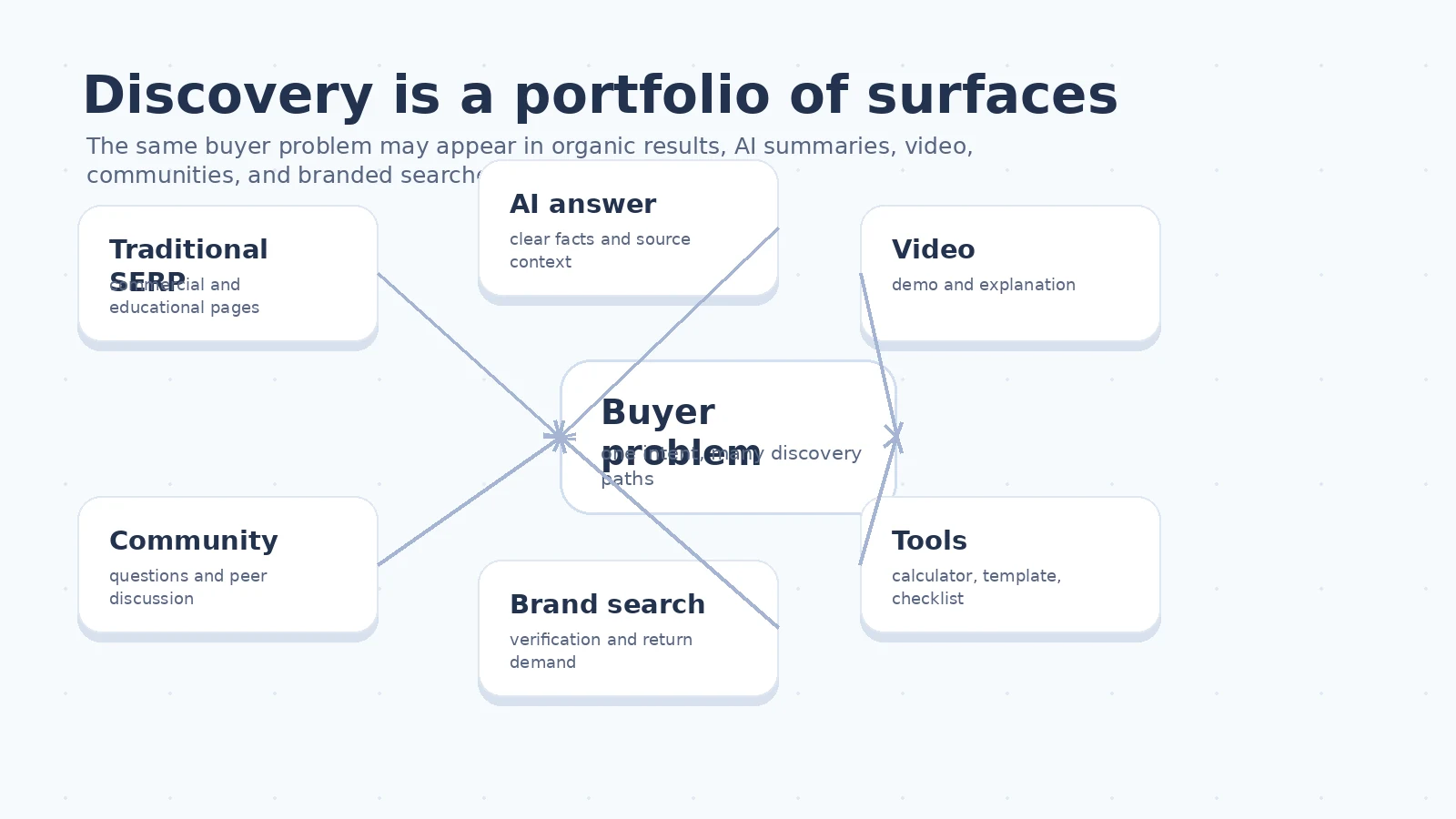
B2B SEO can no longer be planned only around a list of blue links.
A page may be discovered through:
- a classic organic result;
- a generative AI answer;
- a featured snippet;
- a video result;
- a LinkedIn post;
- an industry newsletter;
- a partner mention;
- a branded query;
- a comparison search;
- a sales follow-up link.
This does not mean classic SEO is dead.
It means the source page must be useful outside its original format.
Make important content:
- explicit about the question it answers;
- structured into clear sections;
- supported by examples and evidence;
- easy to quote and reference;
- connected to the responsible company or author;
- internally linked to relevant next steps;
- technically accessible and indexable.
Google’s own guidance for generative AI features still points back to core SEO fundamentals: useful content, crawlability, accessibility, and search-quality systems, not a separate magic layer of “AI-only SEO.”
Related guide: Technical SEO for B2B Websites
Trend 2: AI increases the value of original evidence
Generative tools make surface-level summaries inexpensive.
That changes the value of content.
Generic explanations become easier to produce and easier to ignore.
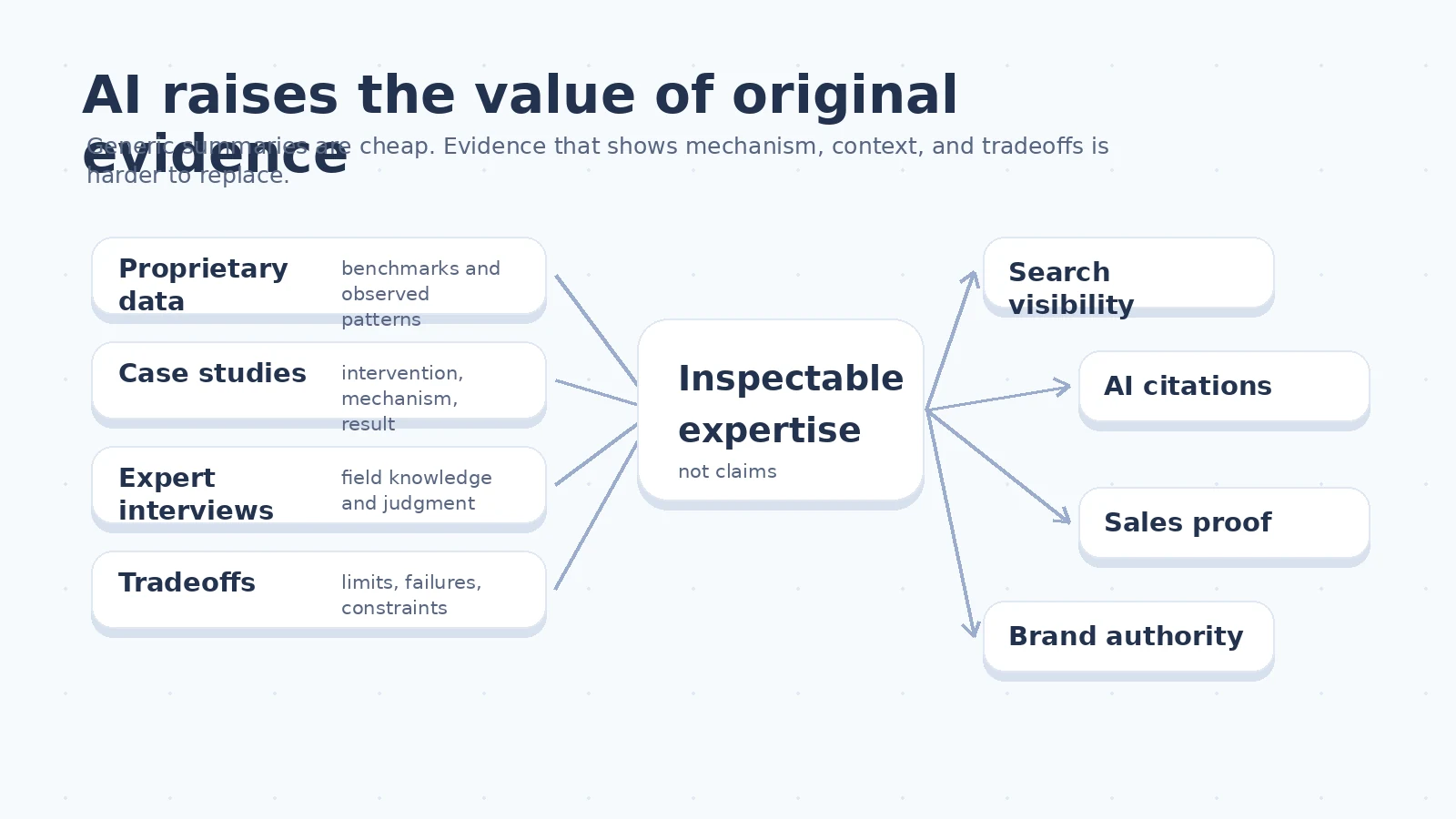
Original evidence becomes more important.
Evidence-rich B2B content can include:
- proprietary data;
- transparent case studies;
- implementation examples;
- specialist interviews;
- original frameworks;
- diagnostic models;
- cost calculators;
- technical benchmarks;
- documented tradeoffs;
- lessons from failed experiments;
- real buyer objections;
- segment-specific decision criteria.
The value is not only the conclusion.
The value is the mechanism.
A case study that says “traffic increased” is weak.
A case study that explains what changed, why it mattered, what was measured, and how it affected qualified demand is much stronger.
Related example: B2B SEO Case Study
Trend 3: Brand and expert identity matter more
When many pages repeat similar advice, buyers look for reasons to trust one source over another.
That makes brand and expert identity more important.
A strong B2B SEO system should make it clear:
- who the company serves;
- which problem space the company understands;
- what point of view it holds;
- which expertise it can demonstrate;
- what proof supports its claims;
- who is responsible for the content;
- why a buyer should trust the source.
This does not mean adding empty author boxes to generic content.
It means making expertise inspectable.
Useful signals include:
- named authors or reviewers where appropriate;
- methodology notes;
- original examples;
- source links;
- customer proof;
- product context;
- implementation details;
- limitations and tradeoffs;
- consistent positioning across SEO, sales, email, social, and product pages.
Avoid manufacturing authority through unsupported claims.
A page saying “we are experts” is weaker than a page showing how the company thinks, solves, measures, and learns.
Related guide: Brand Positioning Through B2B SEO
Trend 4: Technical reliability and UX remain foundational
AI search does not make technical SEO less important.
It makes reliability more important.
Search systems cannot consistently use pages that are:
- blocked;
- noindexed by mistake;
- duplicated;
- orphaned;
- unstable;
- slow;
- difficult to render;
- unclear in structure;
- inaccessible on mobile;
- disconnected from the rest of the site.
Buyers also will not act on pages that are confusing, slow, vague, or hard to use.
This matters most on strategic pages:
- product pages;
- use-case pages;
- comparison pages;
- case studies;
- pricing and calculator pages;
- demo pages;
- high-value educational guides.
Technical and UX work should be prioritized by commercial impact.
Do not chase a perfect score while important pages remain unclear, unlinked, or unmeasured.
Related guide: B2B SEO Audit: Technical, Content, Authority, and Measurement
Trend 5: The SERP is a portfolio of formats
A single topic may deserve more than one asset.
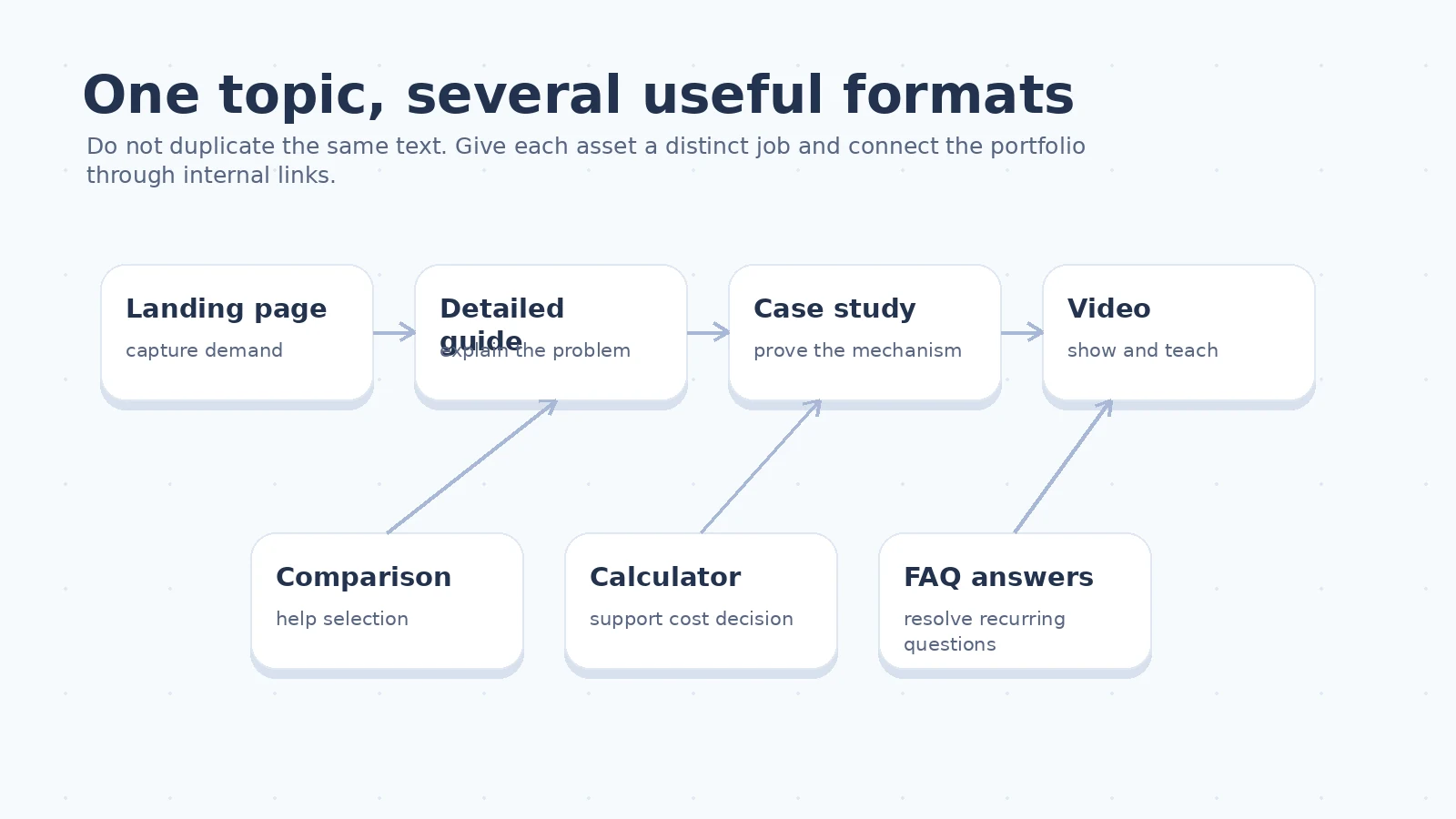
For example, a high-value B2B topic might need:
- a commercial landing page;
- a detailed educational guide;
- a case study;
- a video explanation;
- a comparison page;
- a calculator;
- a template;
- concise answers to recurring questions.
Each format should have a distinct job.
Do not duplicate the same text across every page.
A commercial page should help buyers evaluate the offer.
A guide should explain the problem.
A case study should prove the mechanism.
A calculator should help estimate cost or impact.
A video should show or explain something more clearly than text.
A FAQ should answer recurring decision questions.
Connect the assets through internal links so the buyer can move naturally from learning to evaluation to action.
Trend 6: Calculators and tools become stronger BOFU assets
In B2B SEO, not every valuable page is an article.
Decision-stage tools can be powerful because they help buyers translate a problem into cost, impact, and action.
Examples:
- cost calculators;
- ROI calculators;
- migration checklists;
- vendor comparison templates;
- diagnostic scorecards;
- implementation planners;
- budget estimators.
A tool such as an SEO ROI calculator can support several jobs:
- help buyers test a proposed investment;
- connect customer acquisition to CAC and LTV;
- estimate ROI and payback from explicit assumptions;
- qualify demand;
- create a reason to return;
- support sales conversations;
- attract references from related content;
- connect educational search demand to commercial intent.
A calculator should still be a real SEO page.
That means it needs:
- crawlable explanatory content;
- clear assumptions;
- useful results;
- internal links;
- privacy-friendly behavior;
- conversion tracking;
- a next step.
Related tool: SEO Cost Calculator
Trend 7: Distribution becomes part of content strategy
Publishing alone is rarely enough.
Important content needs distribution.
That does not mean spraying links across every channel.
It means introducing useful expertise to the people who can use it, discuss it, remember it, cite it, or share it.
Distribution channels can include:
- email;
- LinkedIn;
- YouTube;
- specialist communities;
- partner newsletters;
- industry associations;
- webinars;
- sales follow-ups;
- customer enablement;
- employee advocacy;
- digital PR.
Distribution supports SEO indirectly.
It can help content earn:
- relevant referrals;
- branded searches;
- mentions;
- links;
- expert discussion;
- customer questions;
- sales enablement value.
This is not proof that social engagement directly increases rankings.
It is evidence that useful content reached the market.
Related guides:
- How Social Distribution Supports B2B SEO
- How Email Supports B2B SEO and Demand Capture
- B2B Link Building: Authority, Referrals, and Market Evidence
Trend 8: AI helps operations, but not ownership
AI can improve SEO operations.
Useful applications include:
- clustering queries;
- summarizing sales-call themes;
- comparing search intent;
- drafting briefs;
- finding content gaps;
- identifying refresh candidates;
- rewriting for clarity;
- checking consistency;
- generating outlines;
- turning long content into distribution assets;
- testing FAQ coverage;
- reviewing page structure.
But AI should not own the source of truth.
B2B content still needs:
- subject-matter experts;
- product context;
- customer evidence;
- source verification;
- legal and factual review where needed;
- clear ownership;
- real examples;
- judgment about tradeoffs.
The risk is not that AI writes badly.
The bigger risk is that AI makes generic content cheaper, faster, and more abundant.
That makes source quality and expert ownership more important.
Trend 9: Measurement moves closer to revenue
As discovery becomes multi-channel, last-click traffic reports become less useful.
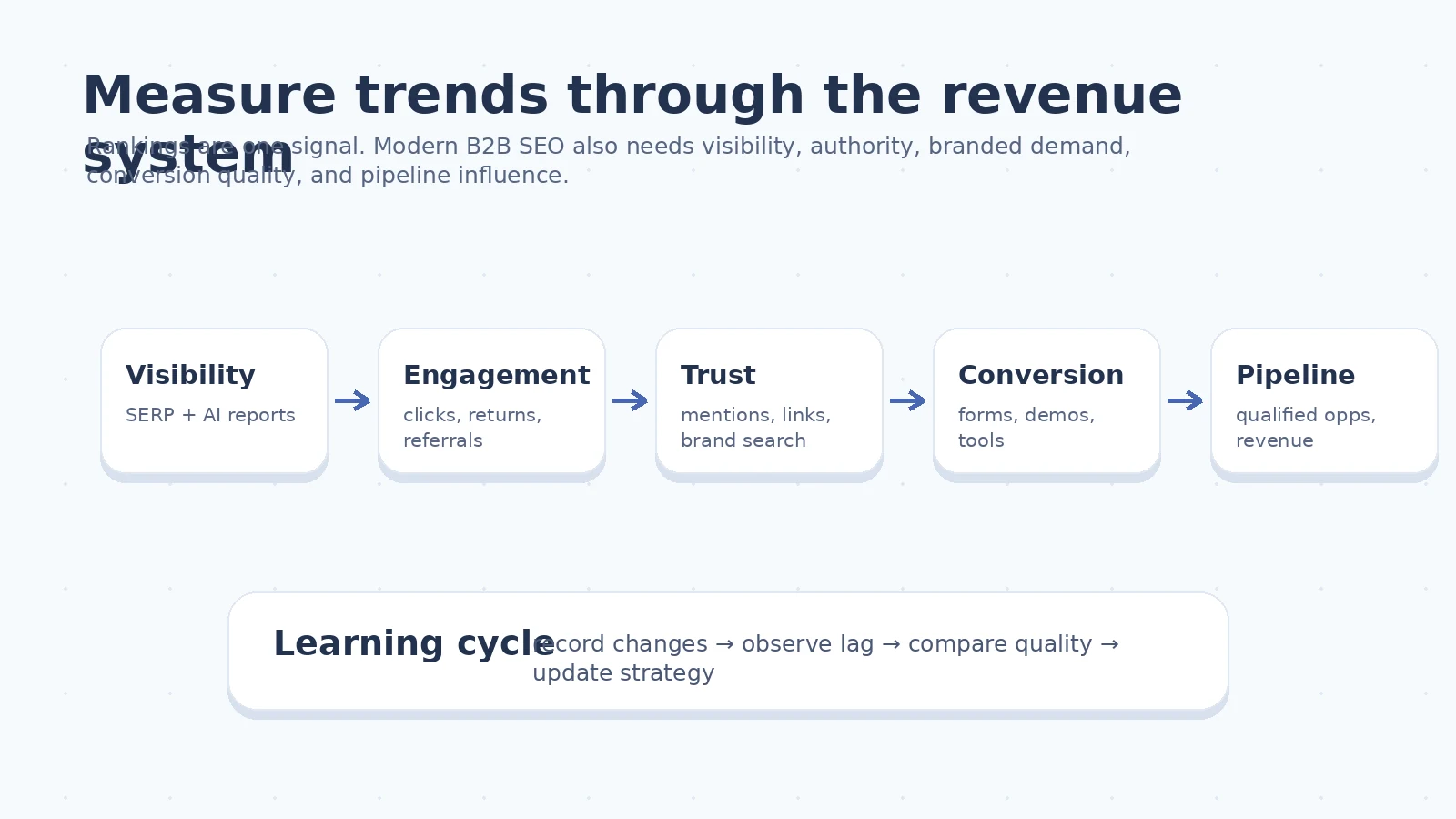
A modern B2B SEO report should connect several layers:
- non-branded visibility;
- AI search visibility where available;
- branded demand;
- qualified organic traffic;
- engagement with strategic pages;
- conversions by intent and page group;
- content-assisted opportunities;
- referral quality;
- pipeline influence;
- revenue and gross profit where attribution is credible.
Search Console’s dedicated generative AI performance reporting is a sign that AI visibility is becoming measurable as its own discovery layer, but it should still be interpreted alongside downstream commercial quality.
Do not pretend the full journey is perfectly observable.
Record uncertainty.
If analytics cannot connect a page visit to a lead, that is a measurement constraint.
If CRM does not preserve original source, that is a system constraint.
If sales uses content but does not log it, that is an enablement measurement gap.
Related guide: B2B SEO KPIs: Measure Pipeline and Revenue, Not Rankings
A practical priority order
B2B teams do not need to chase every trend at once.
Use this order.
1. Make strategic pages technically reliable
Start with pages that support demand capture, evaluation, and conversion.
Check crawlability, indexation, rendering, mobile usability, internal links, and tracking.
2. Define the topics the brand should own
Do not try to become visible for everything.
Define the problems, categories, use cases, comparisons, and buyer questions where the company has a credible right to be remembered.
3. Publish original, evidence-rich answers
Prioritize content that includes real expertise:
- examples;
- data;
- customer context;
- tradeoffs;
- frameworks;
- implementation experience;
- proof.
4. Connect informational content to commercial journeys
Every important guide should have a relevant next step.
That next step might be a product page, comparison, case study, calculator, demo, newsletter, or consultation.
5. Build a portfolio of formats
Turn high-value topics into connected assets.
Do not rely only on blog posts.
Use pages, tools, videos, proof, templates, and FAQs where each format has a real job.
6. Distribute the work
Use owned and relevant external channels to get important content in front of the market.
Distribution is part of the SEO system because it helps useful content earn attention, references, links, branded demand, and sales usage.
7. Measure quality and commercial progress
Track more than traffic.
Measure whether SEO is improving discovery, trust, conversion quality, qualified pipeline, and revenue influence.
8. Use AI to accelerate operations without weakening evidence
Use AI for research support, clustering, editing, summaries, and distribution repurposing.
Do not let it replace source verification, expert judgment, or ownership of claims.
Common mistakes to avoid
Avoid these trend-chasing mistakes:
- treating AI search as a separate hack;
- publishing generic AI-written content at scale;
- optimizing only for traffic volume;
- ignoring branded demand;
- building content without proof;
- ignoring technical reliability;
- duplicating the same topic across many weak pages;
- measuring only rankings and clicks;
- distributing content without a clear source asset;
- confusing social engagement with business impact;
- claiming revenue impact when attribution is not credible.
Trends are useful only when they improve the system.
If a tactic does not help buyers discover, trust, evaluate, or act, it probably does not deserve priority.
FAQ
What are the most important B2B SEO trends?
The most important B2B SEO trends are AI-assisted discovery, stronger demand for original evidence, clearer brand and expert identity, technical and UX reliability, broader SERP formats, stronger distribution, and measurement closer to pipeline and revenue.
Is AI search replacing SEO?
No. AI search changes how information is summarized and discovered, but pages still need to be crawlable, useful, structured, trustworthy, and connected to real user intent. AI search makes strong SEO fundamentals more important, not less important.
How should B2B companies optimize for AI search?
Focus on clear answers, original evidence, expert review, crawlable content, strong internal links, accurate structured data, visible proof, and useful context. Avoid treating AI search as a separate hack.
Why does original evidence matter more in B2B SEO?
Generic summaries are easy to produce with AI. Original data, case studies, expert interviews, frameworks, tradeoffs, and implementation experience are harder to copy and more useful for buyers who need to reduce risk.
Do UX and technical SEO still matter?
Yes. Search systems and buyers cannot reliably use pages that are blocked, slow, duplicated, unstable, or hard to render. Technical reliability and good UX protect every other SEO investment.
What does SERP visibility mean in B2B SEO?
SERP visibility means being discoverable across the formats buyers use: organic results, AI answers, featured answers, video, comparison pages, tools, brand searches, and other discovery surfaces.
How should B2B SEO trends be measured?
Measure visibility, AI search presence where available, non-branded demand, branded demand, referral quality, conversions, qualified pipeline, revenue influence, and operating inputs such as content shipped and technical issues fixed.
What should B2B teams prioritize first?
Start with technical reliability for strategic pages, then define the market territory the brand should own, publish evidence-rich content, connect content to commercial journeys, distribute important assets, and measure quality and pipeline impact.
Conclusion
The direction of B2B SEO is clear.
There is less durable value in generic volume.
There is more value in:
- original evidence;
- expert identity;
- technical reliability;
- useful UX;
- connected SERP formats;
- strong distribution;
- brand consistency;
- measurement tied to qualified demand and revenue.
Companies that treat search as part of a wider growth and knowledge system will be more resilient than companies optimizing isolated pages for isolated rankings.
Questions about a B2B growth system? Contact me via LinkedIn, Telegram, or email.