SEO in B2B: Do You Really Need It?
Quick answer
Yes, most B2B companies still need SEO.
But not the old version of SEO where the goal was to publish generic blog posts, chase traffic, and hope that leads would appear later.
In 2026, B2B SEO is useful when it helps buyers do real buying work:
- understand a problem;
- compare solution types;
- shortlist vendors;
- estimate budget;
- calculate ROI;
- validate implementation risks;
- prepare an internal business case;
- decide whether to talk to sales.
That matters even more now because B2B buyers do not only use classic Google results. They also use AI Overviews, AI Mode, ChatGPT search, Perplexity-style answer engines, internal AI assistants, vendor comparison pages, communities, analyst content, documentation, calculators, and review sites.
So the better question is not “Do we need SEO?”
The better question is:
Can buyers and AI systems find, understand, trust, compare, and reuse your company’s expertise before a sales conversation happens?
If the answer is no, SEO is not just a traffic channel. It is a missing part of your buying journey.

Model the commercial case: Use the SEO ROI Calculator to test how investment, acquired customers, revenue, margin, churn, and discount assumptions affect CAC, LTV, payback, and ROI.
What changed since the old B2B SEO playbook
The old argument for B2B SEO was simple:
- people search online;
- organic traffic is cheaper than paid traffic;
- blogging increases visibility;
- higher rankings generate leads over time.
That was directionally true, but too shallow.
The modern B2B search journey is more complicated.
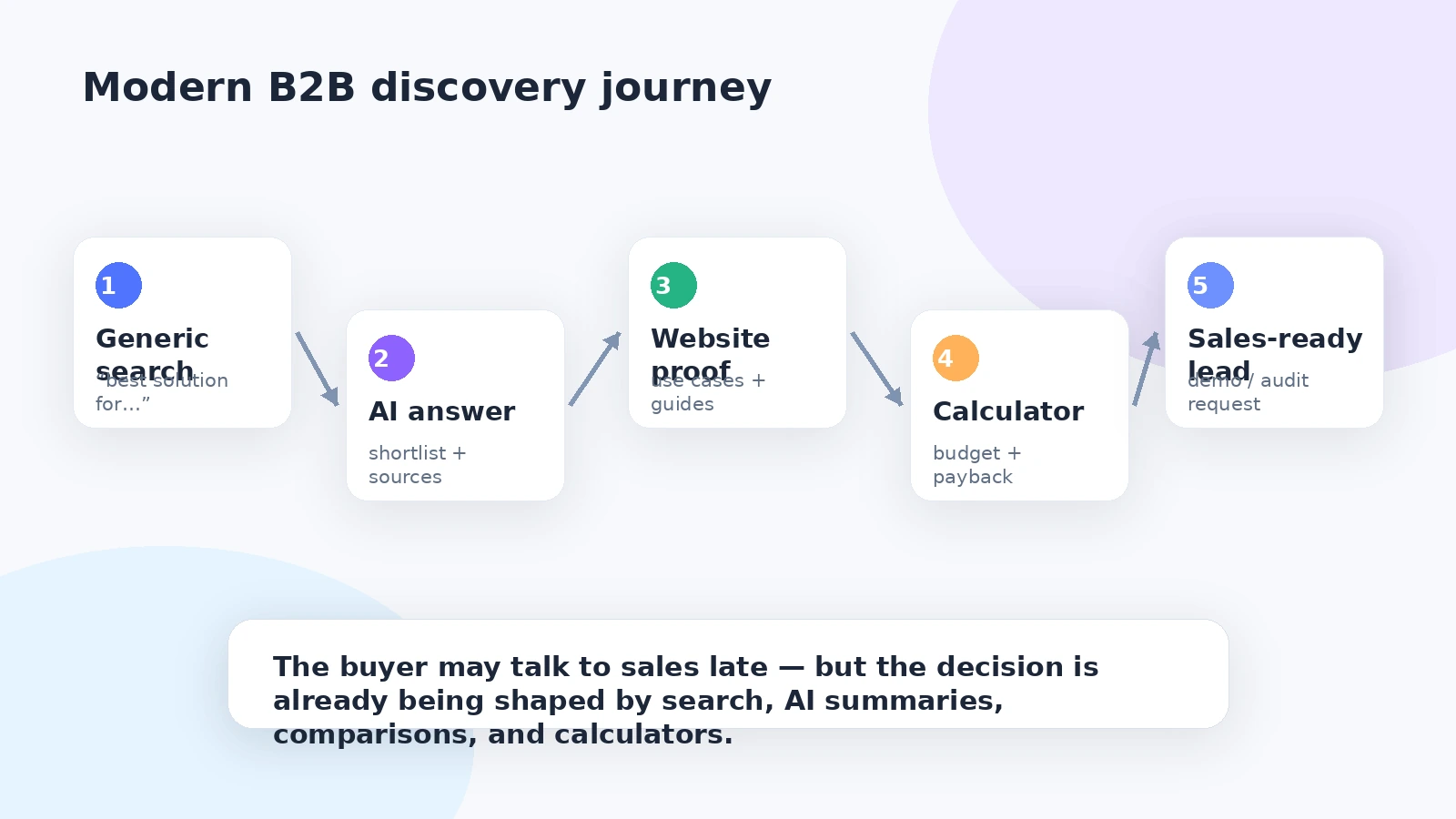
A buyer may start with a generic search query, read an AI-generated answer, ask a follow-up question in ChatGPT, open three comparison pages, check pricing, ask a colleague in Slack, send a link to procurement, and only then submit a demo request.
The content that influenced the deal may not be the page that gets the last-click conversion.
That is why B2B SEO now has to be treated as buyer enablement, not just content marketing.
Good B2B SEO answers the questions your buyer has before they are ready to speak with you.
Great B2B SEO also gives them tools to move the buying process forward.
That is where assets like calculators, comparison pages, implementation guides, migration checklists, ROI models, and technical documentation become more valuable than another generic “top trends” article.
Why SEO still matters in B2B
SEO still matters because B2B buying is research-heavy.
B2B products are often expensive, risky, technical, or hard to replace. Buyers need to reduce uncertainty before they create a shortlist.
They need to answer questions like:
- Is this problem worth solving now?
- What are the available solution categories?
- Which vendors are credible?
- How much should this cost?
- What will implementation require?
- What integrations matter?
- What risks should we expect?
- How do we justify the budget internally?
If your company does not answer these questions, someone else will.
That “someone else” may be:
- a competitor;
- a review site;
- an affiliate listicle;
- an analyst report;
- a community thread;
- a marketplace page;
- an AI answer that does not include you;
- an outdated article that frames the category badly.
B2B SEO gives your company a chance to shape the buyer’s understanding before the vendor shortlist is fixed.
The AI search layer: SEO is becoming source strategy
AI search does not remove the need for web content.
It changes the way content is discovered and reused.
Classic SEO tried to win a click from a search results page.
AI search can summarize multiple sources, compare options, and show links as supporting evidence. This means your content has to be more than “rankable”. It has to be easy to extract, verify, cite, and compare.
For B2B, that changes the practical goal:
Old SEO goal:
Rank for a keyword and get traffic.

Modern B2B SEO goal:
Become a trusted source that search engines, AI systems, buyers, and sales teams can reuse during the buying process.
This is why generic content is losing value.
AI systems do not need another article that says “SEO improves visibility and credibility.”
They need clear, specific, sourceable answers.
Examples:
- pricing models;
- implementation steps;
- integration requirements;
- migration risks;
- product limitations;
- comparison criteria;
- ROI assumptions;
- decision frameworks;
- examples from real projects;
- original data;
- calculators and templates.
If you want visibility in AI search and LLM-assisted discovery, your site should make your expertise easy to identify and reuse.
What B2B buyers actually need from SEO content
B2B buyers do not wake up wanting to read your blog.
They want to make a safer decision faster.
Your SEO content should help with one of five buying jobs.
1. Understand the problem
These pages explain the pain, risk, cost of inaction, and why the problem matters.
Examples:
- “Why cloud infrastructure costs grow faster than revenue”
- “Why customer onboarding breaks in multi-product SaaS”
- “Why manual reporting slows down B2B marketing teams”
2. Define the solution category
These pages teach the buyer how to think about the category.
Examples:
- “What is revenue attribution software?”
- “What is technical SEO for B2B SaaS?”
- “What is a partner management platform?”
3. Compare options
These pages help the buyer understand tradeoffs.
Examples:
- “Agency vs in-house SEO for B2B companies”
- “SEO vs paid search for B2B lead generation”
- “HubSpot vs Salesforce for early-stage B2B SaaS”
4. Estimate business value
These pages help the buyer justify the project.
Examples:
- ROI calculators;
- cost calculators;
- payback models;
- budget benchmarks;
- lead requirement calculators;
- CAC and LTV scenarios.
This is where an SEO ROI calculator can become a central conversion asset.
5. Reduce implementation risk
These pages answer the questions that appear after interest is created.
Examples:
- setup guides;
- migration guides;
- integration pages;
- security documentation;
- data handling pages;
- procurement checklists;
- onboarding timelines.
This is the content that helps a buyer say: “This looks possible. Let’s talk to them.”
When B2B SEO is worth the investment
B2B SEO is worth investing in when at least several of these conditions are true.
Your buyers already search for the problem
You do not need massive search volume.
In B2B, a keyword with 50 qualified searches per month can be more valuable than a generic keyword with 10,000 unqualified searches.
Search volume matters less than buying relevance.
A query like “enterprise SSO implementation checklist” may be more commercially useful than “what is SaaS”.
Your product has a long consideration cycle
SEO works well when the buyer has to learn before buying.
If the product requires internal alignment, budget approval, technical validation, or stakeholder education, content can influence the deal long before a form fill.
Your ACV or LTV can justify the payback period
SEO is rarely the fastest channel.
It becomes attractive when one or a few closed deals can pay back months of content, technical, and distribution work.
A company with a $30,000 annual contract can justify a very different SEO investment than a company with a $20 one-time purchase.
Your category needs education
If buyers do not fully understand the problem or solution, SEO can create demand, not just capture demand.
This is common in:
- B2B SaaS;
- infrastructure software;
- cybersecurity;
- fintech;
- dev tools;
- HR tech;
- martech;
- legal tech;
- data platforms;
- AI products;
- professional services.
Your sales team repeats the same explanations
If sales, founders, or customer success teams answer the same questions every week, those questions are SEO assets waiting to be built.
A good article, comparison page, calculator, checklist, or guide can make the sales process easier.
When B2B SEO is not the right priority
SEO is not always the best first move.
Be careful with SEO if:
- you need revenue in the next 30 days;
- your ICP changes every month;
- your product positioning is not clear;
- you cannot explain why buyers choose you;
- your market is only a small named-account list;
- there is no search behavior around the problem;
- you cannot publish real expertise;
- your website cannot convert visitors;
- sales and marketing do not agree on what a qualified lead is;
- nobody will maintain or update the content.
In those cases, SEO may still matter later.
But the first priority may be positioning, outbound, founder-led sales, paid experiments, partner channels, customer interviews, or conversion work.
SEO amplifies a clear strategy.
It does not fix a vague one.
B2B SEO is not only blog content
A common mistake is treating B2B SEO as a blog calendar.
A blog is only one part of the system.
A serious B2B SEO program may include:
- product pages;
- use case pages;
- industry pages;
- integration pages;
- comparison pages;
- alternative pages;
- pricing pages;
- calculator pages;
- documentation;
- templates;
- glossary pages;
- case studies;
- partner pages;
- webinar pages;
- research reports;
- migration guides;
- implementation checklists;
- FAQ hubs.
The goal is not to publish more.
The goal is to cover the buyer’s decision path better than competitors and better than generic AI summaries.
The topical authority approach for B2B SEO
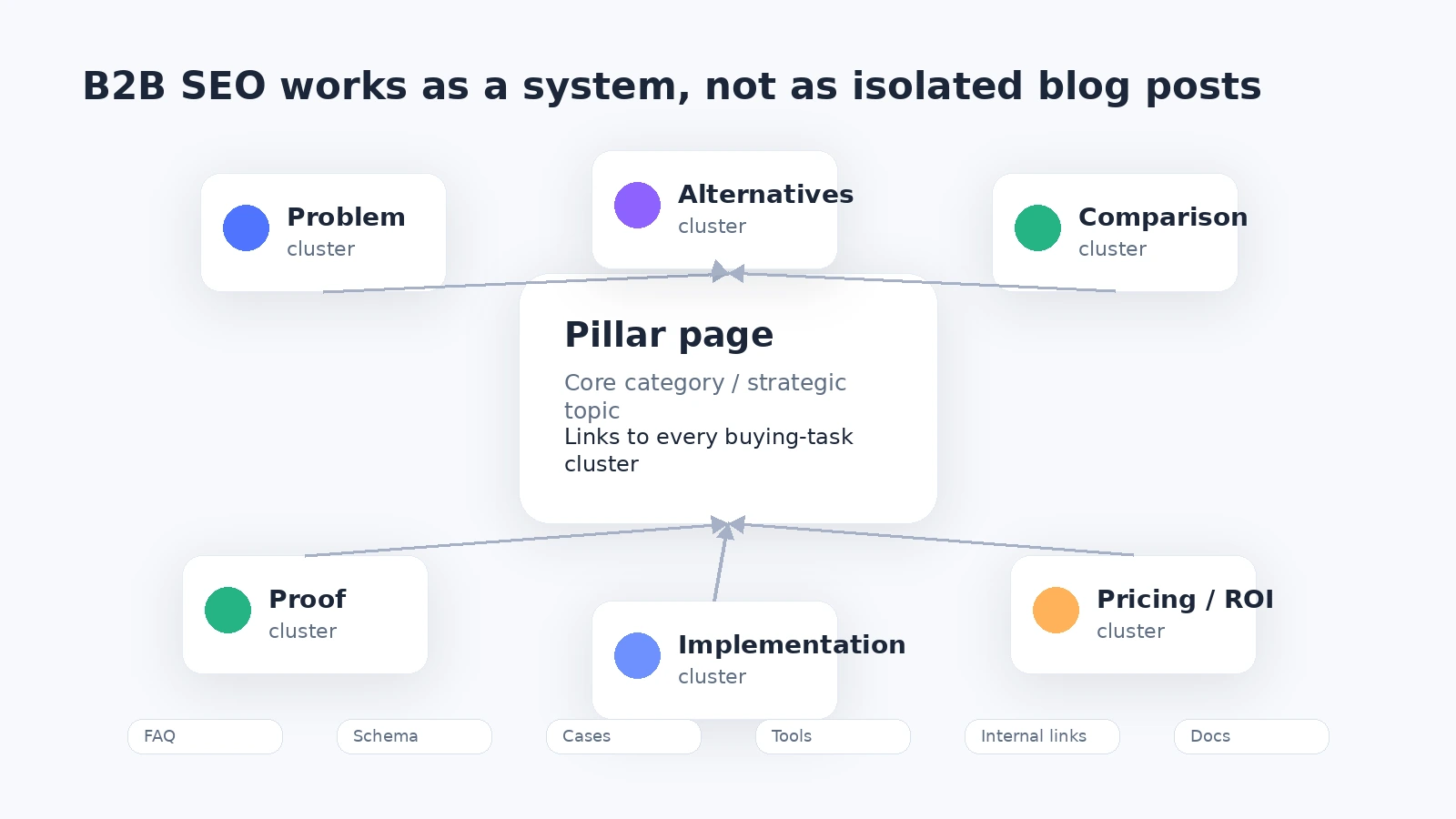
B2B SEO works best as a structured topic system.
Use the B2B SEO checklist to turn this system into an operating sequence, and the B2B SEO audit to find the constraints that should be fixed first.
Start with a strategic topic that is close to your product and important to your buyer.
Then build clusters around the buying journey.
Example structure:
Pillar topic:
B2B SEO strategy

Clusters:
- B2B SEO cost
- B2B SEO ROI
- B2B SEO vs paid search
- B2B SEO agency vs in-house
- B2B SaaS SEO benchmarks
- B2B SEO content strategy
- Technical SEO for B2B websites
- AI search and LLM visibility for B2B
- B2B SEO reporting and attribution
- SEO cost calculator
This works better than random articles because each page supports the others.
The pillar explains the category.
The cluster pages answer specific buyer questions.
The calculator converts high-intent users.
The internal links help both users and search engines understand the relationship between pages.
How AI search changes content structure
AI search rewards clarity.
For the broader discovery implications, read B2B SEO Trends: AI Search, Authority, UX, and SERP Visibility.
That does not mean you should write for robots.
It means your content should be easy for humans and machines to understand.
Use clear structure:
- answer the main question early;
- define key terms;
- use descriptive headings;
- include comparison tables where useful;
- separate facts from opinions;
- explain assumptions;
- show examples;
- include dates for time-sensitive claims;
- keep product names consistent;
- link to supporting sources;
- avoid vague claims like “best-in-class” without proof.
For AI and LLM visibility, the page should make extraction easy.
For example, instead of writing:
There are many factors that may influence the final cost depending on different circumstances.
Write:
B2B SEO cost usually depends on five factors: strategy, content production, subject-matter expert time, technical implementation, and reporting. The biggest cost driver is usually expert content production, not keyword research.
That second version is more useful to a reader.
It is also easier for an AI system to summarize accurately.
Your SEO cost calculator should be part of the SEO strategy
A calculator is not just a CRO widget.
For B2B SEO, it can become a search asset, sales asset, and AI-search asset at the same time.
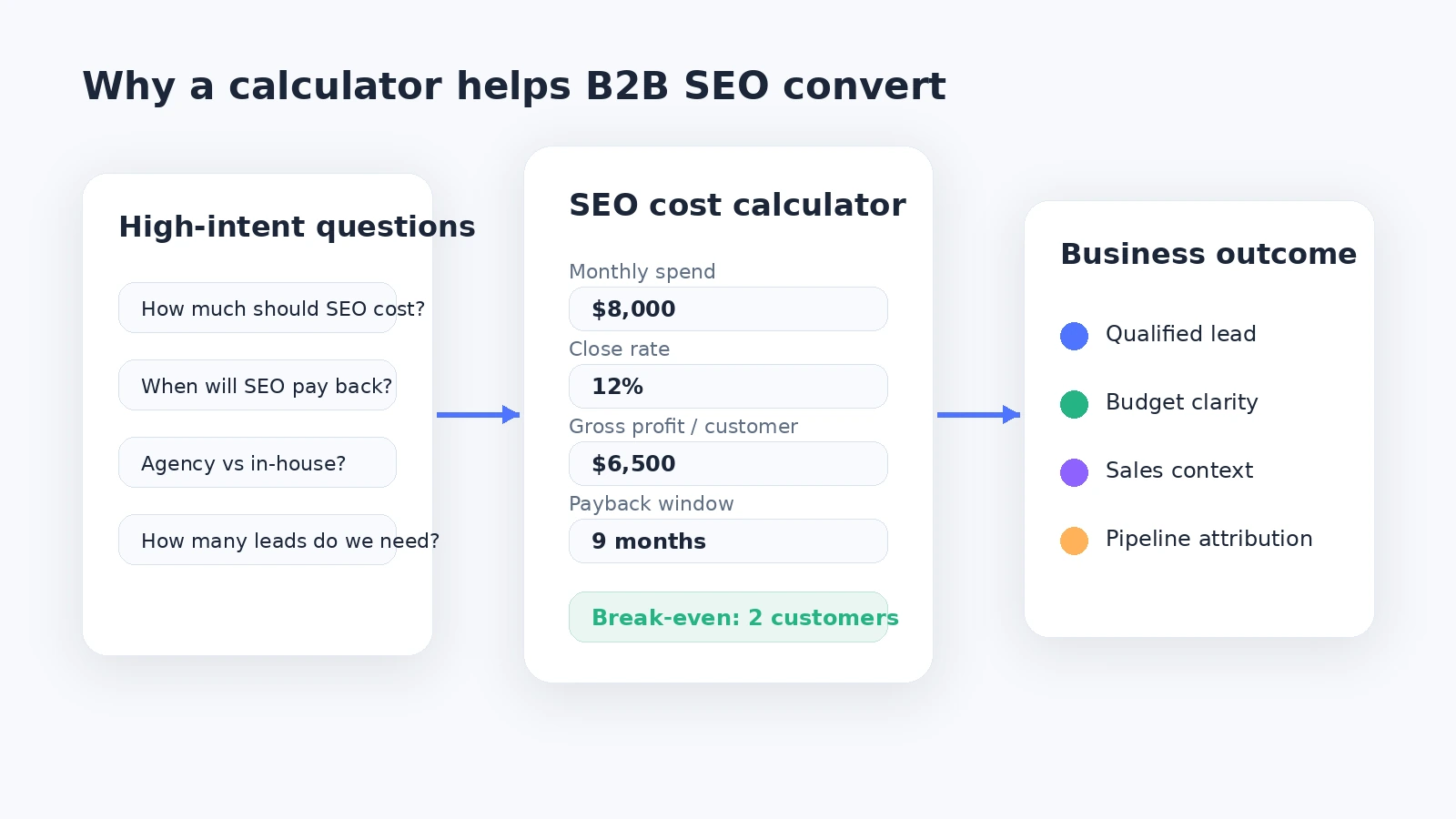
The current SEO ROI Calculator lets you test total SEO investment, customers acquired, annual revenue per customer, gross margin, churn, and discount rate. It then estimates CAC, LTV, LTV:CAC, ROI, payback, and expected customer lifetime.
A calculator model can support questions like:
- How much should we spend on SEO?
- How many leads do we need to break even?
- How many customers should SEO generate to pay back?
- What close rate is required?
- How does SEO compare with paid acquisition?
- What happens if content takes six months to rank?
- Should we hire in-house or use an agency?
That is high-intent content.
Someone asking these questions is not reading for fun.
They are trying to make a budget decision.
Your calculator page should not be a thin tool page.
It should include:
- a quick answer;
- explanation of the formula;
- editable assumptions;
- examples by company stage;
- common mistakes;
- FAQ;
- internal links to deeper guides;
- CTA to request an audit, plan, or consultation.
Simple formula:
Required customers = SEO investment / gross profit per customer during the payback window

Required leads = required customers / lead-to-customer close rate
Example:
Monthly SEO investment: $8,000
Gross profit per customer in payback window: $6,500
Close rate from qualified lead to customer: 12%

Required customers: $8,000 / $6,500 = 1.23 customers
Required qualified leads: 1.23 / 0.12 = 10.25 leads
In this example, SEO needs roughly two customers or eleven qualified leads in the payback window to make sense.
That is much more useful than saying “SEO has great ROI over time.”
Run the model: Calculate SEO CAC, LTV, payback, and ROI using your own assumptions.
How to optimize B2B SEO for AI search and LLM visibility
There is no magic LLM SEO button.
But there are practical improvements that make your site more likely to be understood, cited, and reused.
1. Make important content crawlable and indexable
If a page cannot be crawled, indexed, or shown with a snippet, it is unlikely to help you in search-led AI experiences.
Avoid hiding key content behind scripts, tabs that do not render reliably, gated PDFs, or images without text alternatives.
2. Build entity consistency
Use the same names for your company, product, category, features, and use cases across the site.
For example, do not describe the same product as:
- “AI SEO platform”;
- “organic growth software”;
- “search visibility engine”;
- “content intelligence suite”;
- “LLM traffic product”.
Unless those distinctions are intentional, inconsistent naming makes your positioning harder to understand.
3. Publish sourceable facts
AI systems need facts they can attribute.
Useful sourceable facts include:
- pricing ranges;
- product limits;
- implementation timelines;
- supported integrations;
- methodology;
- data sources;
- examples;
- case study numbers;
- benchmark assumptions.
4. Add original assets
Original assets are harder to replace with generic AI content.
Examples:
- calculators;
- templates;
- benchmarks;
- original research;
- teardown articles;
- migration checklists;
- expert commentary;
- customer examples;
- practical frameworks.
5. Use structured data carefully
Structured data is not a guarantee of rankings or AI visibility.
But it helps search engines understand page types and content when used correctly.
For many B2B sites, useful schema types may include:
- Organization;
- Product;
- SoftwareApplication;
- FAQPage;
- Article;
- BreadcrumbList;
- Review, if you have real review data;
- HowTo, where the page is genuinely instructional.
Only mark up content that is visible on the page.
6. Create pages for comparison and decision-making
AI answers often help users compare options.
If your site does not have comparison-ready content, other sources will define the comparison for you.
Create honest pages around:
- alternatives;
- competitors;
- pricing models;
- migration;
- integrations;
- use cases;
- limitations;
- best-fit and not-best-fit scenarios.
Do not make every comparison page a sales pitch.
The page should help the buyer decide.
That is what makes it credible.
What B2B SEO should not look like anymore
Avoid the weak version of SEO:
- generic AI-written posts;
- no expert review;
- no product connection;
- no internal links;
- no conversion path;
- no original examples;
- no clear author or company expertise;
- no dates on time-sensitive content;
- no point of view;
- no measurement beyond traffic.
This kind of SEO may create pages, but it does not create trust.
And in B2B, trust is the channel.
How to measure B2B SEO properly
Traffic is not enough.
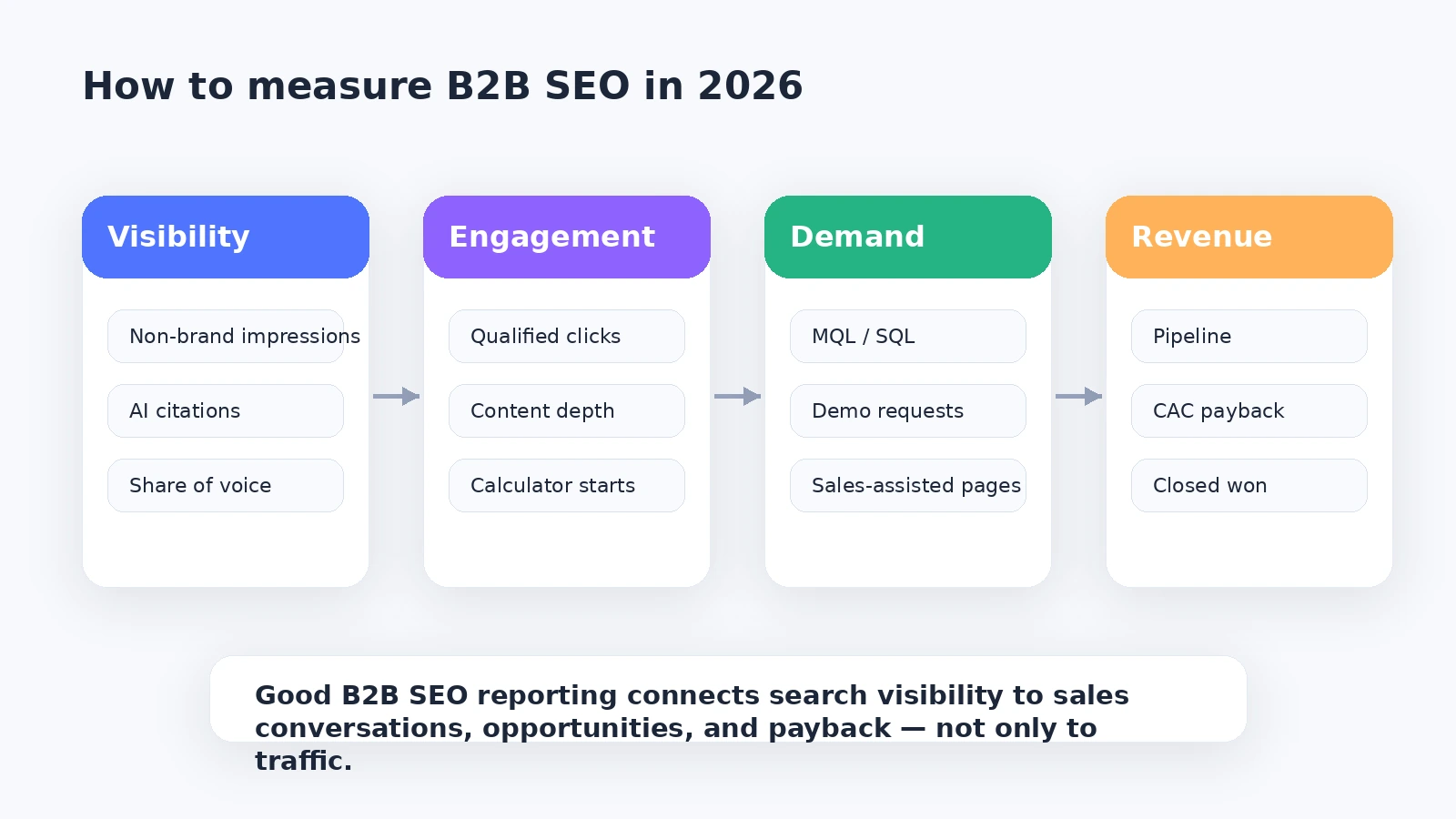
A B2B SEO report should connect visibility to business outcomes.
The B2B SEO KPI framework provides a deeper reporting hierarchy from delivery and visibility to qualified pipeline and revenue.
Use four layers.
1. Visibility metrics
Track whether your market can find you.
Useful metrics:
- non-brand impressions;
- non-brand clicks;
- rankings for strategic topics;
- visibility for comparison queries;
- share of voice;
- indexed strategic pages;
- AI answer mentions and citations, where measurable.
2. Engagement metrics
Track whether the right visitors interact with the content.
Useful metrics:
- engaged sessions;
- scroll depth;
- return visits;
- internal clicks to product or calculator pages;
- downloads;
- calculator starts;
- pricing page visits;
- documentation visits;
- time on strategic pages.
3. Demand metrics
Track whether SEO creates buying signals.
Useful metrics:
- demo requests;
- audit requests;
- trial starts;
- calculator completions;
- contact forms;
- newsletter signups from strategic pages;
- content-assisted MQLs;
- content-assisted SQLs.
4. Revenue metrics
Track whether SEO helps create pipeline and customers.
Useful metrics:
- opportunities influenced by organic pages;
- pipeline value;
- closed-won revenue;
- CAC;
- payback period;
- organic-assisted deal velocity;
- win rate for SEO-influenced deals.
This is especially important in B2B because the last click is often misleading.
A buyer may discover you through SEO, return through branded search, read a comparison page, use the calculator, and then convert from a direct visit.
If you only measure last-click form fills, SEO will look weaker than it really is.
Pros and cons of B2B SEO
Pros
B2B SEO can create durable demand.
It can reduce paid media dependency, support sales, educate buyers, improve brand credibility, and create assets that keep working after publication.
It also compounds.
A strong topic cluster can support many future pages, campaigns, sales conversations, and AI-search mentions.
Cons
B2B SEO takes time.
It requires expert input, technical quality, content maintenance, analytics, and patience.
It can also fail when companies publish too broadly, measure the wrong metrics, or create informational content with no path to pipeline.
SEO is not free.
Even if you do not pay for clicks, you pay for strategy, content, editing, design, development, tools, reporting, and subject-matter expert time.
That is why a cost and payback model matters.
A practical B2B SEO plan for 90 days
Days 1–15: clarify the commercial SEO map
Define:
- ICP;
- buying committee;
- core use cases;
- sales objections;
- highest-value topics;
- competitor comparison gaps;
- conversion paths;
- calculator assumptions;
- analytics events.
Do not start with keywords only.
Start with buying questions.
Days 16–30: audit and update existing content
Find pages that are outdated, thin, duplicated, or disconnected from conversion.
For each important page, decide whether to:
- update;
- merge;
- redirect;
- expand;
- turn into a cluster page;
- connect to the calculator;
- add expert commentary;
- add examples;
- add schema;
- improve internal links.
This article is a good example: the old version made the basic case for SEO, but it did not reflect AI search, self-service buying, LLM visibility, or pipeline measurement.
Days 31–60: build the first strategic cluster
Pick one cluster close to revenue.
For example:
B2B SEO cost cluster

- How much does B2B SEO cost?
- SEO cost calculator
- B2B SEO ROI model
- SEO agency vs in-house team
- How many leads does SEO need to pay back?
- SEO vs paid search for B2B acquisition
- B2B SEO budget planning template
Every page should link naturally to the calculator.
The calculator should link back to the educational pages.
Days 61–90: improve distribution and measurement
SEO content should not wait passively for Google.
Use it in:
- sales follow-ups;
- founder LinkedIn posts;
- newsletters;
- partner content;
- onboarding sequences;
- remarketing;
- webinars;
- community answers;
- internal sales enablement.
Then measure assisted impact, not only organic sessions.
So, do you really need SEO in B2B?
You need B2B SEO if buyers research your category before they buy.
You need it if your sales team needs better educational assets.
You need it if AI search results should mention your brand, not only your competitors.
You need it if your product requires trust, comparison, budget justification, or implementation confidence.
But you do not need random SEO.
You need a system:
- clear ICP;
- strategic topic clusters;
- expert content;
- comparison and decision pages;
- technical SEO hygiene;
- internal links;
- structured data;
- conversion assets;
- calculator-based ROI paths;
- pipeline reporting;
- regular content maintenance.
B2B SEO is not just a way to get more traffic.
Done well, it becomes the public knowledge base that helps buyers understand the market, trust your point of view, justify the investment, and move closer to a sales conversation.
FAQ
Is SEO still worth it for B2B companies?
Yes, SEO is still worth it for many B2B companies, especially when buyers research problems, compare vendors, calculate ROI, or look for implementation details before talking to sales. It is less useful when there is no search demand, no clear ICP, no useful expertise to publish, or no way to connect organic demand to pipeline.
How has B2B SEO changed because of AI search and LLMs?
B2B SEO now has to serve both humans and AI-mediated discovery. Content should still be crawlable, indexable, useful, and trustworthy, but it also needs clear answers, comparison logic, sourceable facts, consistent entity information, and pages that AI systems can cite or summarize.
Does AI search replace SEO?
No. AI search changes how discovery happens, but it still relies on accessible web content, useful sources, and clear information architecture. SEO becomes less about isolated keyword rankings and more about being discoverable, quotable, comparable, and trusted across search and AI-assisted research journeys.
When should a B2B company not invest heavily in SEO?
A B2B company should be careful with SEO when it needs revenue immediately, sells only to a small named-account list, has no repeatable ICP, cannot produce expert content, or has not built a conversion path from content to demo, audit, calculator, trial, or sales conversation.
What should B2B SEO be measured by?
B2B SEO should be measured by a chain of metrics: non-brand visibility, qualified organic traffic, engagement with strategic pages, calculator or demo usage, MQLs, SQLs, opportunities, pipeline value, closed revenue, CAC, and payback period.
What role does an SEO cost calculator play in B2B SEO?
An SEO cost calculator is a strong bottom-of-funnel asset. It helps buyers examine budget, customer acquisition, payback, and ROI assumptions. It can also turn informational SEO traffic into a measurable conversion path.
Related guides and tools
- SEO ROI Calculator
- B2B SEO Audit
- B2B SEO Checklist
- B2B SEO KPIs
- How to Choose a B2B SEO Partner
- Technical SEO for B2B Websites
- B2B SEO Trends
- B2B SEO Case Study