How Social Distribution Supports B2B SEO
Quick answer
Social distribution supports B2B SEO by helping useful expertise reach the people who can use it, discuss it, cite it, link to it, remember it, or act on it.
It is not a shortcut where likes and shares automatically turn into higher rankings.
It is a distribution layer that can strengthen the surrounding system:
- more relevant people see important owned content;
- specialists ask better follow-up questions;
- partners and employees have better material to share;
- journalists, analysts, and community members can discover linkable assets;
- buyers return directly or search for the brand later;
- sales teams can use the content in real conversations;
- the content roadmap improves because the market reacts.
The best B2B social strategy is not “post everywhere.”
It is:
Publish evidence on an owned page, adapt the useful insight to the right channel, join the conversation, learn from the response, and connect the journey back to business outcomes.
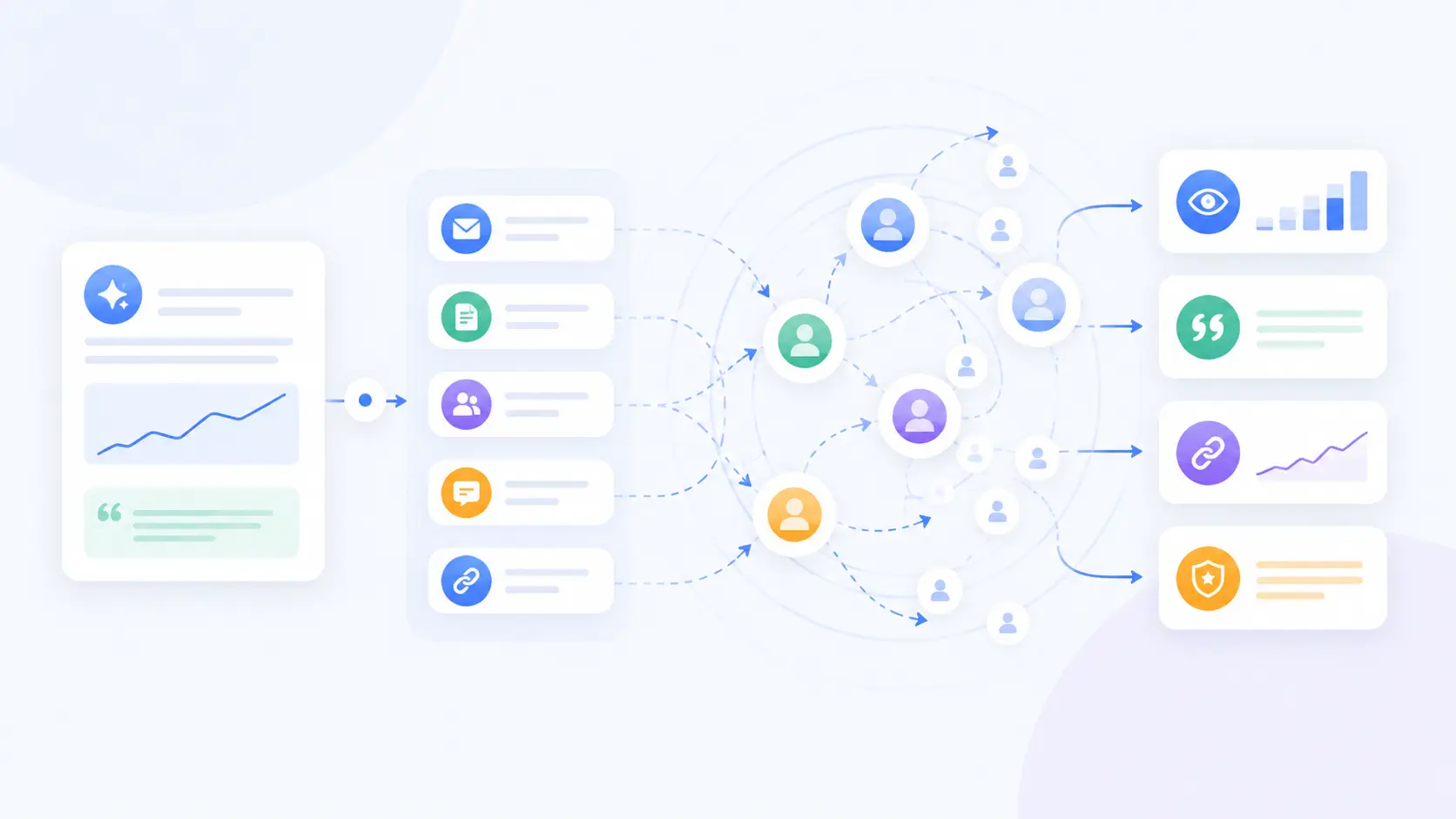
Social distribution is not a ranking shortcut
A weak version of social SEO says:
Get more likes and shares so rankings improve.
That is the wrong frame.
For B2B companies, social distribution should not be treated as a direct ranking lever. A post can get engagement without creating search demand, qualified traffic, links, leads, or revenue. A post can also get almost no visible engagement and still reach the exact buyer, partner, journalist, or internal champion who matters.
The better question is not:
Did this post get reactions?
The better question is:
Did this distribution help the right market discover, trust, remember, cite, or use the source asset?
That distinction matters because B2B SEO usually depends on several slow-moving inputs:
- technical accessibility;
- topical coverage;
- useful owned assets;
- internal linking;
- external references;
- brand recognition;
- conversion quality;
- sales follow-up;
- long buying cycles.
Social distribution helps when it makes one or more of these inputs stronger.
It fails when it becomes a disconnected posting calendar.
Related guide: B2B SEO KPIs: Measure Pipeline and Revenue, Not Rankings
Search creates discovery; social creates reach and conversation
Search and social solve different parts of the B2B buying journey.
Search is strong when someone already has a question, a problem, a comparison, or an implementation need. It captures demand and creates self-directed discovery.
Social is strong when the market is not yet searching, does not know what to search, or needs repeated exposure before a problem becomes urgent.
A buyer may first see a specialist observation on LinkedIn. A technical evaluator may later search for the category. A manager may remember a benchmark shared by a colleague. A partner may cite the company’s framework in a webinar. A sales rep may use the original page in a follow-up email.
No single touchpoint “caused” the deal.
Together, they shaped familiarity and trust.
That is why social distribution belongs inside a broader B2B SEO checklist rather than inside a vanity-metric social report.
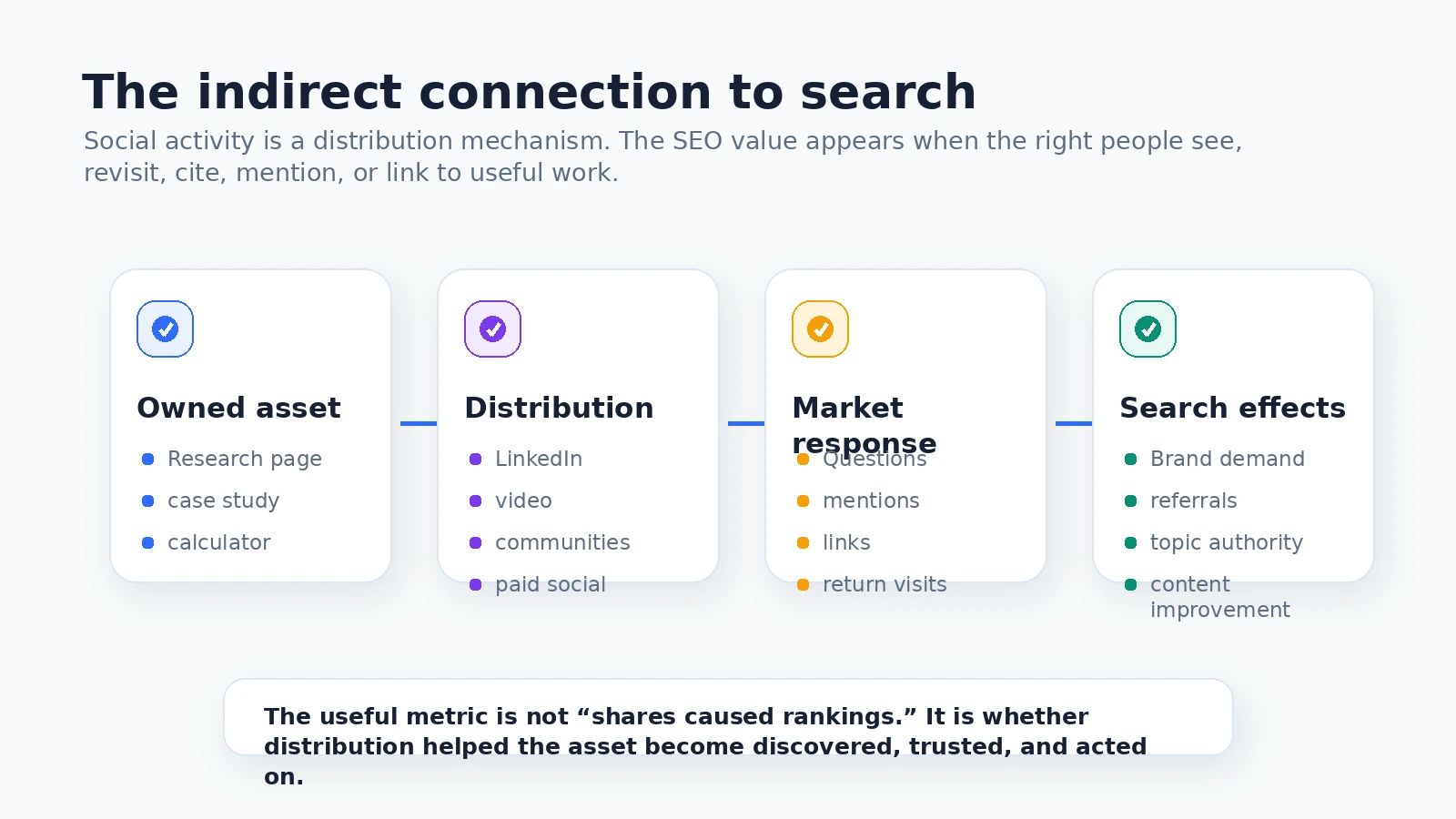
The indirect connection to search
Social distribution can support organic growth by:
- introducing new research to potential linkers;
- increasing branded searches and direct return visits;
- helping experts become associated with a topic;
- collecting questions that improve future content;
- creating referral traffic to strategic pages;
- giving sales teams useful material to share;
- exposing decision-stage assets to people who were not searching yet;
- creating more reasons for partners and employees to talk about the brand;
- improving the language used on SEO pages through market feedback.
This is a distribution mechanism, not proof of a ranking factor.
A useful post can lead to a conversation. A conversation can reveal a better objection. That objection can become a stronger section in a guide. A stronger guide can convert better, earn links more naturally, and become more useful in search.
The SEO benefit is not the social metric itself.
The benefit is the improved market reach and learning loop around the source asset.
Social distribution and AI search visibility
AI search adds another reason to take distribution seriously, but it does not change the fundamentals.
B2B buyers are increasingly using AI assistants, AI search, and conversational research tools to summarize categories, compare vendors, and prepare questions before speaking to sales. That makes the visible evidence around a company more important.
Social distribution can help indirectly by making evidence travel:
- expert commentary becomes easier to associate with a topic;
- research assets are discovered by people who may cite them elsewhere;
- partners and employees repeat consistent language about the company;
- public discussions reveal questions that need clearer answers on owned pages;
- off-site mentions can reinforce that the company exists in a real professional network.
But do not overclaim this.
A social post does not guarantee that an AI system will cite your page.
A better goal is to make your important pages and claims easier to verify:
- clear page titles and summaries;
- specific claims supported by evidence;
- visible authorship or expert contribution where relevant;
- consistent product, category, and use-case language;
- internal links to proof pages;
- external references from relevant market sources;
- transcripts or summaries for video-based content;
- pages that are crawlable, indexable, and useful without relying only on visual assets.
That is the overlap between social distribution, B2B link building, and AI-search readiness.
The goal is not “AI hacks.”
The goal is to make expertise easier for humans and machines to find, interpret, and verify.
Choose channels by audience behavior
A B2B company does not need to be active on every platform.
It needs to understand where the relevant market already exchanges information.
The channel choice should follow the audience, the content type, and the commercial objective.
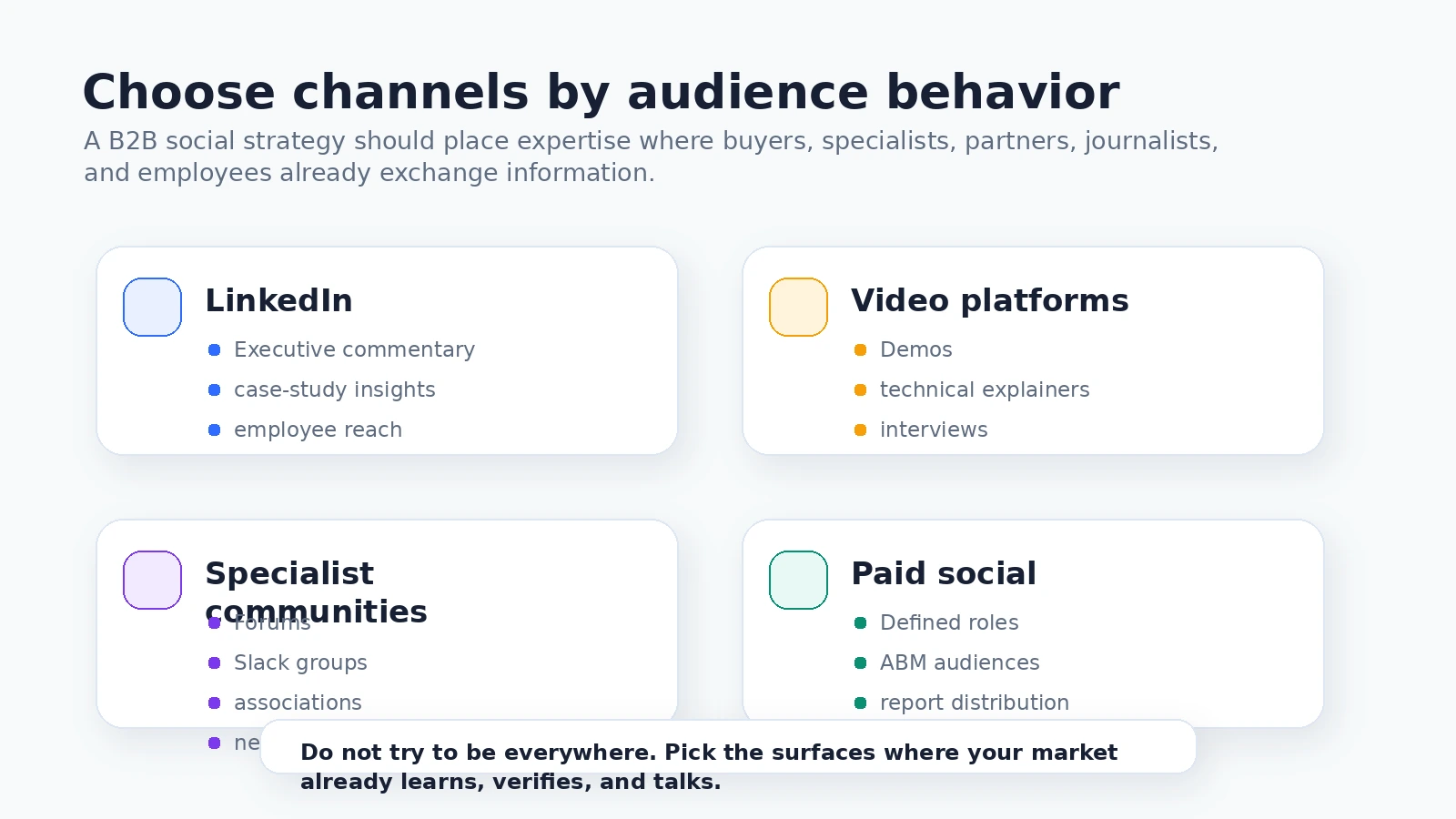
LinkedIn is often useful for professional commentary, executive perspective, case-study insights, partner posts, employee advocacy, and short observations from a larger owned asset.
It works best when the post contains a useful idea before the click.
Weak LinkedIn distribution says:
We published a new article. Read it here.
Stronger LinkedIn distribution says:
Here is the problem we keep seeing in the market. Here is the pattern. Here is the implication. The full breakdown is on the source page.
Good LinkedIn posts can support B2B SEO by:
- making subject-matter experts more visible;
- increasing return visits from known audiences;
- helping partners and employees share the same point of view;
- testing which positioning lines create useful discussion;
- driving qualified traffic to strategic pages;
- surfacing objections that should be added to the article.
LinkedIn is especially useful for content connected to brand positioning through B2B SEO.
YouTube and video platforms
Video is useful when the topic benefits from demonstration or explanation.
Examples:
- product walkthroughs;
- technical implementation guides;
- feature explanations;
- executive interviews;
- customer stories;
- conference talks;
- teardown-style educational content;
- comparison walkthroughs.
Video can reach a discovery surface that written search content may not reach.
It can also strengthen a related page when embedded with:
- a clear title;
- a short summary;
- transcript or key points;
- related links;
- next steps;
- supporting screenshots or diagrams;
- a reason to continue to the owned page.
Do not publish a video and leave the website empty.
The owned page should remain the durable source asset.
Specialist communities
Specialist communities may be small, but they can be commercially important.
Examples include:
- industry forums;
- Slack or Discord groups;
- professional associations;
- niche newsletters;
- partner communities;
- developer communities;
- analyst or practitioner groups;
- event communities.
The rule is simple:
Participate with expertise before dropping links.
A community does not exist to distribute your content.
It exists because people exchange problems, opinions, examples, and experience. A company earns the right to share source assets by being useful in that context.
This can support SEO because specialist communities often reveal the language, objections, and edge cases that do not appear in keyword tools.
Those insights can improve future pages.
Paid social
Paid social is useful when the organic audience is too small or too slow to reach the right segment.
For B2B SEO, paid distribution can be useful for:
- promoting a report;
- testing positioning;
- driving traffic to a comparison page;
- distributing a webinar;
- supporting an account-based marketing program;
- exposing a calculator or diagnostic tool to a defined role;
- retargeting visitors who consumed educational content.
Paid social should not be judged only by cheap clicks.
The question is whether it helps the right audience reach the right source asset and take a meaningful next step.
For example, an SEO ROI calculator can be a better paid-social destination than a generic blog post when the audience is already evaluating investment, CAC, LTV, ROI, or payback.
Turn one research asset into a distribution system
A strong B2B source asset should not be published once and forgotten.
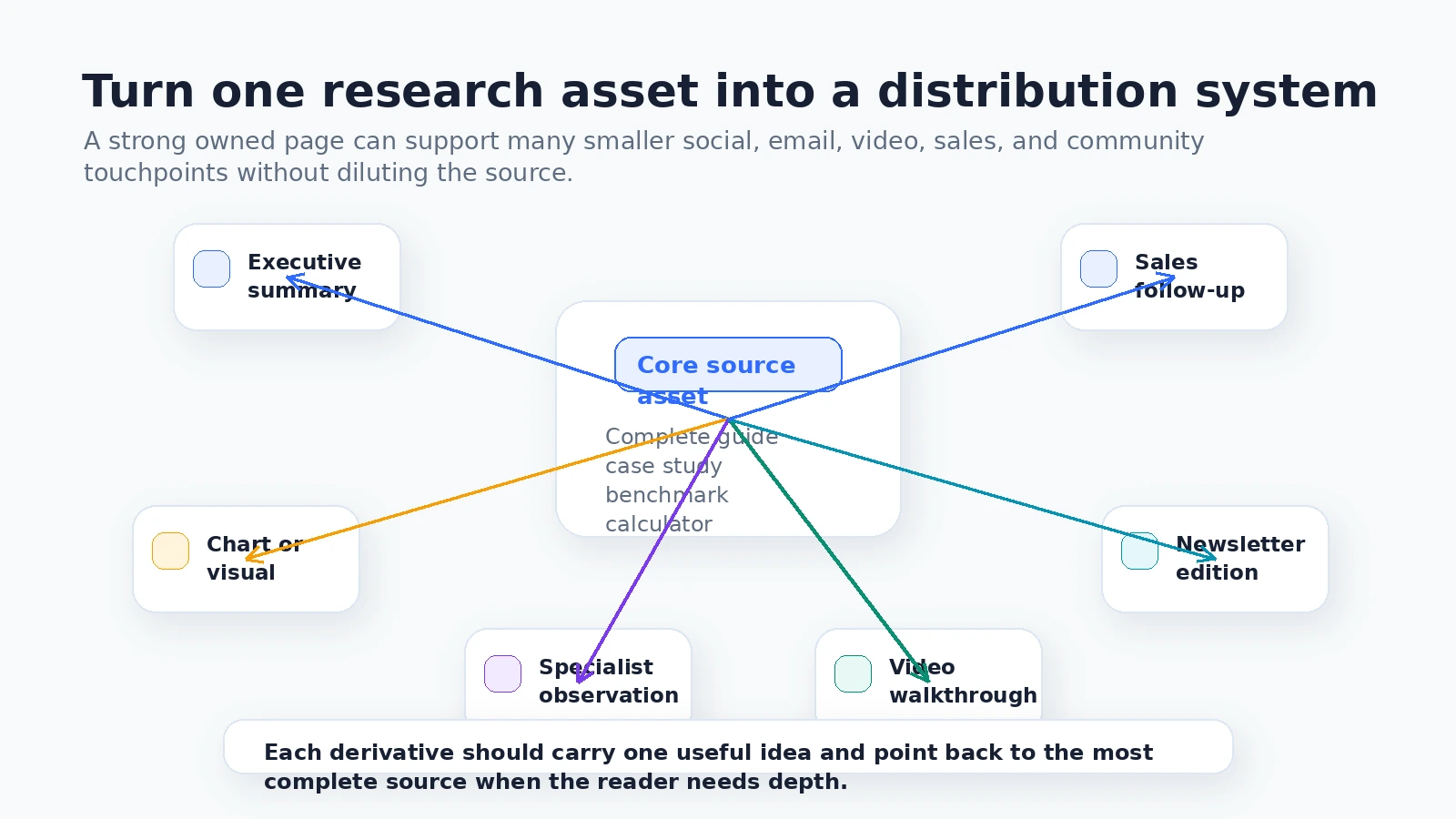
A substantial case study, guide, benchmark, calculator, or framework can become:
- a short executive summary;
- a chart or visual explanation;
- several specialist observations;
- a video walkthrough;
- a newsletter edition;
- a sales follow-up resource;
- answers to recurring community questions;
- partner enablement material;
- an event talk;
- a comparison post;
- an internal training note.
Each derivative should do one job.
It should not be a thin duplicate of the source page.
The source page contains the full answer. The distributed pieces carry useful ideas into the channels where people already spend attention.
The full B2B SEO case study is the kind of source asset that can support many smaller discussions:
- what changed technically;
- which pages were added;
- how internal linking changed;
- what happened to traffic;
- what happened to leads;
- what the commercial measurement showed;
- which assumptions were validated or rejected.
That is stronger than one announcement post saying “we published a case study.”
Adapt content to the channel without losing the source
Repurposing does not mean copying the same text everywhere.
Each channel has a different job.
A source page should be complete.
A social post should be focused.
A video should explain or demonstrate.
A community answer should solve the immediate question.
A sales follow-up should connect the asset to the buyer’s context.
A newsletter should give continuity and a reason to return.
Example:
| Source asset | Social angle | Audience | Next step |
|---|---|---|---|
| Technical SEO audit guide | “The audit finding that usually matters is not the loudest warning in the tool.” | SEO, growth, technical leads | Read the audit framework |
| B2B SEO KPI guide | “Average ranking is a weak KPI when the buying journey is multi-touch.” | Marketing leaders, growth teams | Use the KPI tree |
| B2B link-building guide | “A relevant association profile can beat a random high-DR placement.” | SEO, PR, partnerships | Run a relationship audit |
| SEO cost calculator | “SEO budget decisions should include payback and implementation cost, not only content volume.” | Founders, CMOs, growth leads | Calculate the cost model |
This keeps distribution connected to the owned asset while avoiding repetitive promotion.
Connect social, brand, and authority
Social distribution is strongest when the message reinforces the company’s positioning.
If each post sounds like a different company, distribution creates noise.
If the content repeatedly connects the same market problems to the same point of view, the brand becomes easier to understand.
That matters in B2B because buyers rarely decide after one touch.
They may see:
- a specialist post;
- a category page;
- a comparison guide;
- a case study;
- a webinar clip;
- a sales deck;
- a partner mention;
- a calculator;
- a customer story.
These touchpoints should not contradict each other.
The same positioning should appear across:
- SEO pages;
- product pages;
- executive communication;
- social posts;
- sales enablement;
- webinar narratives;
- partner content;
- email sequences.
This is why social distribution belongs next to the brand positioning guide, not only next to the social media calendar.
Connect social and link building
Social distribution also supports authority building.
Not because every post creates a backlink.
Because important content cannot earn links, citations, or references if the people who might cite it never see it.
A useful source page may need to reach:
- journalists;
- analysts;
- partners;
- consultants;
- operators;
- industry newsletter writers;
- conference organizers;
- community moderators;
- technical experts;
- customers with public audiences.
Social distribution can help introduce the work to those people.
Then link building becomes more natural:
- Publish useful evidence.
- Put it in front of relevant people.
- Join the discussion.
- Build relationships around the topic.
- Earn references where the source genuinely helps the reader.
That is different from buying placements or publishing generic guest posts.
Related guide: B2B Link Building: Authority, Referrals, and Market Evidence
Use email for continuity and social for reach
Email and social distribution are complementary.
Email is usually stronger for continuity with an owned audience.
Social is usually stronger for reach, conversation, employee advocacy, community discovery, and exposure to people who do not yet know the brand.
A strong B2B distribution system uses both:
- publish the complete source asset on the website;
- send the useful version to the right email segment;
- adapt the core insight for social;
- give sales and customer-facing teams a short version;
- share the asset with relevant partners or communities;
- collect questions;
- improve the source page.
Related guide: How Email Supports B2B SEO and Demand Capture
Measure useful outcomes
Social reports often over-focus on reactions.
Reactions are not useless, but they are weak as final metrics.
For B2B SEO, measure whether social distribution helps the content system move forward.
Track:
- referral visits to strategic pages;
- engaged visits from relevant sources;
- demo requests, form fills, calculator usage, or other qualified actions;
- new brand mentions;
- earned links;
- growth in branded search;
- direct return visits after distribution;
- content-assisted opportunities;
- qualified conversations with buyers, partners, or journalists;
- sales conversations that reference published content;
- questions that influence the content roadmap;
- visibility changes in supported topic clusters;
- AI-search visibility where reliable reporting is available.
Put these indicators inside the broader B2B SEO KPI model.
Social metrics are leading indicators unless they connect to discovery, authority, conversion, or commercial progress.
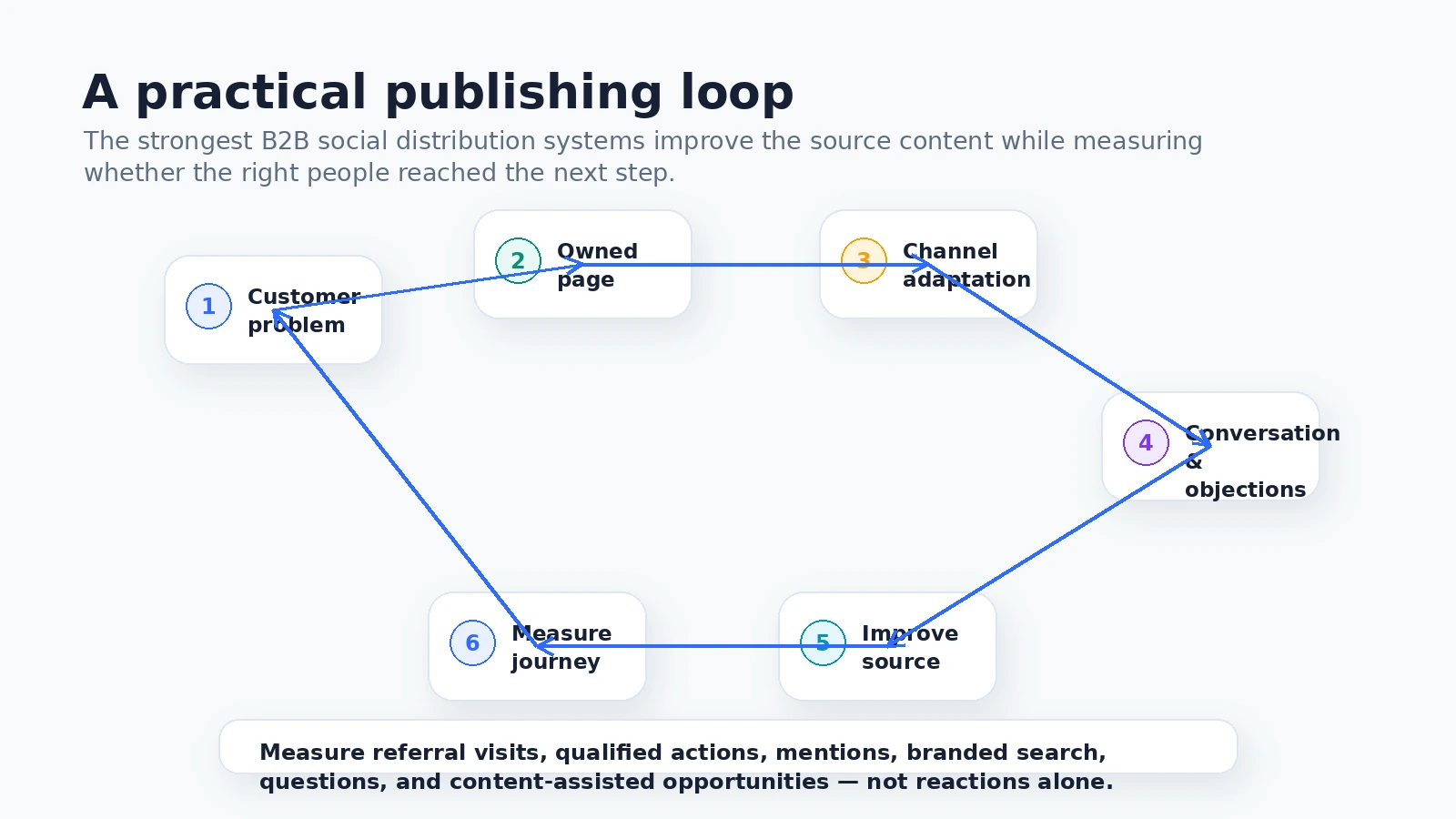
A practical publishing loop
Use this workflow for important B2B content.
1. Start with a customer problem
Do not start with a platform.
Start with a problem that matters commercially.
Examples:
- a recurring sales objection;
- a technical implementation barrier;
- a pricing or budget question;
- a comparison buyers keep asking for;
- a category misconception;
- a risk that slows procurement;
- a problem that appears in support conversations;
- a topic where the company has a strong point of view.
2. Publish the complete answer on an owned page
The owned page is the durable asset.
It should include:
- the direct answer;
- context;
- examples;
- tradeoffs;
- proof;
- internal links;
- a relevant next step;
- current information;
- clear sections that can be cited or summarized.
This is the asset search engines, AI systems, buyers, and sales teams can return to.
3. Adapt the core insight to the selected channel
Choose the channel based on audience behavior.
Do not distribute every page the same way.
A technical guide may need a community discussion.
A benchmark may need a chart.
A product comparison may need a short executive summary.
A calculator may need a direct paid-social or newsletter push.
A case study may need several posts for different audiences.
4. Join the resulting conversation
Distribution does not end when the post goes live.
The useful material often appears in the replies:
- objections;
- alternative examples;
- missing use cases;
- misunderstood claims;
- buyer language;
- competitor comparisons;
- requests for more detail.
Those responses can improve both content and positioning.
5. Capture objections and follow-up questions
Create a simple feedback loop.
For each important distributed asset, collect:
- repeated questions;
- new objections;
- strong phrases from the market;
- misunderstood sections;
- requests for examples;
- new internal-link opportunities;
- possible follow-up articles;
- sales enablement needs.
This turns social from a broadcast channel into a learning system.
6. Improve the source content
Update the page based on what the market revealed.
This may mean adding:
- a clearer summary;
- a stronger example;
- a missing comparison;
- a FAQ;
- a diagram;
- a proof point;
- a calculator CTA;
- a link to a case study;
- a stronger next step.
The page becomes more useful each time the company learns.
7. Measure whether the right people reached the next step
For each distributed asset, ask:
- Did the right audience see it?
- Did qualified visitors reach the source page?
- Did visitors take a useful next step?
- Did the content create relevant conversations?
- Did it generate mentions or links?
- Did branded search or direct return behavior change?
- Did sales use the asset?
- Did the page improve after the distribution cycle?
This is much better than reporting only impressions and likes.
Common failure modes
Avoid these patterns:
- posting every article with the same generic announcement;
- chasing reactions from the wrong audience;
- distributing content that has no strong source page;
- treating social as separate from SEO, sales, and brand;
- posting thought leadership that contradicts product positioning;
- measuring only likes, shares, and follower growth;
- dropping links into communities without participating;
- sending all content to every audience segment;
- turning every post into a demo pitch;
- ignoring questions and objections from the market;
- failing to update the original article after distribution;
- expecting social engagement to directly cause rankings.
A social program that never improves owned content is only a broadcast habit.
A social program that feeds better pages, better positioning, stronger authority, and clearer sales conversations can support B2B SEO.
A 90-day social distribution plan for B2B SEO
Use a focused sprint instead of trying to post everything everywhere.
Days 1–15: choose the source assets
Pick 3–5 strategic pages.
Prioritize assets that support:
- priority product or service pages;
- high-value topic clusters;
- comparison or alternative searches;
- case studies;
- technical guides;
- calculators or templates;
- sales objections;
- partner enablement;
- content that deserves links.
Document the intended audience, distribution angle, and next step for each asset.
Days 16–30: map the channels and segments
For each asset, choose the right distribution surface.
Examples:
- LinkedIn for executive or specialist commentary;
- video for explanations and demos;
- email for owned-audience continuity;
- communities for practitioner discussion;
- paid social for precise role or account targeting;
- sales enablement for active opportunities;
- partner distribution for shared audiences.
Do not use every channel by default.
Days 31–60: publish and distribute
For each asset, create several derivative pieces:
- one core post;
- one specialist insight;
- one visual or chart;
- one sales-friendly summary;
- one email or newsletter version;
- one community-safe answer if relevant;
- one internal note for customer-facing teams.
Keep each piece useful on its own.
Days 61–75: capture market feedback
Review:
- questions;
- objections;
- comments;
- sales feedback;
- referral traffic;
- conversion behavior;
- mentions;
- link opportunities;
- search query changes;
- content gaps.
Separate noise from useful learning.
Days 76–90: update the source pages and report the system
Improve the original pages.
Then report:
- what was distributed;
- who it reached;
- which pages received qualified visits;
- which conversations or opportunities appeared;
- which pages were improved;
- which mentions or links were earned;
- which assumptions should be tested next.
This connects social distribution to the monthly SEO learning cycle.
Summary checklist
Use this checklist before distributing an important B2B SEO asset:
- The source page answers a real customer problem.
- The page has a clear audience and next step.
- The claim is supported by proof, examples, or experience.
- The channel matches the audience behavior.
- The post contains a useful idea before the click.
- The distributed piece does not distort the source page.
- Sales and customer-facing teams know how to use it.
- Email and social roles are separated clearly.
- Community participation is helpful, not spammy.
- Measurement includes referral quality and downstream action.
- Questions and objections will be captured.
- The source page will be updated after the cycle.
FAQ
Does social media directly improve SEO rankings?
Social likes, shares, and comments should not be treated as direct ranking shortcuts. Social distribution supports B2B SEO indirectly by helping useful content reach people who may revisit, cite, link to, discuss, or search for the brand later.
How does social distribution support B2B SEO?
It introduces evidence-rich content to buyers, specialists, partners, journalists, and employees. That can create referral traffic, branded searches, expert conversations, content feedback, earned links, and better distribution for strategic pages.
Which social channels work best for B2B SEO?
The best channels depend on where the target market already exchanges information. LinkedIn, video platforms, specialist communities, newsletters, events, and paid social can all work when they are connected to a useful owned source asset.
How should B2B companies measure social distribution for SEO?
Measure referral visits to strategic pages, engaged visits, qualified conversions, branded search growth, earned mentions, relevant links, content-assisted opportunities, and questions that improve the content roadmap.
Does social distribution help AI search or LLM visibility?
It can help indirectly by spreading evidence-rich content, expert perspectives, consistent brand language, and third-party references. It does not guarantee AI citations, but it can make useful sources easier for the market to discover, cite, and verify.
Should every B2B article be promoted on social media?
No. Prioritize articles, case studies, benchmarks, calculators, comparisons, and frameworks that support strategic topics, commercial pages, or customer questions. Some pages need distribution; others only need internal linking and maintenance.
How are email and social distribution different for B2B SEO?
Email is stronger for continuity with an owned audience. Social is stronger for reach, conversation, employee advocacy, community discovery, and exposure to people who do not yet know the brand.
Conclusion
Social distribution supports B2B SEO by making expertise visible to the people who can use, discuss, remember, or reference it.
It is not a direct ranking shortcut.
It works when it is connected to a strong source asset, a clear brand position, relevant channels, useful conversations, and a measurable customer journey.
That is how a post becomes more than a post.
It becomes a way to move knowledge from the website into the market, and market feedback back into the website.
Questions about a B2B growth system? Contact me via LinkedIn, Telegram, or email.