Brand Positioning Through B2B SEO
Quick answer
B2B SEO is not only a traffic channel.
It is also a positioning system.
Every page that appears for a technical question, category query, comparison, implementation problem, or pricing concern teaches the market what the company understands and where it belongs.
A coherent B2B SEO program can help a brand become associated with:
- a specific customer problem;
- a specific product category;
- a clear point of view;
- visible expertise;
- credible proof;
- a practical next step.
That matters even when the first search does not convert.
In B2B, a buyer may discover a company through one article, return later through a comparison query, send a case study to a colleague, ask an AI tool to compare options, and only then book a call.
The job of SEO is not just to make the brand visible. It is to make the brand understandable and memorable across that journey.
Difference in one sentence: SEO captures demand when buyers search for a solution, but it shapes positioning when every search-visible page reinforces the same market territory, expertise, and proof.

SEO is not only a distribution channel
Search is often treated as a distribution channel:
- choose keywords;
- publish pages;
- collect traffic;
- report rankings and conversions.
That view is too narrow for B2B.
In a complex buying journey, search is also part of the brand experience.
A company can appear when a prospect searches for:
- a problem they are trying to understand;
- a technical requirement;
- a category name;
- a competitor alternative;
- a pricing question;
- an implementation risk;
- a migration path;
- a checklist;
- a case study;
- a calculator;
- a vendor comparison.
Each appearance can either clarify the brand or make it feel generic.
This is why B2B SEO should not be separated from positioning, messaging, product marketing, sales enablement, and proof.
A page that ranks but says nothing distinct may generate traffic. It will not build much memory.
A page that explains a hard problem with evidence, constraints, and a strong point of view can become a positioning asset.
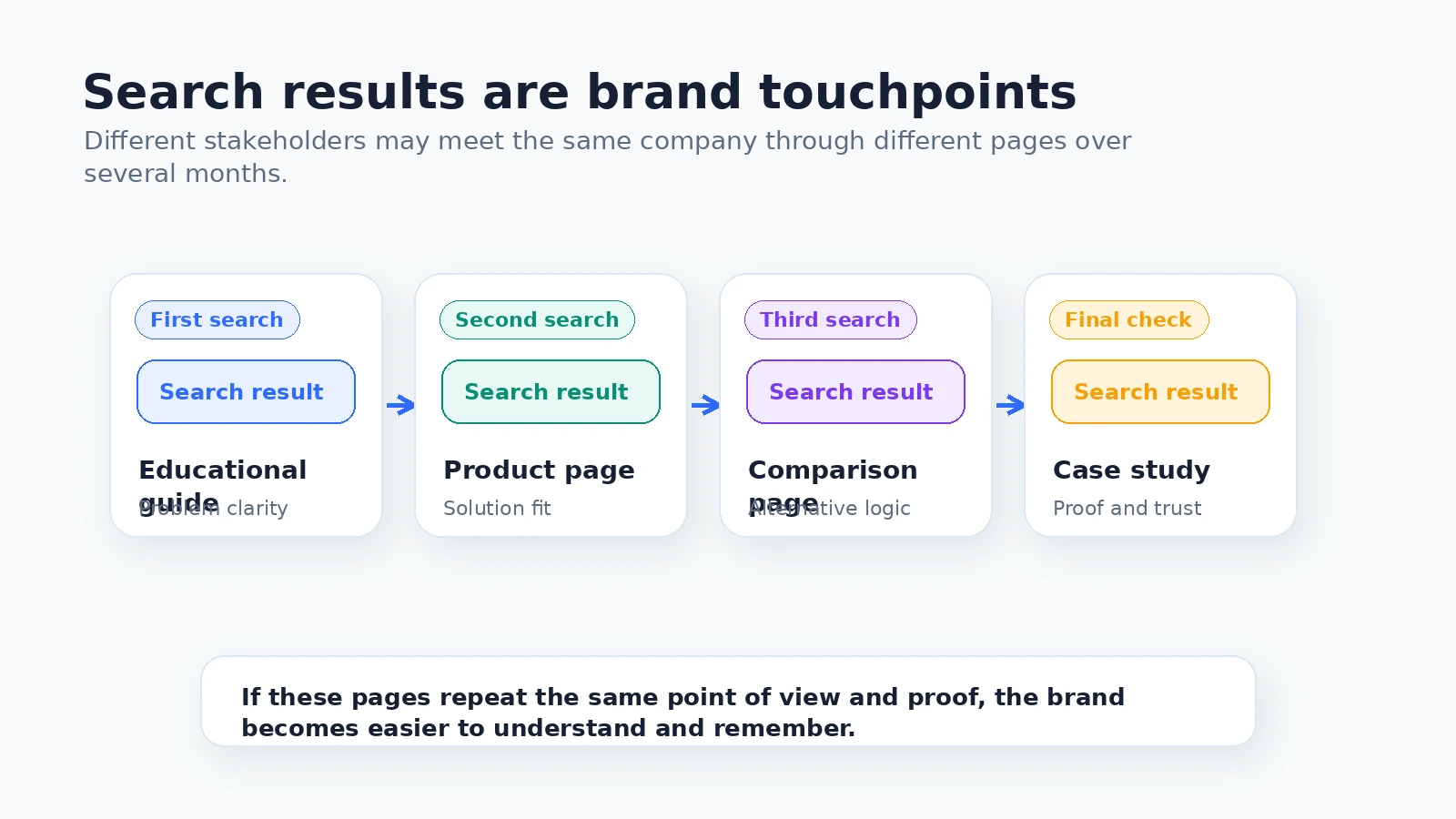
Search results are brand touchpoints
A buyer rarely sees a B2B brand once and immediately converts.
The same account may encounter the company through several searches over weeks or months:
- a technical buyer finds an implementation guide;
- a commercial buyer finds a cost comparison;
- a manager finds a case study;
- an analyst asks an AI search system for options;
- a founder searches for the brand name later;
- a sales conversation references a published framework.
Together, these pages create an impression of the company.
If the messages contradict each other, the brand feels unfocused.
If they consistently connect a specific problem to a specific point of view and credible proof, the brand becomes easier to remember.
What each search touchpoint teaches
Every important page should answer a positioning question.
| Search touchpoint | What the buyer is trying to understand | What the brand should prove |
|---|---|---|
| Educational guide | “Do they understand my problem?” | Problem expertise |
| Category page | “Do they belong in this market?” | Category fit |
| Use-case page | “Is this relevant to my situation?” | Segment relevance |
| Comparison page | “Why this option instead of another?” | Differentiation |
| Case study | “Has this worked before?” | Evidence |
| Calculator or template | “What does this mean for my business?” | Practical value |
| Technical resource | “Can they support implementation?” | Operational competence |
This is why a B2B content library should not be a pile of disconnected articles.
It should behave like a distributed brand narrative.
Define the territory the brand should own
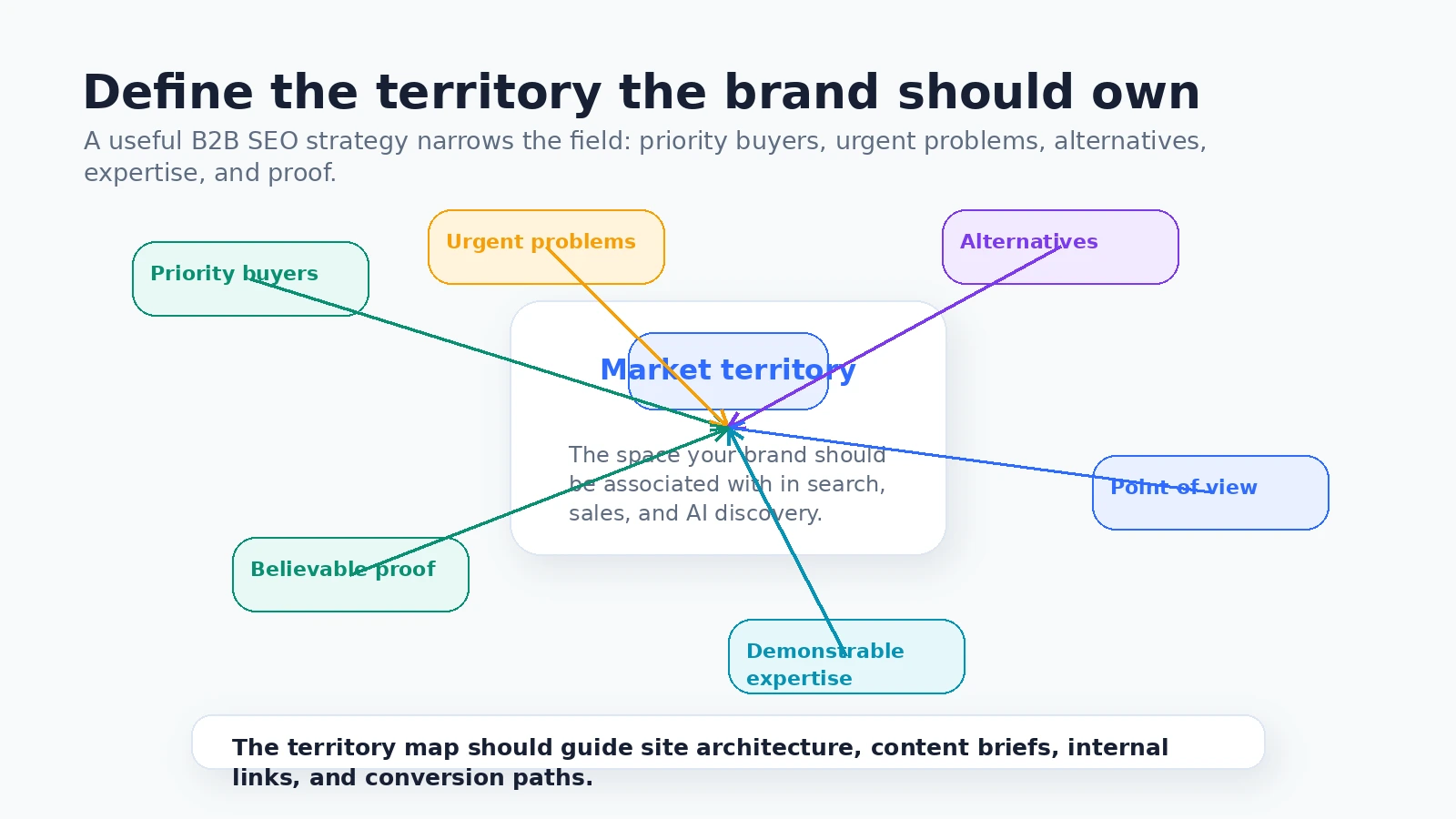
Brand positioning through SEO starts with a territory decision.
The question is not:
“Which keywords can we rank for?”
The better question is:
“Which market problems should buyers associate with our brand?”
That answer should be narrower than everything the product can technically do.
A useful positioning map includes:
- the customer groups that matter most;
- the urgent or expensive problems they face;
- the language they use for the category;
- the alternatives they compare;
- the expertise the company can demonstrate;
- the proof that makes the claim believable;
- the pages and tools that turn interest into action.
This map should guide the B2B SEO checklist, site architecture, content briefs, internal links, case studies, and conversion paths.
Example of a weak territory
A weak territory sounds like this:
“We want to rank for all keywords around our software category.”
That is not positioning.
It gives the SEO team no meaningful filter.
It usually leads to generic pages, broad informational content, and weak differentiation.
Example of a stronger territory
A stronger territory sounds like this:
“We want mid-market infrastructure teams comparing legacy control panels to understand that our product reduces operational complexity, avoids vendor lock-in, and gives hosting providers more pricing control.”
This is much more useful.
It defines:
- the buyer;
- the category;
- the competitive context;
- the problem;
- the angle;
- the proof the brand needs to show.
The SEO strategy can now decide which pages must exist and what each page must prove.
Turn internal expertise into public evidence
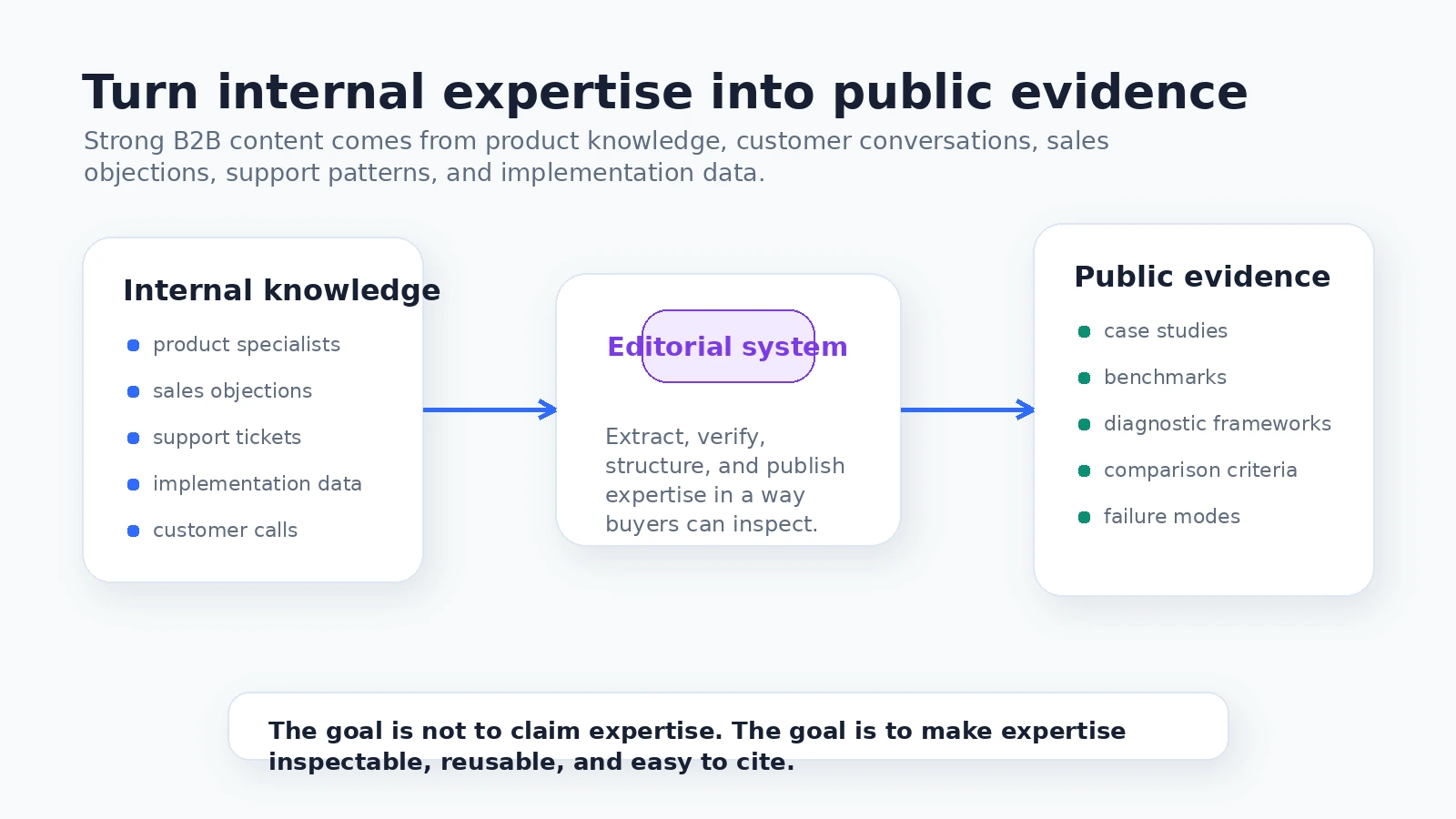
Strong B2B content rarely comes from keyword research alone.
Keyword research can show demand patterns, but it cannot create the company’s point of view.
The strongest material usually comes from:
- product specialists;
- customer calls;
- sales objections;
- support conversations;
- implementation data;
- migration projects;
- pricing conversations;
- failed experiments;
- operational constraints;
- partner feedback.
The job is to turn that internal knowledge into public evidence.
Useful evidence can include:
- original case studies;
- benchmarks;
- diagnostic frameworks;
- technical specifications with interpretation;
- failure modes and lessons learned;
- comparison criteria;
- decision trees;
- calculators and templates;
- examples of how the answer changes by segment.
The goal is not to repeatedly claim expertise.
The goal is to make expertise inspectable.
The B2B SEO case study is one example of this principle.
It does not only present a polished result. It explains the mechanism: what changed, why it mattered, which pages and technical constraints were involved, and how the result connected to leads and revenue.
That kind of content builds positioning because it shows how the company thinks.
Make expertise extractable for AI search and LLMs
AI search does not remove the need for brand positioning.
It raises the standard for clarity.
When buyers use AI search or conversational search during research, they may not read a full page first. They may see a synthesized answer, a cited source, a comparison, or a summary of market options.
That makes it more important that your pages are easy to understand, extract, and verify.
For B2B SEO, AI-search-ready positioning means:
- the company, product, category, and audience are clearly named;
- pages answer the main question directly before expanding into nuance;
- claims are supported by examples, data, or proof;
- comparison criteria are explicit;
- author and company context are visible;
- important pages are crawlable and indexable;
- related pages are connected through internal links;
- external mentions and links reinforce the entity and topic association.
This does not guarantee citation in an AI answer.
It does make the brand’s expertise easier for search systems and buyers to interpret.
Google’s own guidance for generative AI features still points back to fundamentals: useful content, technical accessibility, good page experience, and clear information architecture. It is not a separate magic layer that can compensate for vague content or weak evidence.
Connect branded and non-branded demand
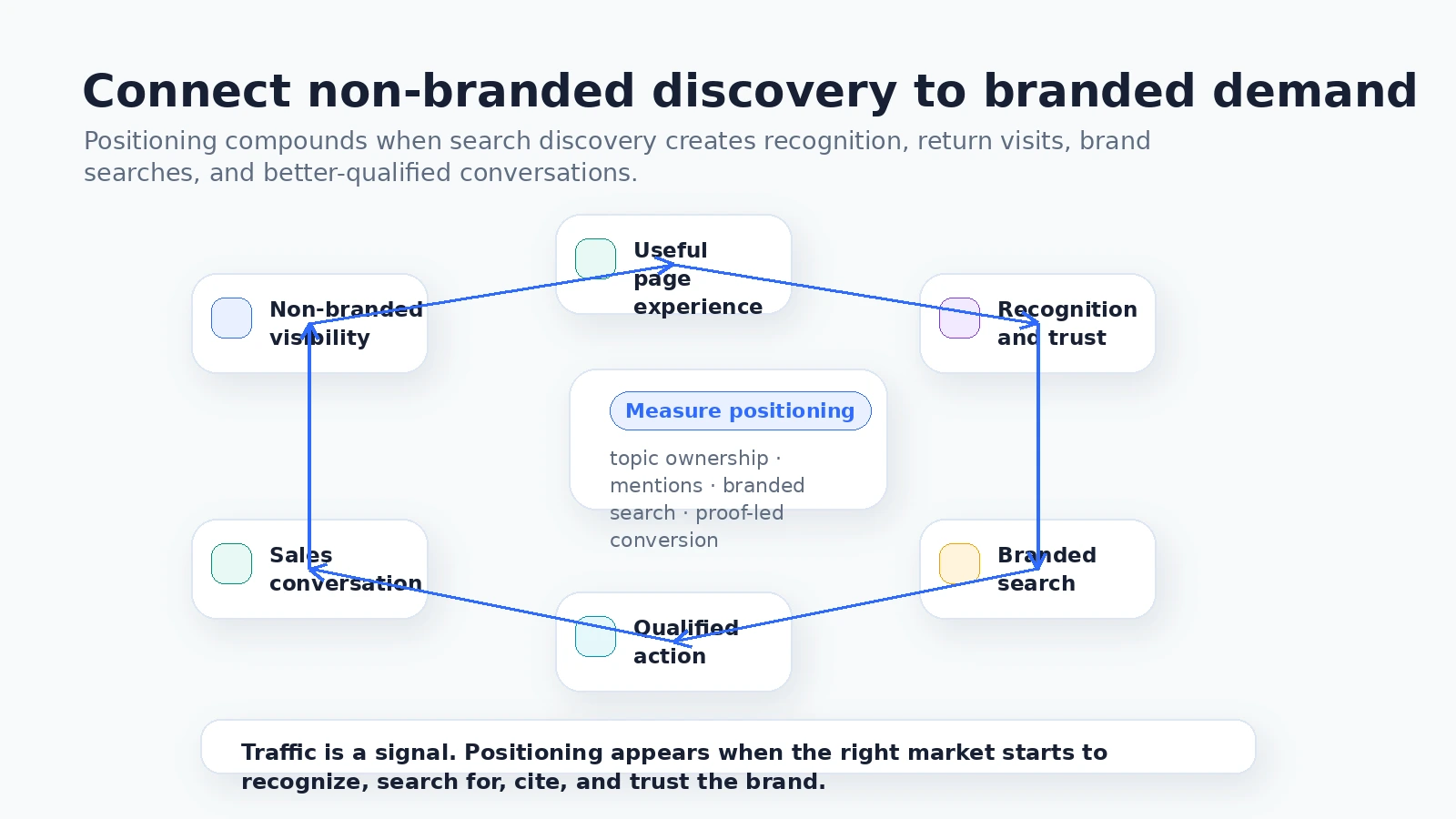
Non-branded queries introduce the company to people who do not yet know it.
Branded queries reveal what the market wants to verify after that introduction.
A positioning-led SEO system should monitor both.
Track non-branded signals such as:
- visibility for priority topic clusters;
- clicks to strategic educational pages;
- comparison and alternative query growth;
- engagement with commercial pages;
- returning organic visitors;
- new visitors from target segments.
Track branded signals such as:
- brand search volume;
- searches combining the brand with pricing;
- searches combining the brand with reviews;
- searches combining the brand with alternatives;
- searches combining the brand with competitors;
- branded traffic to proof and product pages;
- conversion quality from branded landing pages.
The relationship matters.
Search discovery should create enough recognition that future buyers remember the brand, return directly, search for it by name, or bring published content into internal evaluation.
Build authority through connected proof
Brand authority is not created by publishing more pages alone.
It is strengthened when expert pages are supported by relevant internal and external proof.
Internally, this means:
- product pages link to relevant guides;
- guides link to relevant commercial pages;
- comparisons link to proof and decision-stage assets;
- case studies link back to the product, segment, and use case;
- calculators and templates are connected to the problems they help evaluate.
Externally, this means:
- relevant industry sources mention or cite the work;
- partners and customers reference the company accurately;
- association and directory profiles are complete;
- expert commentary appears in places the market already trusts;
- original research is distributed to people who can use it.
This is where B2B link building and distribution become part of positioning.
The point is not to collect arbitrary authority metrics.
The point is to make the brand’s chosen territory visible in the places buyers, partners, journalists, and AI systems may use as sources.
Keep one voice across SEO, product, sales, and leadership
Do not build a separate “SEO voice” that sounds unlike the company.
That creates a positioning problem.
If search content says one thing, product pages say another, sales decks say a third, and executive communication says a fourth, the buyer receives a fragmented brand.
A positioning-led SEO system needs shared messaging across:
- SEO pages;
- product pages;
- sales decks;
- case studies;
- webinars;
- social posts;
- executive posts;
- partner materials;
- comparison pages;
- onboarding and technical documentation.
This does not mean every page should repeat the same wording.
It means the same strategic ideas should be recognizable everywhere.
The buyer should feel that the company has one coherent view of the market.
Use commercial tools to make positioning practical
Positioning becomes stronger when the company gives buyers a useful way to act on its point of view.
That is where tools can support SEO.
For example, an SEO ROI calculator is not just a conversion widget.
It can support positioning by showing how the company thinks about:
- investment level;
- customers acquired;
- annual revenue per customer;
- gross margin;
- churn;
- discount rate;
- CAC;
- LTV;
- ROI;
- payback;
- expected customer lifetime.
A calculator can turn an abstract claim into a practical decision-stage experience.
For a buyer, that can be more memorable than another generic “SEO is important” article.
For AI search and LLM visibility, a useful tool can also become a clear entity-level asset: a page that explains a problem, defines inputs, gives an output, and connects to related educational content.
Measure positioning, not only traffic
Traffic is useful, but it is not the only signal that positioning is working.
A B2B SEO program should also measure whether the brand is becoming associated with the right market territory.
Useful indicators include:
- visibility for priority topic clusters;
- branded search growth;
- branded query themes;
- mentions from relevant industry sources;
- links to strategic proof pages;
- conversion rate on pages with clear evidence;
- calculator usage from organic visitors;
- returning organic visitors from target accounts or regions;
- sales conversations that reference published content;
- lead quality from target segments;
- opportunities influenced by organic and content touchpoints.
These indicators belong beside commercial metrics in the B2B SEO KPI model.
The purpose is not to replace revenue measurement.
The purpose is to explain how search visibility is changing the way the market understands the brand.
Common mistakes
Mistake 1: Publishing generic content for broad coverage
Broad coverage can look productive in a content calendar.
But if every page sounds like any other vendor could have written it, the brand does not become more distinct.
Mistake 2: Treating SEO and brand as separate teams
SEO pages often become the first brand experience.
If the SEO team does not understand positioning, the company may rank for terms that do not support the desired market association.
Mistake 3: Hiding expertise inside sales calls
Many B2B companies have strong expertise, but it lives only in sales calls, support tickets, Slack threads, and product conversations.
That knowledge cannot shape search visibility until it is turned into public evidence.
Mistake 4: Measuring only rankings and sessions
Rankings and sessions are useful, but they do not show whether the market is learning the right thing about the brand.
Add branded demand, proof-led conversion, mentions, and sales feedback to the reporting model.
Mistake 5: Creating content that cannot be reused by sales
If sales would never send the page to a prospect, the page probably does not carry enough proof.
Good positioning content should help both search discovery and sales conversations.
A 90-day positioning sprint
A practical first sprint can look like this.
Days 1–15: define the territory
Document:
- priority segments;
- most expensive or urgent problems;
- current category language;
- key alternatives;
- sales objections;
- existing proof;
- gaps in public evidence.
Review the current site through a B2B SEO audit lens.
Days 16–30: map search touchpoints
Map priority queries to:
- product pages;
- use-case pages;
- comparison pages;
- technical guides;
- case studies;
- calculators;
- proof pages;
- decision-stage content.
Identify where the brand currently appears generic or inconsistent.
Days 31–60: publish or upgrade proof-led pages
Focus on a small number of high-leverage pages.
Improve:
- page introductions;
- audience clarity;
- examples;
- proof;
- internal links;
- comparison logic;
- conversion paths;
- author or company context;
- freshness and factual support.
Days 61–90: distribute and measure
Use email, social distribution, partners, and expert commentary to put the strongest assets in front of the market.
Measure:
- changes in priority topic visibility;
- branded query themes;
- referral mentions and links;
- engagement with proof-led pages;
- calculator usage;
- assisted conversions;
- sales feedback.
This creates a loop: positioning hypothesis → search-visible proof → distribution → measurement → refinement.
Related guides
Use this article together with:
- B2B SEO: Do You Really Need It?
- B2B SEO KPIs: Measure Pipeline and Revenue, Not Rankings
- B2B SEO Audit: Technical, Content, Authority, and Measurement
- B2B SEO Checklist: From Baseline to Revenue
- B2B Link Building: Authority, Referrals, and Market Evidence
- How to Choose a B2B SEO Partner
- SEO Cost Calculator
FAQ
What is brand positioning through B2B SEO?
Brand positioning through B2B SEO means using search-visible pages to make a company’s market territory, expertise, proof, and point of view easier for buyers to understand before they speak with sales.
How does SEO affect B2B brand positioning?
SEO affects B2B brand positioning because search results are repeated brand touchpoints. Product pages, guides, comparisons, case studies, and technical resources teach buyers what the company knows and where it belongs.
Can B2B SEO build brand demand?
Yes. Non-branded pages can introduce the company to buyers who do not know it yet. If the experience is useful and memorable, those buyers may return directly, search for the brand by name, or bring the content into sales conversations.
What should a B2B positioning map include?
A useful positioning map includes priority customer groups, urgent problems, alternatives, category language, demonstrable expertise, proof points, and the commercial actions that should follow each search journey.
How does AI search change B2B brand positioning?
AI search increases the importance of clear, extractable, well-supported content. It does not replace SEO fundamentals, but it makes entity clarity, source quality, structured explanations, and public evidence more important.
What content supports B2B brand positioning?
Strong positioning content includes original case studies, diagnostic frameworks, implementation lessons, benchmarks, comparison criteria, failure modes, expert explanations, and technical resources that make expertise inspectable.
How should B2B companies measure positioning through SEO?
Measure topic visibility, branded search growth, relevant mentions and links, conversion quality, engagement with proof-led pages, sales conversations that reference content, and lead quality from target segments.
Where does an SEO cost calculator fit into positioning?
An SEO ROI calculator can support positioning by making the company’s thinking practical. It turns an abstract claim about growth into a decision-stage tool that helps buyers test investment, CAC, LTV, ROI, and payback assumptions.
Conclusion
B2B SEO can do more than capture existing demand.
It can define the market territory a company wants to own, make specialist knowledge visible, and give buyers a consistent reason to trust the brand.
The strongest SEO systems do not only answer queries. They repeat a coherent point of view across technical guides, product pages, comparisons, case studies, calculators, distribution, and sales conversations.
That is how search becomes part of brand positioning.
Questions about a B2B growth system? Contact me via LinkedIn, Telegram, or email.