B2B SEO Audit: Technical, Content, Authority, and Measurement
Quick answer
A useful B2B SEO audit is not a 100-page export of warnings.
It is a diagnosis of why qualified buyers cannot reliably:
- discover your company;
- understand what you offer;
- trust your expertise;
- compare you with alternatives;
- take the next step;
- become measurable pipeline.
That means the audit has to evaluate the website as more than a set of URLs.
A B2B website is a technical system, a knowledge base, a conversion path, a source of evidence, and now also a source that may be summarized or cited by AI-assisted search experiences.
The output should not be a flat checklist.
The output should be a short decision queue: what to fix first, why it matters commercially, who owns it, and how you will know whether it worked.

What a B2B SEO audit should diagnose
A B2B SEO audit should answer one central question:
Where is qualified organic demand being blocked?
The blocker may be technical.
Important pages may not be indexed. A JavaScript template may hide content from crawlers. A canonical tag may point to the wrong URL. A product page may be orphaned from the internal-link structure.
The blocker may be strategic.
The site may rank for informational traffic while missing the comparison, alternative, pricing, integration, and migration pages that buyers need before a sales conversation.
The blocker may be content quality.
The page may be long, but generic. It may describe a topic without showing original expertise, product fit, examples, limitations, or decision criteria.
The blocker may be authority.
The company may have useful expertise, but no credible external signals around the topics where it needs to be trusted.
The blocker may be measurement.
Organic traffic may be growing, but forms, CRM fields, source attribution, lead qualification, and revenue reporting may be too weak to prove whether SEO is creating qualified demand.
The audit should find the constraint, not just the symptom.
Why old SEO audit reports fail in B2B
Many SEO audits are built around tool exports.
They report hundreds of items like:
- missing meta descriptions;
- title length warnings;
- low word count;
- duplicate H1 tags;
- redirect notices;
- image alt warnings;
- pages with few internal links;
- page speed opportunities.
Some of these findings can matter.
But they are not automatically important.
In B2B, the commercial question is different:
- Is this issue blocking a strategic page?
- Is this page connected to a priority segment?
- Does the page support a product, use case, comparison, integration, or buying stage?
- Can the fix affect qualified leads, opportunities, or revenue influence?
- Is the implementation cost worth it?
A missing meta description on an old announcement page is not equal to a canonical problem on the main comparison page for your highest-value segment.
The audit has to separate noise from constraints.
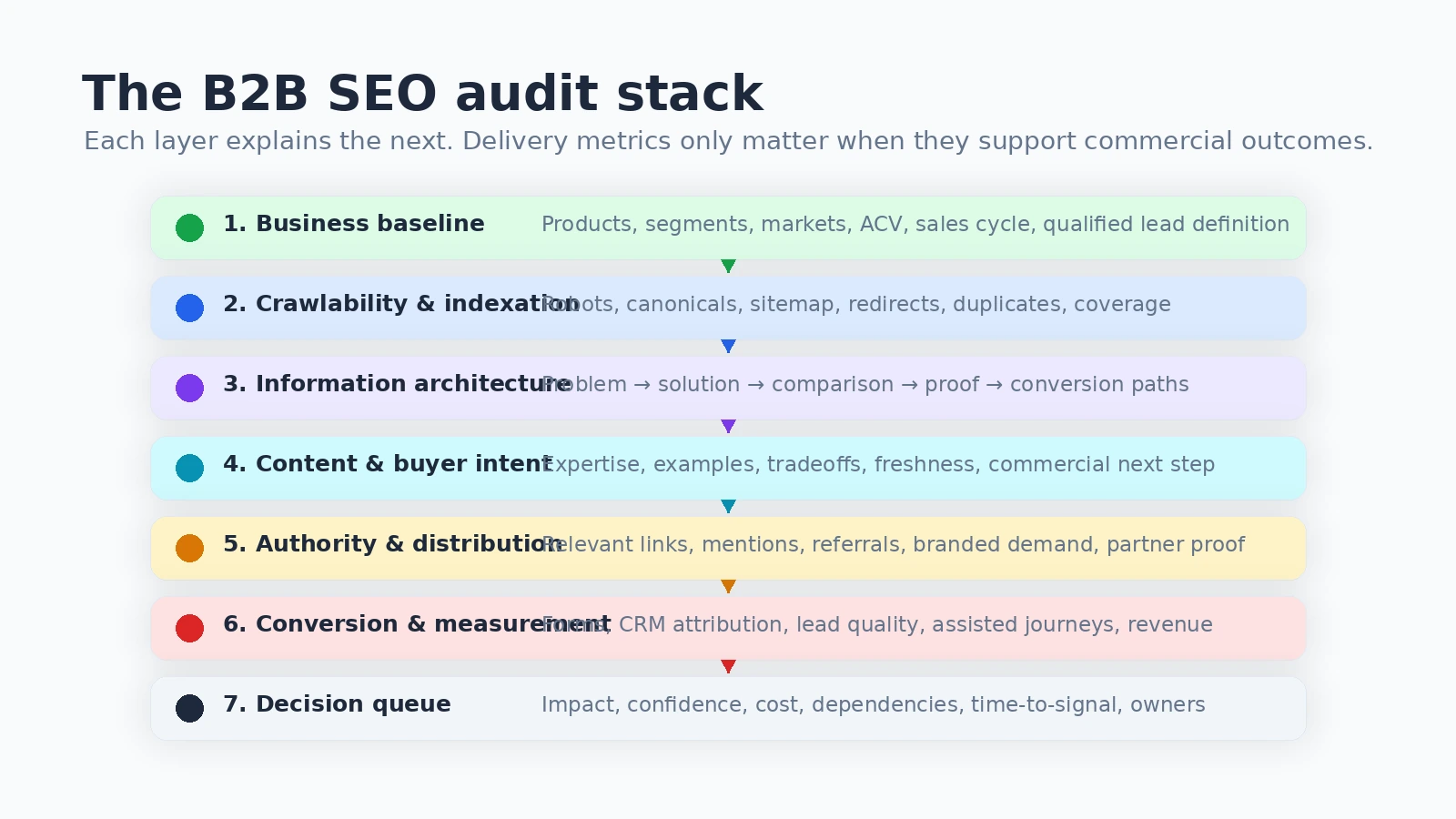
The B2B SEO audit stack
A strong audit should move through seven layers:
- business baseline;
- crawlability and indexation;
- information architecture;
- content and buyer intent;
- authority and distribution;
- conversion and measurement;
- decision queue.
Each layer explains the next.
If you skip the business baseline, you cannot prioritize technical issues.
If you skip crawlability, great content may never be discovered.
If you skip architecture, buyers may not move from problem awareness to proof and action.
If you skip measurement, you may increase traffic without knowing whether it creates pipeline.
1. Establish the business baseline
Before opening an SEO tool, document the business context.
You need to know:
- priority products;
- priority markets;
- target customer segments;
- average contract value;
- gross margin;
- sales-cycle length;
- what counts as a qualified lead;
- what counts as a qualified opportunity;
- current organic leads;
- current organic pipeline;
- current closed revenue from organic acquisition;
- influenced revenue in multi-touch journeys;
- branded versus non-branded demand;
- known website constraints;
- known publishing constraints;
- known sales objections.
Without this baseline, the audit cannot distinguish a high-impact problem from an interesting but commercially irrelevant one.
For example, a blog post with declining traffic may look like a problem.
But if the traffic is low-intent and never converts, it may not deserve immediate attention.
At the same time, a low-traffic comparison page may be commercially important if it influences late-stage opportunities.
Use the B2B SEO KPI framework to define the measurement hierarchy before prioritizing audit findings.
If CAC, LTV, and payback are part of the baseline, test the current economics with the SEO ROI Calculator before estimating the upside from new SEO work.
2. Audit crawlability and indexation
Crawlability and indexation are the foundation.
Google’s own documentation separates the process into crawling, indexing, and serving. If you do not understand whether Google can find, parse, and index your important pages, it is difficult to debug search performance or predict what will happen after site changes.
Check whether search engines can discover and index the pages that matter:
- robots.txt;
- meta robots directives;
- x-robots-tag headers;
- XML sitemaps;
- canonical tags;
- redirect chains;
- broken internal links;
- duplicate or near-duplicate pages;
- orphan pages;
- faceted navigation;
- URL parameters;
- pagination patterns;
- JavaScript rendering issues;
- hreflang problems if the site is multilingual;
- index coverage in Google Search Console.
Do not audit technical SEO only at the domain level.
Audit strategic templates and strategic page groups separately:
- product pages;
- solution pages;
- industry pages;
- comparison pages;
- alternative pages;
- integration pages;
- pricing pages;
- case studies;
- calculators;
- documentation pages;
- blog clusters.
A technical issue is much more urgent when it affects pages that support buying decisions.
3. Audit AI search readiness
Modern B2B SEO audits should also check whether content is useful for AI-assisted discovery.
This does not mean chasing a separate set of magic “AI SEO” tricks.
Google’s public guidance for generative AI features says that the same SEO fundamentals still matter: create helpful, reliable, people-first content; make sure pages are accessible; use clear page titles and snippets; and control preview settings through existing mechanisms.
But the audit should add a practical question:
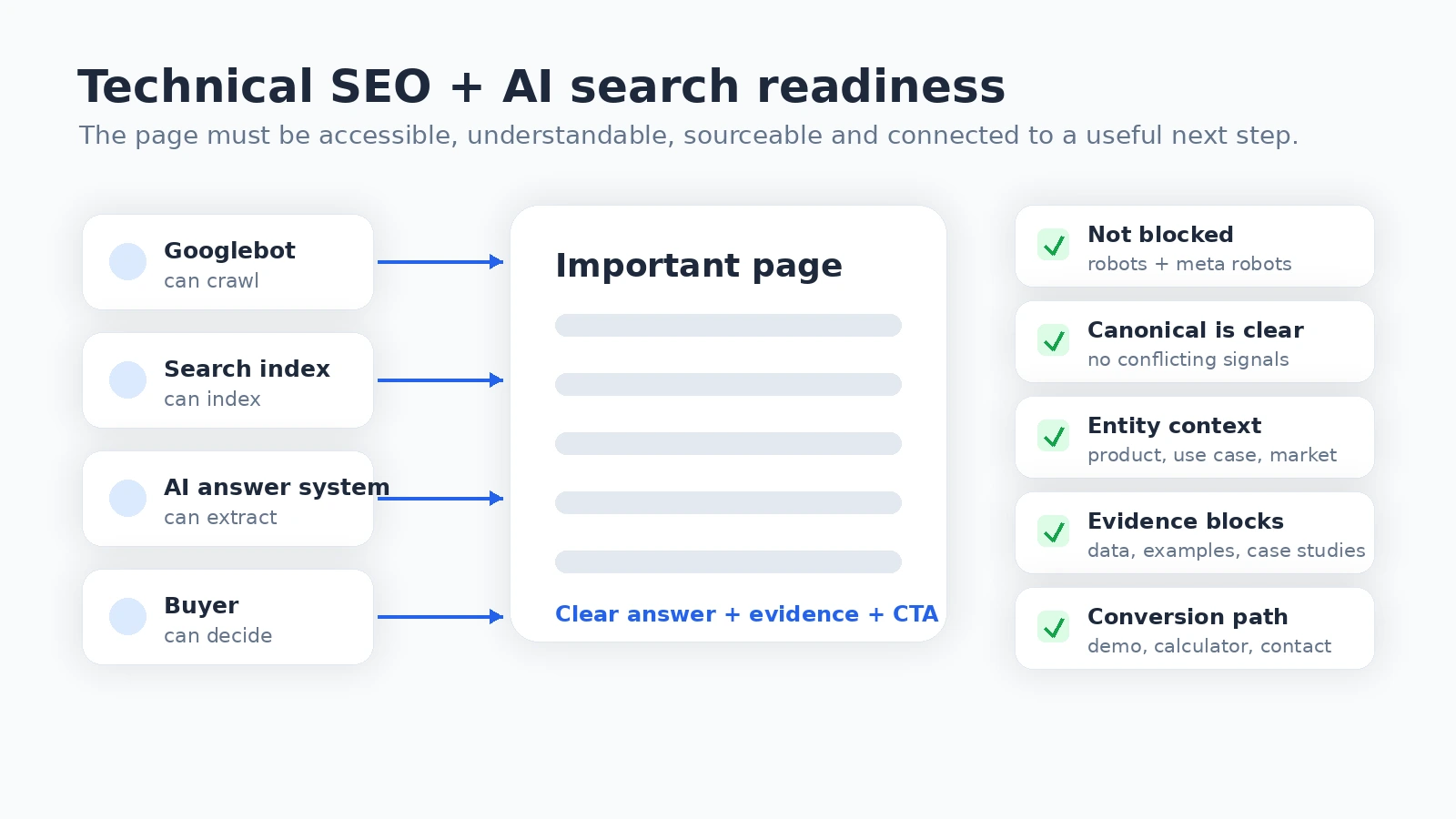
Can a search engine, AI answer system, or buyer extract a clear answer, evidence, and next step from this page?
For important pages, check whether they include:
- a clear answer to the main query;
- visible product or service context;
- named audience and use case;
- concrete examples;
- original data or first-hand experience;
- comparison criteria;
- tradeoffs and limitations;
- evidence blocks;
- author or company credibility signals;
- current dates where freshness matters;
- links to supporting resources;
- a relevant commercial next step.
AI search visibility is not perfectly measurable across every platform.
Outputs can vary across prompts, locations, personalization, and time. That makes single-run AI visibility checks risky if they are treated as exact rankings.
For audit purposes, use AI visibility as a directional layer:
- Which pages are being cited or summarized where data is available?
- Which entities, products, and categories are associated with the brand?
- Which competitors are cited for priority questions?
- Which pages provide strong source material?
- Which pages are too vague, thin, outdated, or unsupported to be useful as sources?
Google has also started adding dedicated Search Console reporting for generative AI features in Search. Where this data is available, include it in the audit as a visibility layer, not as the only measure of success.
4. Review information architecture
Information architecture should reflect how customers understand the market.
It should not only reflect the company’s internal structure.
Map important queries, objections, and use cases to page types:
- product pages;
- service pages;
- industry pages;
- use-case pages;
- comparison pages;
- alternative pages;
- migration pages;
- integration pages;
- pricing or cost pages;
- technical resources;
- case studies;
- customer proof;
- calculators;
- demo and contact pages.
Then review the internal links between these layers.
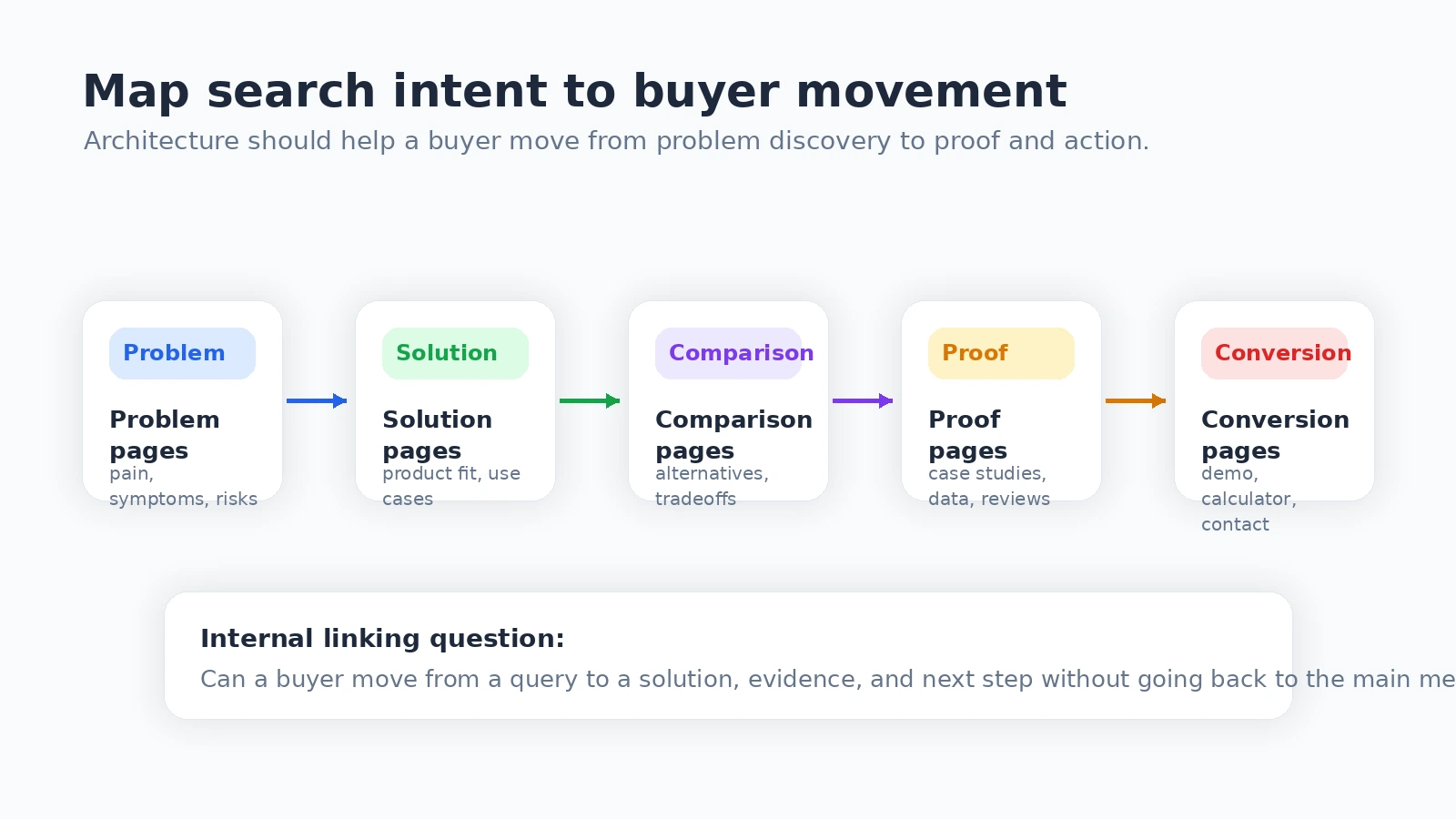
A buyer should be able to move from problem to solution, from solution to proof, and from proof to a next step without returning to the main navigation menu.
For example:
Problem query
→ educational page
→ product or use-case page
→ comparison or alternative page
→ case study or proof page
→ calculator, demo, or contact page
This matters because B2B buyers rarely make decisions from one page.
They compare options, validate claims, involve colleagues, check pricing logic, and look for risk reduction.
Your architecture should support that movement.
The B2B SEO checklist can turn this architecture into an ongoing operating process rather than a one-time audit task.
5. Evaluate content against buyer intent
Content quality is not the same as content length.
A long page can still be thin if it repeats generic advice without helping a specialist make a decision.
For each important page, ask:
- Does the page answer the actual query?
- Is the intended audience clear?
- Is the use case clear?
- Does the page explain when the solution is a good fit?
- Does it explain when the solution is not a good fit?
- Does it include original expertise, examples, data, screenshots, workflows, or implementation detail?
- Does it make tradeoffs visible?
- Does it address common objections?
- Does it link to proof?
- Does it lead naturally to a relevant next step?
- Is the content current?
- Are factual claims supported?
For B2B, the most important content gaps often appear close to the buying decision.
Common missing pages include:
- “[competitor] alternative” pages;
- comparison pages;
- pricing explanation pages;
- migration guides;
- integration pages;
- implementation guides;
- security pages;
- procurement or compliance pages;
- ROI and cost pages;
- case studies by segment;
- objection-handling content.
This is where a lot of commercially valuable search demand lives.
Traffic volume may be lower than top-of-funnel topics, but conversion quality is usually higher.
6. Audit conversion paths
A page can rank, educate, and still fail commercially.
Audit what happens after the visitor arrives.
For strategic landing pages, check:
- primary CTA;
- secondary CTA;
- form length;
- demo booking path;
- email and contact visibility;
- calculator or self-service path;
- proof near CTA;
- page speed on conversion templates;
- mobile usability if the audience uses mobile;
- trust signals near commercial actions;
- whether the CTA matches the page intent.
Not every page should push the same action.
A comparison page may lead to a demo.
A cost page may lead to the SEO ROI Calculator.
A technical guide may lead to a checklist, template, or implementation consultation.
A case study may lead to a sales conversation.
For a B2B SEO audit, conversion paths should be evaluated by intent.
Do not judge every page by the same form-fill rate.
7. Audit measurement and attribution
Organic traffic can grow while commercial performance remains flat.
That is why the audit has to verify measurement.
Check whether the company can track:
- form submissions;
- demo requests;
- email clicks;
- phone clicks if relevant;
- calculator starts and completions;
- pricing page visits;
- account signups;
- trial starts;
- CRM source;
- campaign fields;
- landing page at first touch;
- landing page before conversion;
- lead quality;
- disqualification reasons;
- opportunity creation;
- pipeline value;
- closed revenue;
- assisted journeys.
Then check whether marketing and sales systems agree.
Common problems include:
- analytics events firing twice;
- forms not passing source data to CRM;
- organic leads being overwritten by direct traffic;
- paid and organic campaigns using inconsistent UTMs;
- demo requests without landing page data;
- no distinction between branded and non-branded demand;
- no reporting by product, segment, or page group;
- no visibility into disqualified leads.
In complex B2B funnels, the most valuable SEO finding may sit after the click.
For example, organic traffic may be qualified, but the CTA may be wrong, the form may be too early, or sales may disqualify leads for reasons the page could have handled earlier.
8. Review authority and distribution
Authority is not just a domain score.
For B2B SEO, authority means credible signals around the topics where buyers and search systems need to trust the company.
Audit:
- relevant referring domains;
- unlinked brand mentions;
- partner mentions;
- customer mentions;
- analyst or industry mentions;
- podcast, webinar, and event references;
- citations from technical resources;
- review platforms;
- comparison pages that mention the brand;
- branded search demand;
- social distribution of expert content;
- referral traffic quality;
- which pages attract links and mentions.
The goal is not to collect links randomly.
The goal is to build evidence around strategic topics.
For example, if a company wants to rank and be cited for “enterprise Kubernetes cost optimization,” authority should not only point to the homepage. It should support the product, technical explainers, benchmark pages, case studies, and comparison content around that topic.
Use the B2B link-building strategy to connect authority building with topics, partners, research assets, and distribution.
9. Audit commercial assets: calculators, tools, and proof
B2B SEO should not rely only on articles.
Commercial assets often do more work than blog posts because they help buyers make decisions.
Audit whether the site has assets such as:
- ROI calculators;
- cost calculators;
- migration estimators;
- comparison tables;
- templates;
- benchmark reports;
- procurement checklists;
- implementation guides;
- case studies;
- technical demos;
- product tours;
- self-assessment tools.
For example, the SEO ROI Calculator can support several jobs at once.
It can:
- turn bottom-of-funnel interest into a concrete economics check;
- test a proposed SEO investment against acquired customers and customer value;
- calculate CAC, LTV, LTV:CAC, ROI, payback, and expected lifetime;
- create a natural CTA from audit and KPI articles;
- give sales a more informed conversation;
- become a sourceable asset for AI search and traditional search.
The calculator does not forecast visits, leads, close rates, or required pipeline. Audit those funnel assumptions separately, then connect the resulting customer estimate to the calculator.
In the audit, evaluate whether commercial assets are findable, internally linked, indexed, conversion-tracked, and connected to relevant articles and landing pages.
10. Separate branded demand from new demand creation
A B2B SEO audit should separate branded and non-branded performance.
Branded search is important.
It shows demand, trust, and market awareness.
But branded growth can hide weaknesses in non-branded discovery.
Segment performance by:
- branded queries;
- non-branded product queries;
- problem queries;
- comparison queries;
- alternative queries;
- integration queries;
- pricing or cost queries;
- industry queries;
- technical implementation queries.
This helps answer a more useful question:
Are we capturing existing demand, creating new demand, or only benefiting from brand activity happening somewhere else?
The answer affects strategy.
If branded demand is strong but non-branded visibility is weak, the site may need better category, comparison, and use-case coverage.
If non-branded traffic is growing but pipeline is weak, the issue may be intent mismatch, conversion, or qualification.
If visibility exists but branded searches do not grow, the problem may be authority, distribution, or positioning.
11. Prioritize findings by commercial impact
The audit output should not be a giant spreadsheet with every issue marked “high priority.”
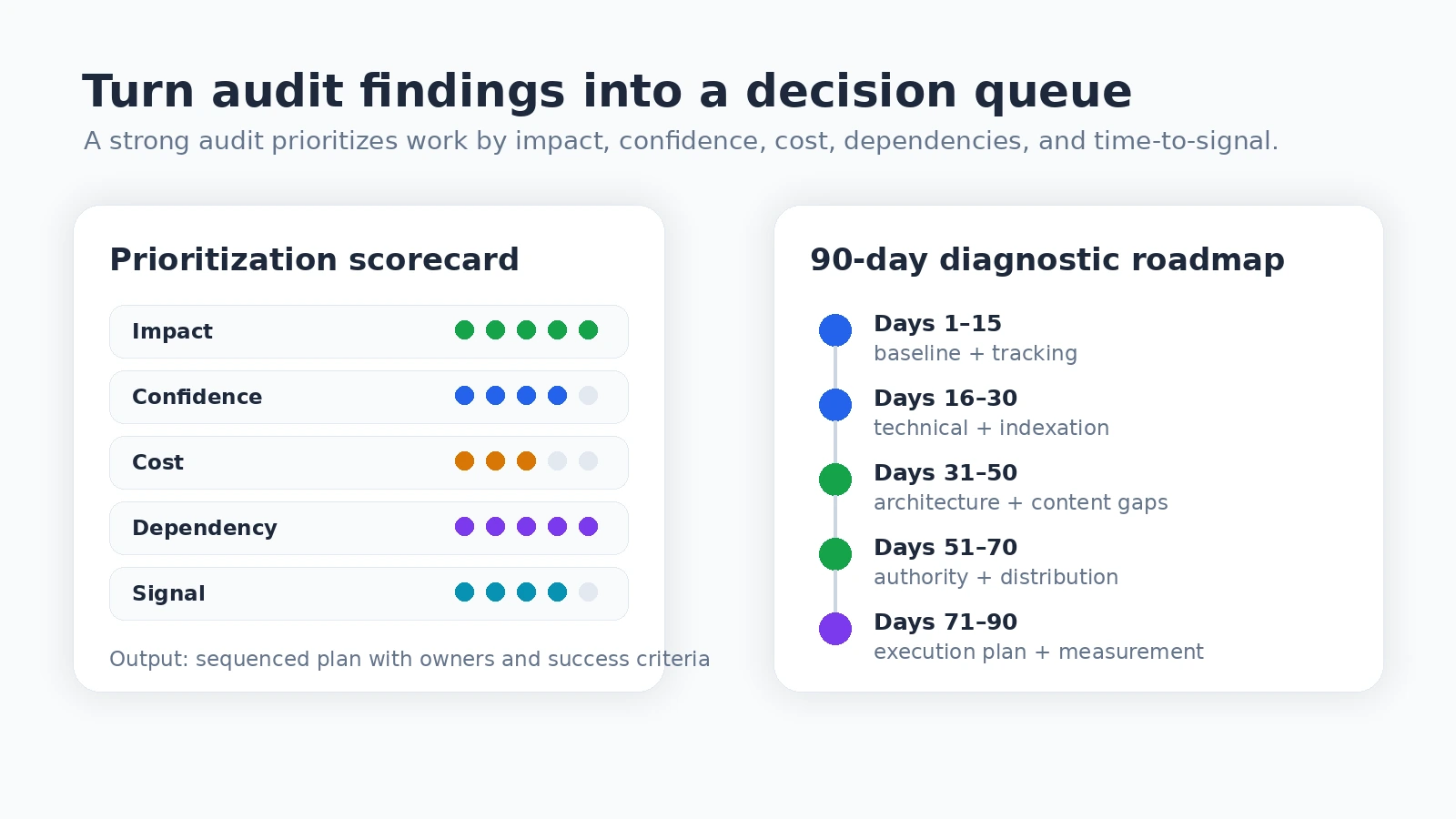
Prioritize every recommendation by:
- expected commercial impact;
- confidence in the diagnosis;
- implementation cost;
- dependency on other work;
- time required to observe a result;
- owner;
- success criteria.
A simple scoring model can be enough.
Priority = Impact × Confidence ÷ Effort
But B2B audits need one more layer: dependency.
For example, a content plan may depend on new templates, CMS changes, internal-link updates, or analytics fixes.
A page refresh may not matter until the canonical and indexation issue is fixed.
A reporting dashboard may not be useful until CRM source data is reliable.
Prioritization should produce a sequence, not only a score.
12. Build a 90-day execution plan
A strong audit should produce a practical 90-day plan.
The plan should be short enough to execute and specific enough to measure.
A useful structure:
Days 1–15: baseline and measurement
- define qualified lead and opportunity criteria;
- verify analytics events;
- verify CRM source capture;
- split branded and non-branded reporting;
- group pages by product, segment, and intent;
- document current pipeline and revenue baseline.
Days 16–30: technical and indexation fixes
- fix blocking robots or meta robots issues;
- repair strategic canonical problems;
- update sitemaps;
- fix broken internal links to important pages;
- resolve redirect chains on commercial paths;
- submit or validate key pages in Search Console.
Days 31–50: architecture and internal links
- map buyer journeys by product or segment;
- identify missing decision-stage pages;
- add internal links between problem, solution, comparison, proof, and CTA pages;
- make calculators, case studies, and commercial assets easier to find.
Days 51–70: content refresh and expansion
- update stale strategic pages;
- add examples, tradeoffs, and proof;
- create missing comparison or alternative pages;
- improve pages that already have impressions but weak CTR or conversion;
- add expert review where claims need credibility.
Days 71–90: authority and distribution
- identify linkable assets;
- distribute research and practical guides;
- pitch partner or customer collaborations;
- reclaim unlinked mentions;
- connect social distribution with SEO assets;
- review early movement in indexation, impressions, clicks, assisted conversions, and lead quality.
This plan should not promise full revenue impact in 90 days.
It should create a controlled system where future impact can be observed.
13. What to include in the final audit deliverable
A useful B2B SEO audit deliverable should include:
- executive summary;
- commercial baseline;
- strategic page groups;
- technical constraints;
- indexation findings;
- architecture map;
- content gap analysis;
- authority and distribution review;
- conversion-path findings;
- measurement and CRM findings;
- AI search readiness notes;
- prioritized decision queue;
- 90-day execution plan;
- owners and dependencies;
- success criteria;
- review windows.
The executive summary matters.
Leadership usually does not need every URL-level detail.
They need to know:
- what is blocking growth;
- what it affects commercially;
- what must happen first;
- what resources are needed;
- when results should be reviewed;
- which risks remain uncertain.
The SEO and content team can keep the detailed working files.
14. Common B2B SEO audit mistakes
Avoid these mistakes:
Treating every warning as equal
Tool warnings are inputs, not strategy.
The audit has to explain which warnings matter and why.
Ignoring sales and CRM data
SEO cannot be evaluated properly if no one knows which organic leads become qualified opportunities.
Auditing content without buyer intent
A page can be optimized for a keyword and still fail the buyer.
Separating technical SEO from content strategy
Technical fixes and content expansion should support the same commercial page groups.
Reporting traffic without quality
More organic sessions are not automatically better.
The audit should measure whether the right audience is arriving.
Ignoring AI-assisted search
AI visibility is not a replacement for SEO.
But B2B buyers are increasingly using AI and conversational search during research. The audit should check whether your content is clear, sourceable, and evidence-rich enough to be useful in that environment.
Skipping implementation reality
A recommendation that cannot be implemented is not a plan.
The audit should account for CMS limits, developer capacity, subject-matter expert availability, legal review, brand constraints, and sales input.
15. How often to run a B2B SEO audit
A full B2B SEO audit is usually useful once or twice per year.
But some checks should happen more often.
Monthly or biweekly checks can include:
- indexation of strategic pages;
- technical errors on key templates;
- organic conversions;
- lead quality;
- non-branded clicks by cluster;
- page refresh progress;
- new links and mentions;
- calculator or demo conversions;
- major ranking or CTR changes;
- generative AI visibility data where available.
Quarterly reviews can include:
- pipeline from organic;
- influenced pipeline;
- content gap progress;
- commercial page performance;
- authority-building impact;
- conversion-rate changes;
- priority market performance;
- roadmap changes.
The audit becomes much more valuable when it feeds an operating rhythm.
Example in practice
A practical B2B SEO audit should explain the mechanism behind growth.
It should not only say “traffic increased.”
It should show what changed:
- technical repair;
- site structure;
- content expansion;
- internal linking;
- authority signals;
- conversion paths;
- measurement quality.
Then it should connect those changes to traffic, leads, opportunities, and financial outcomes.
That is why a full B2B SEO case study is useful: it shows the chain from diagnosis to implementation to commercial result.
For implementation, use this audit together with the 2026 B2B SEO strategy guide, the B2B SEO KPI framework, the B2B SEO checklist, and the guide to choosing a B2B SEO partner.
FAQ
What is a B2B SEO audit?
A B2B SEO audit is a structured diagnosis of why qualified buyers cannot reliably discover, understand, trust, or act on a company’s offer through organic search and related discovery channels.
What should a B2B SEO audit include?
A useful B2B SEO audit should include the business baseline, crawlability, indexation, information architecture, buyer-intent content, authority signals, conversion tracking, CRM measurement, and a prioritized decision queue.
How is a B2B SEO audit different from a standard SEO audit?
A standard audit often focuses on technical warnings and rankings. A B2B SEO audit connects those findings to qualified leads, opportunities, pipeline, sales cycles, buying committees, and revenue influence.
Should a B2B SEO audit include AI search visibility?
Yes. Modern B2B SEO audits should check whether pages are crawlable, sourceable, clearly structured, evidence-rich, and useful enough to be cited or summarized in AI-assisted search experiences.
Which technical SEO issues matter most in a B2B audit?
The most important technical issues are the ones that prevent strategic pages from being crawled, indexed, rendered, internally linked, or measured. Examples include blocked pages, incorrect canonicals, broken internal links, duplicate templates, and missing indexation for commercial pages.
How do you audit B2B content quality?
Audit whether each page answers the real buyer question, names the audience and use case, includes original expertise or evidence, explains tradeoffs, stays current, and leads to a relevant next action.
How do you prioritize SEO audit findings?
Prioritize each finding by expected commercial impact, confidence in the diagnosis, implementation cost, dependencies, and time required to observe a result.
How often should a B2B company run an SEO audit?
A full B2B SEO audit is usually useful once or twice per year. Technical checks, content refresh reviews, indexation monitoring, and pipeline reporting should happen more frequently as part of the operating process.
Conclusion
A strong B2B SEO audit reduces uncertainty.
It identifies the few constraints that prevent the current website, content, authority, and measurement system from becoming qualified demand.
The goal is not to produce a bigger report.
The goal is to make better decisions.
The right audit helps a team understand what to fix, what to publish, what to measure, what to ignore, and what commercial result should be expected next.
Questions about a B2B growth system? Contact me via LinkedIn, Telegram, or email.