B2B SEO Checklist: From Baseline to Revenue
Quick answer
A B2B SEO checklist should not start with “publish more blog posts” or “fix every warning in an SEO tool.”
It should start with the commercial system:
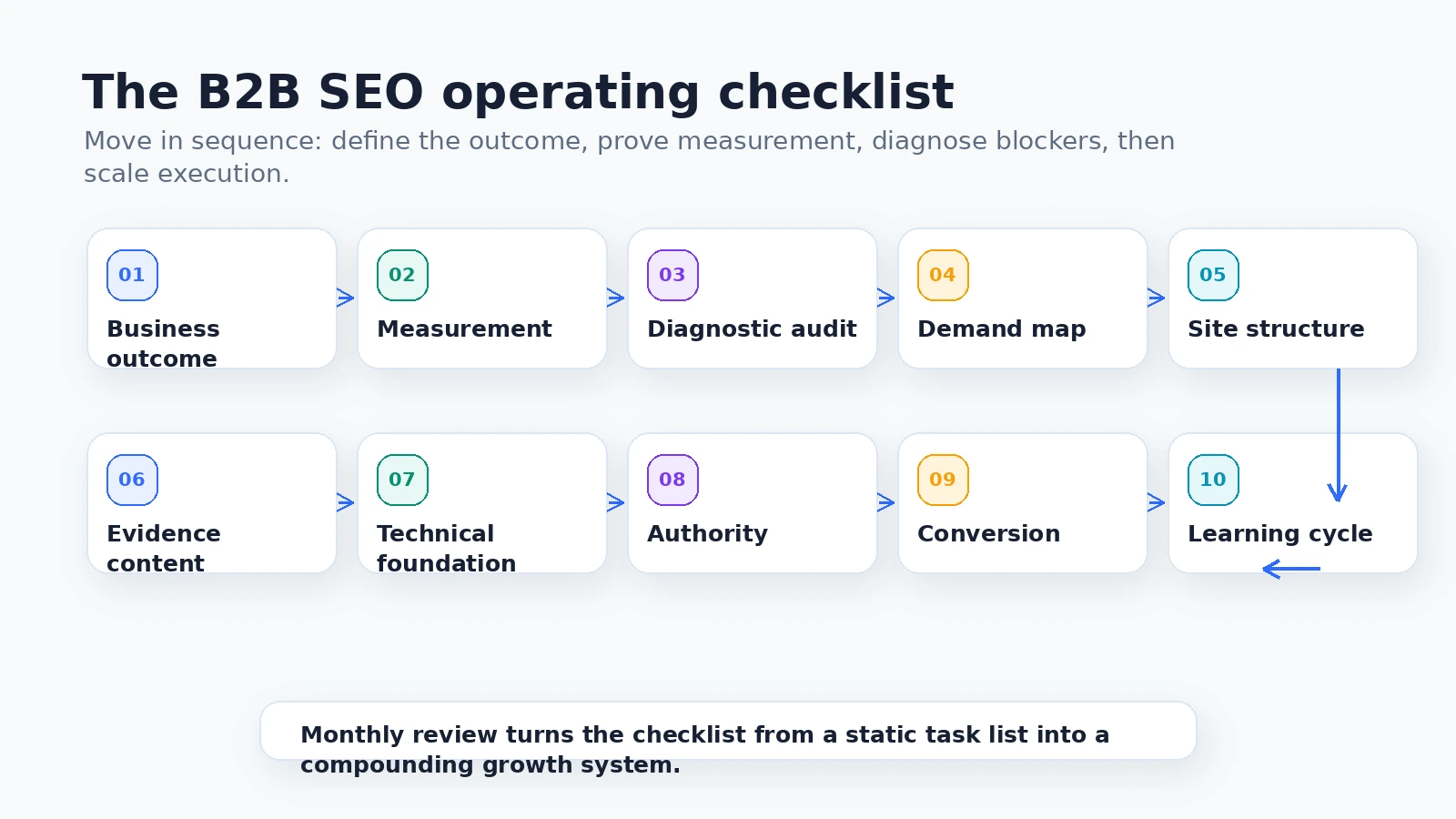
- Define the business outcome.
- Confirm measurement.
- Complete a diagnostic audit.
- Map search demand to the buying journey.
- Build a clear site structure.
- Publish evidence-rich content.
- Strengthen technical foundations.
- Build authority and distribution.
- Improve conversion.
- Run a monthly learning cycle.
The goal is not to complete SEO tasks for their own sake. The goal is to create a repeatable system that turns qualified search demand into pipeline, revenue, and learning.
Why most B2B SEO checklists fail
Most SEO checklists are useful for quality control, but weak as growth tools.
They usually list tasks such as:
- check title tags;
- update meta descriptions;
- fix broken links;
- add internal links;
- improve page speed;
- publish new content;
- build backlinks.
These tasks can matter. The problem is that they do not explain why the work matters, which buyer problem it supports, which page group it improves, or how it should eventually affect pipeline.
That is especially risky in B2B.
A B2B company may have low search volume, long sales cycles, multiple decision-makers, and a small number of high-value opportunities. A page with 100 qualified visits can be more valuable than a generic article with 10,000 casual visits.
So the checklist needs to answer a commercial question:
What must improve so that more qualified buyers can discover, understand, trust, and act on our offer?
That is the operating logic behind this checklist.
1. Define the business outcome
Before keyword research, define the business outcome.
Document:
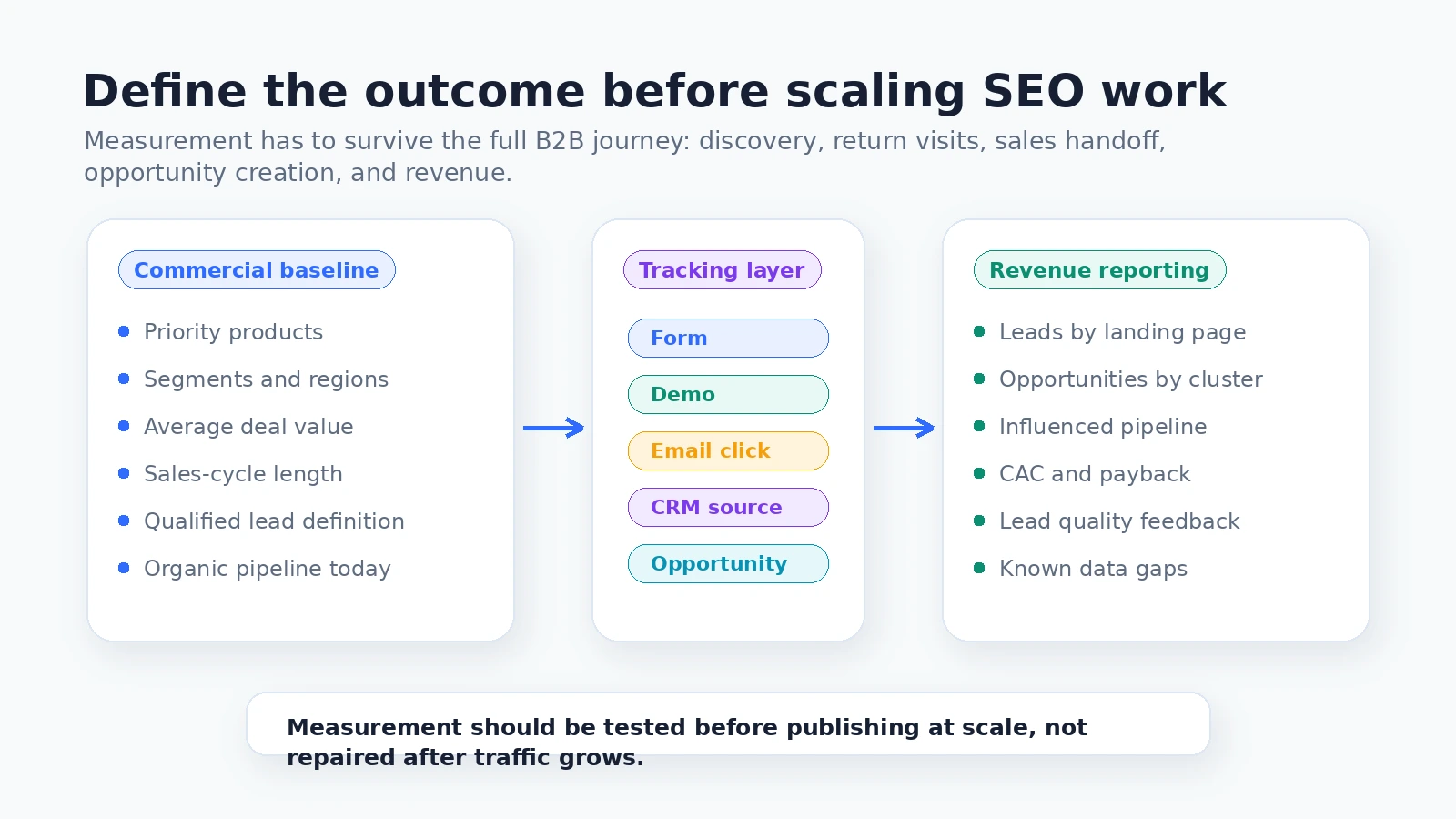
- priority products;
- priority customer segments;
- target regions;
- average deal value;
- gross margin if available;
- sales-cycle length;
- what counts as a qualified lead;
- what counts as a qualified opportunity;
- current organic pipeline;
- current organic revenue;
- current customer acquisition cost;
- current payback period;
- whether the goal is demand capture, demand creation, or both.
Do not set “rank higher” as the final objective.
A better objective is more specific:
Increase qualified pipeline from mid-market SaaS companies in the US for Product A.
Or:
Increase demo requests from comparison and alternative pages for buyers evaluating Vendor X.
Or:
Reduce paid acquisition dependency by growing non-branded organic opportunities in the enterprise segment.
This changes the work.
Instead of asking “Which keywords have volume?”, you ask:
- Which problems does this segment search for?
- Which buying stages are currently uncovered?
- Which pages can influence real sales conversations?
- Which content gaps block buyers from moving forward?
- Which pages should connect to a calculator, demo, comparison, case study, or pricing conversation?
Use the B2B SEO KPI framework to connect the outcome to leading indicators.
Use the SEO ROI Calculator to test whether the proposed investment and expected customer economics can produce acceptable CAC, LTV:CAC, ROI, and payback.
2. Confirm measurement
Measurement should be tested before large-scale publishing begins.
At minimum, confirm that you can track:
- organic landing pages;
- forms;
- demo requests;
- trial starts;
- calls;
- copied email clicks;
- newsletter signups if they support nurture;
- calculator submissions;
- sales-qualified leads;
- opportunities;
- closed revenue;
- source and campaign data in the CRM;
- lead quality by landing page group;
- assisted or influenced pipeline where last-click attribution is insufficient.
A common mistake is to start publishing content first and fix analytics later.
That creates a reporting gap. Traffic may grow, but nobody can tell which pages created qualified conversations, which leads were disqualified, and which clusters influenced revenue.
For B2B, that is a serious problem because the click is often far away from the deal.
The checklist should include a measurement QA step:
Organic landing page → conversion event → CRM source → opportunity → revenue
If this chain breaks, fix it before treating SEO performance as reliable.
3. Complete a diagnostic audit
A B2B SEO audit should diagnose constraints, not produce a long export of warnings.
Review:
- crawlability;
- indexation;
- robots.txt;
- XML sitemaps;
- canonical tags;
- redirect chains;
- broken internal links;
- orphan pages;
- duplicate pages;
- outdated content;
- page templates;
- internal linking;
- information architecture;
- conversion paths;
- analytics and CRM attribution;
- authority signals around priority topics.
Then prioritize every finding by:
- expected commercial impact;
- confidence in the diagnosis;
- implementation cost;
- dependency on other work;
- time required to observe a result.
A broken link on an old low-value post is not equal to a canonical issue that blocks a product cluster from being indexed.
A missing meta description is not equal to a weak comparison page that fails to explain why a buyer should choose your product.
Use the full B2B SEO audit framework for this layer.
4. Map demand to the buying journey
Keyword research is not enough.
Map demand by:
- customer problem;
- use case;
- product;
- industry;
- region;
- role;
- buying stage;
- urgency;
- commercial value.
Separate search intent into practical groups:
- problem-aware queries;
- educational queries;
- technical queries;
- comparison queries;
- alternative queries;
- implementation queries;
- integration queries;
- pricing and cost queries;
- risk and migration queries;
- decision-stage queries.
Low-volume specialist queries can be commercially valuable when they describe an urgent or expensive problem.
For example, a generic top-of-funnel article may bring more visits. But a specific “alternative to [competitor] for [use case]” page may influence a much more serious buyer.
Include inputs from outside SEO tools:
- sales calls;
- lost-deal notes;
- support tickets;
- product demos;
- onboarding questions;
- community discussions;
- partner conversations;
- internal subject-matter experts.
This is also where AI search matters.
Modern buyers may not only type a short keyword into Google. They may ask long, specific questions in AI search systems, compare vendors conversationally, or ask for a shortlist. Google’s own guidance for generative AI search features still emphasizes SEO fundamentals, valuable content, technical accessibility, and clear page experience rather than a separate magic optimization layer.
That means demand mapping should include the questions buyers ask in natural language:
Which solution is better for a mid-market company with strict compliance requirements?
What are the tradeoffs between building this in-house and buying a platform?
How much should this cost if we need implementation support?
These questions can become pages, sections, FAQs, comparison tables, calculators, or sales enablement assets.
5. Build a clear site structure
The website should reflect how buyers understand the market, not only how the company is organized internally.
A strong B2B SEO structure usually includes:
- product pages;
- service pages;
- use-case pages;
- industry pages;
- integration pages;
- comparison pages;
- alternatives pages;
- technical resources;
- case studies;
- proof pages;
- pricing or cost pages;
- calculators;
- demo or contact pages.
The internal linking should help buyers move naturally:
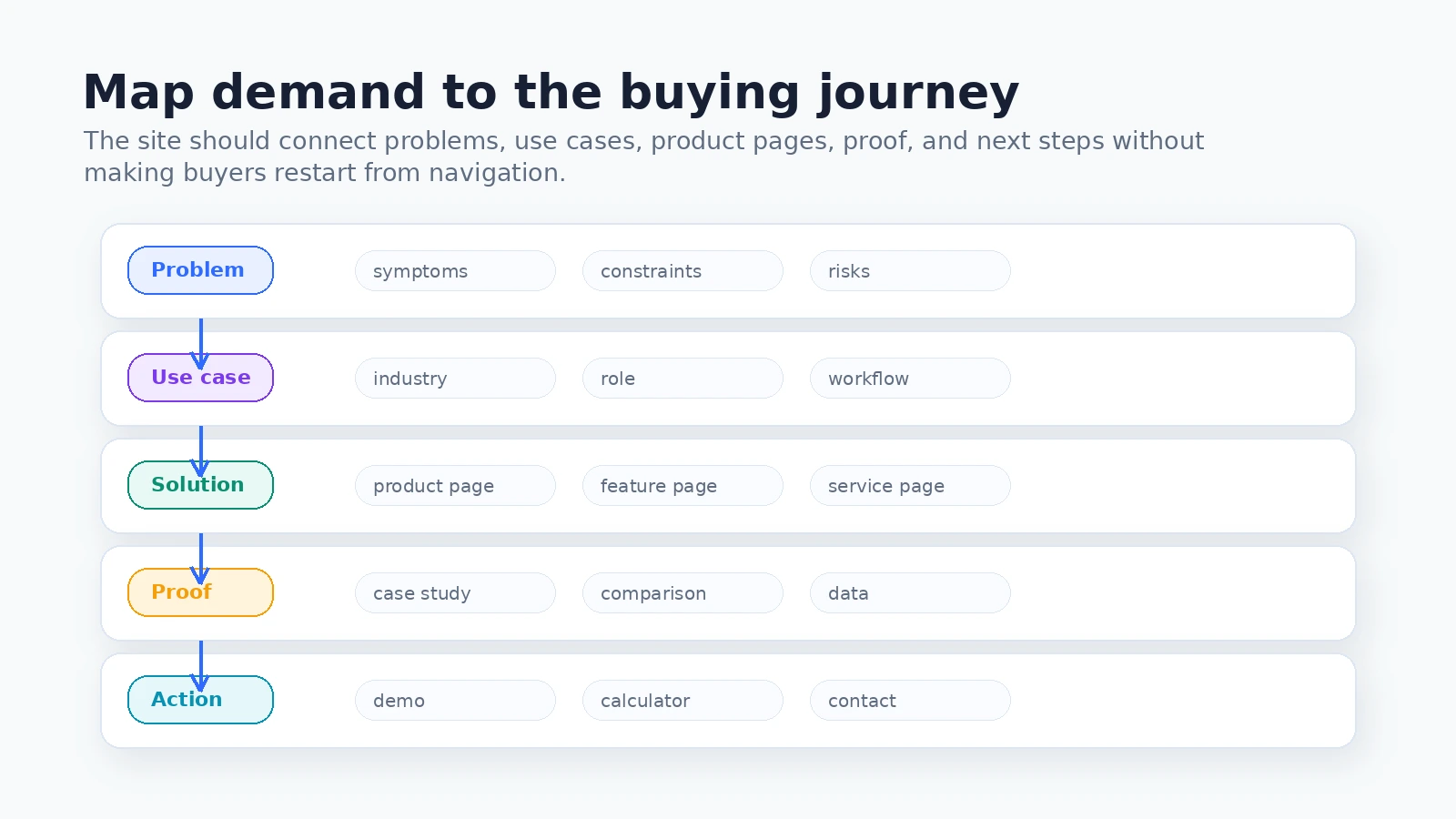
Problem → use case → solution → proof → cost → next step
A buyer should not need to return to the main navigation after every page.
Commercial pages should receive internal links from relevant educational pages. Educational pages should not become dead ends. Case studies should connect back to the product, use case, industry, and conversion path they support.
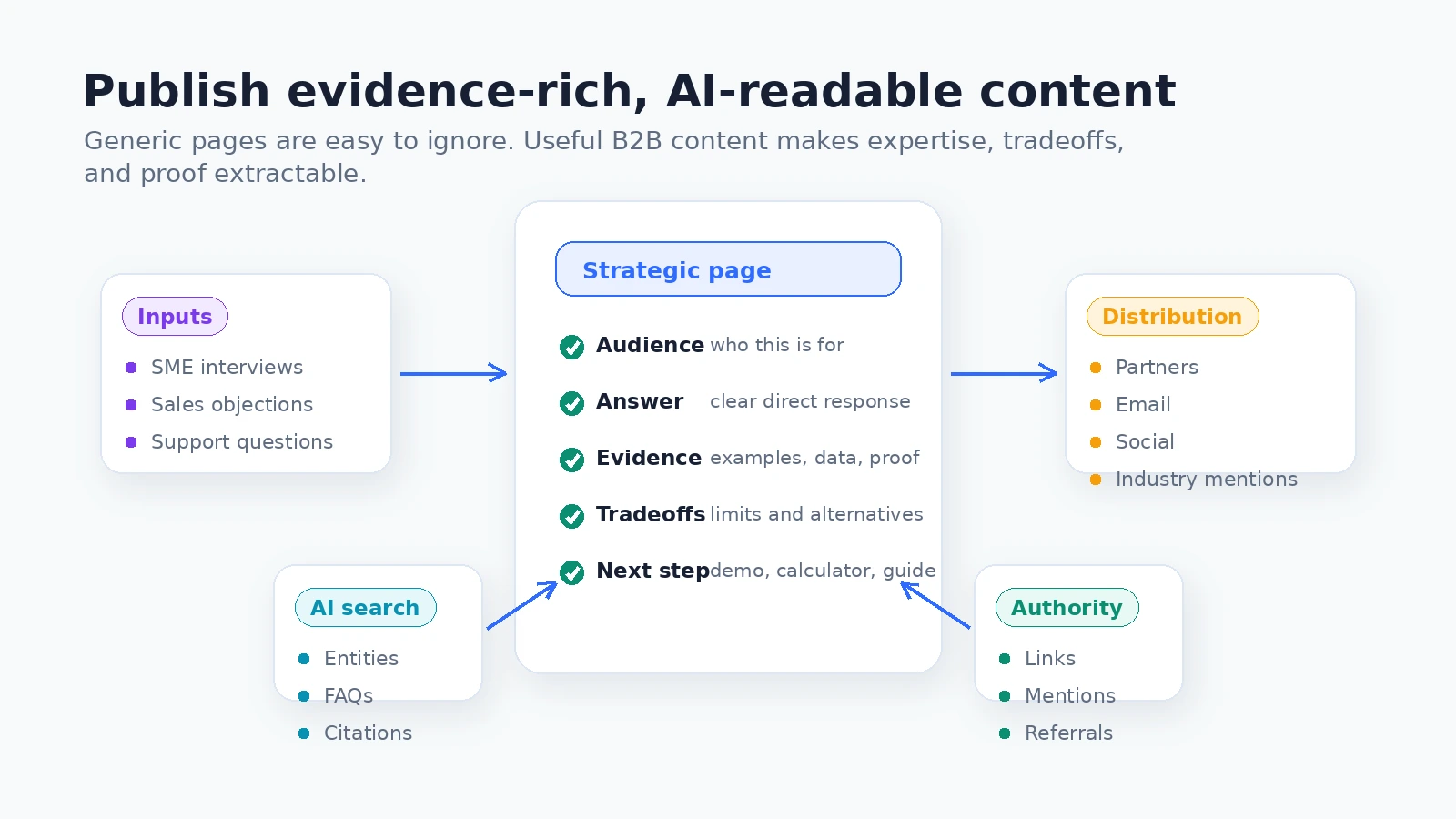
6. Publish evidence-rich content
Generic content is easy to produce and easy to ignore.
For every important page, check:
- Is the intended audience clear?
- Is the use case specific?
- Does the page answer the query early?
- Does it include original expertise?
- Does it include examples, data, or operational details?
- Does it explain tradeoffs and limitations?
- Does it show proof near claims?
- Does it link to the next useful page?
- Does it include a conversion action that matches intent?
- Is it current?
- Is it reviewed by someone who understands the product or market?
A long page can still be thin if it repeats generic advice.
A shorter page can be strong if it answers a specific buyer question clearly and supports the answer with evidence.
This matters for both traditional search and AI search visibility. AI systems need clear, extractable information: entities, definitions, comparisons, claims, supporting evidence, and unambiguous page purpose.
That does not mean writing for robots. It means writing pages that are easy for both humans and machines to understand.
7. Strengthen technical foundations
Technical SEO is the operating layer that allows strategy to work.
Check:
- important pages are crawlable;
- important pages are indexable;
- sitemap files are clean;
- canonical tags are intentional;
- redirects are maintained;
- duplicate and faceted URLs are controlled;
- internal links are not broken;
- JavaScript rendering does not hide critical content;
- templates work on mobile;
- page performance is acceptable on strategic templates;
- structured data is valid where useful;
- migrations preserve important URLs;
- releases do not accidentally break indexation, metadata, or internal links.
Google Search Central’s crawling and indexing documentation is still the best starting point for understanding this foundation. The newer AI search layer does not remove the need for crawlable, indexable, useful pages.
Use the detailed technical SEO guide for the operational checklist.
8. Build authority and distribution
Authority is not only “get more backlinks.”
For B2B, authority should support the topics and markets where the company needs to be trusted.
Check:
- relevant referring domains;
- unlinked brand mentions;
- broken backlinks;
- partner pages;
- customer mentions;
- association profiles;
- analyst and directory listings;
- industry publications;
- expert collaborations;
- original research assets;
- comparison pages worth referencing;
- social distribution for important assets;
- referral traffic quality;
- branded search demand;
- mentions in AI answers where you can observe them.
Evaluate relevance and referral value, not only domain metrics.
A link from a niche industry resource may be more useful than a generic high-authority mention that no buyer in your market reads.
Use the B2B link-building guide and social distribution framework together. Distribution helps useful content reach the people, partners, journalists, and communities that can create durable authority signals.
9. Improve conversion
SEO does not end at the visit.
Review every important organic landing page for conversion clarity:
- Is the offer clear?
- Is the target audience obvious?
- Is proof placed near major claims?
- Does the CTA match the buying stage?
- Are forms too long for the intent?
- Is there a lower-friction action for early-stage buyers?
- Are commercial pages connected to case studies and comparisons?
- Are educational pages connected to relevant next steps?
- Do sales objections appear in the content?
- Does the page help a buyer continue the journey without talking to sales immediately?
This is where a calculator can be useful.
The SEO ROI Calculator is not only a tool for engagement. It acts as a decision-stage economics check: buyers can enter a proposed SEO investment, customers acquired, annual revenue per customer, gross margin, churn, and discount rate, then review CAC, LTV, LTV:CAC, ROI, payback, and expected lifetime.
It does not forecast traffic, leads, close rates, or pipeline. Keep those funnel assumptions in the KPI model and use the calculator to test the customer economics that result.
If the calculator is part of the SEO cluster, track it like a serious conversion asset:
- visits from organic pages;
- starts;
- completions;
- copied or submitted results;
- demo/contact clicks after use;
- CRM source preservation;
- pipeline influenced by calculator sessions.
10. Run a monthly learning cycle
A checklist is static. A growth system learns.
Each month, review:
- what shipped;
- what changed technically;
- which pages were published or updated;
- which pages were indexed;
- which clusters gained or lost visibility;
- which pages brought qualified actions;
- which leads became opportunities;
- which leads were disqualified;
- what sales heard from buyers;
- what AI search or zero-click behavior appears to be changing;
- which assumption should be tested next.
Do not attribute every movement to the most recent change.
SEO effects have different time horizons:
- technical fixes can be observed relatively quickly;
- content refreshes may take longer;
- new topic clusters need time to earn visibility;
- authority programs compound slowly;
- enterprise sales cycles can delay revenue reporting.
Use explicit review windows and record intervention dates.
The monthly question is not only “Did traffic grow?”
It is:
What did we learn about qualified demand, and what should we improve next?
Google has also started adding more dedicated reporting around generative AI features in Search Console for eligible sites, which makes it increasingly important to separate normal organic visibility, AI search visibility, clicks, and downstream commercial influence where the data is available.
B2B SEO checklist summary
Use this compact version for recurring reviews.
Business outcome
- Priority product defined.
- Priority segment defined.
- Target region defined.
- Qualified lead definition agreed with sales.
- Organic pipeline and revenue baseline recorded.
- Demand capture and demand creation goals separated.
Measurement
- Analytics configured.
- Search Console configured.
- Forms, demos, calls, emails, and calculator events tracked.
- CRM source data preserved.
- Landing page and cluster reporting available.
- Known attribution gaps documented.
Audit
- Crawlability reviewed.
- Indexation reviewed.
- Canonicals reviewed.
- Sitemaps reviewed.
- Redirects reviewed.
- Broken links reviewed.
- Orphan pages found.
- Duplicate and outdated content reviewed.
- Findings prioritized by impact, confidence, and effort.
Demand and structure
- Queries grouped by problem, use case, product, industry, and buying stage.
- Sales and support questions included.
- Existing pages mapped to demand.
- Missing pages identified.
- Competing pages consolidated or differentiated.
- Internal links connect education, product, proof, and conversion pages.
Content
- Pages answer the query early.
- Audience and use case are clear.
- Specialist expertise is visible.
- Examples, data, tradeoffs, and limitations are included.
- Claims are supported.
- Content is current.
- Next steps match intent.
Technical foundation
- Important pages are crawlable and indexable.
- Page templates are stable.
- Performance problems are prioritized by user and rendering impact.
- Structured data is valid where useful.
- Migration and release risks are controlled.
Authority and distribution
- Relevant links and mentions reviewed.
- Partner and customer opportunities identified.
- Link-worthy assets planned.
- Social and email distribution connected to priority assets.
- Referral quality evaluated.
- Branded demand monitored.
Conversion and learning
- Offers are clear.
- Proof supports claims.
- CTAs match buying stage.
- Form friction is reviewed.
- Lead quality is reviewed by page group.
- Sales feedback updates the content roadmap.
- Monthly learning cycle is documented.
How this connects to the wider B2B SEO system
This checklist is the operating layer.
Use it with:
- the 2026 B2B SEO strategy guide for the commercial model;
- the B2B SEO audit framework for diagnosis;
- the B2B SEO KPI framework for measurement;
- the technical SEO guide for implementation details;
- the B2B link-building guide for authority;
- the social distribution framework for distribution;
- the B2B SEO case study for a practical example;
- the SEO ROI Calculator for decision-stage economics.
External references used for current AI search context:
- Google Search Central: Optimizing for generative AI features
- Google Search Central: Crawling and indexing
- Google Search Central: Search Generative AI performance reports
FAQ
What should a B2B SEO checklist include?
A useful B2B SEO checklist should include business baseline, measurement, diagnostic audit, demand mapping, site structure, evidence-rich content, technical foundations, authority building, conversion, and a monthly learning cycle.
Why is a B2B SEO checklist different from a generic SEO checklist?
B2B SEO has longer buying cycles, more stakeholders, lower search volume, and higher deal value. The checklist must connect search work to qualified pipeline and revenue, not only traffic or rankings.
Should B2B SEO start with keywords or business goals?
Start with business goals. Keywords matter, but they should be mapped to priority products, customer segments, regions, use cases, and buying stages.
How do you measure B2B SEO success?
Measure B2B SEO through a KPI tree: pipeline and revenue outcomes, conversion quality, non-branded demand and visibility, technical health, content delivery, and authority signals.
How does AI search change a B2B SEO checklist?
AI search makes clarity, evidence, entity structure, original expertise, comparisons, and answerable pages more important. It does not replace technical SEO, measurement, or buyer-focused content.
How often should a B2B SEO checklist be reviewed?
Review the checklist monthly for execution and learning. Use longer review windows for new topic clusters, authority programs, and revenue impact because B2B sales cycles can create a delay between discovery and closed revenue.
Where does an SEO cost calculator fit in the checklist?
An SEO ROI calculator fits in the conversion and decision-stage layer. It helps buyers test a proposed SEO investment against acquired customers, CAC, LTV, ROI, and payback before moving to a commercial conversation.
Conclusion
A checklist cannot replace strategy. But it can prevent a B2B SEO program from becoming a collection of disconnected tasks.
The right checklist keeps the work tied to revenue logic:
Business outcome → measurement → diagnosis → demand map → execution → conversion → learning
That is what makes B2B SEO compound.
Questions about a B2B growth system? Contact me via LinkedIn, Telegram, or email.