B2B Link Building: Authority, Referrals, and Market Evidence
Quick answer
B2B link building is not about collecting as many backlinks as possible.
A good B2B link-building program earns market evidence:
- relevant links from trusted industry sources;
- mentions from partners, customers, events, and associations;
- expert citations in useful articles and research;
- referral visits from people who may actually buy, partner, or influence a deal;
- stronger topical authority around the problems the company solves;
- clearer evidence for search engines, AI search systems, and human buyers.
The goal is not a higher third-party domain score.
The goal is to make your company easier to discover, verify, cite, and trust in the market where you need to win.
Why B2B link building is different
Generic link building often starts with a simple target:
Get more backlinks from higher-authority domains.
That can be too shallow for B2B.
In B2B, the market is usually smaller, the buying cycle is longer, and a single qualified opportunity can be more valuable than thousands of casual visits. The link that matters most may not come from the biggest media site. It may come from a specialist association, a technology partner, a niche comparison page, a conference profile, or a customer story that a buyer actually trusts.
So the question is not only:
Will this link help rankings?
The better question is:
Does this reference help the right market understand that we are a credible option?
A durable B2B authority program should support four things at once:
- Search visibility — stronger signals around topics, entities, and useful pages.
- Referral discovery — qualified visitors from relevant sources.
- Buyer confidence — evidence that the company exists in a real professional network.
- AI-search readiness — clearer off-site evidence that can help systems verify the brand, experts, products, and assets.
That is why link building should sit inside the broader B2B SEO checklist, not exist as a disconnected outreach task.
What makes a B2B link valuable?
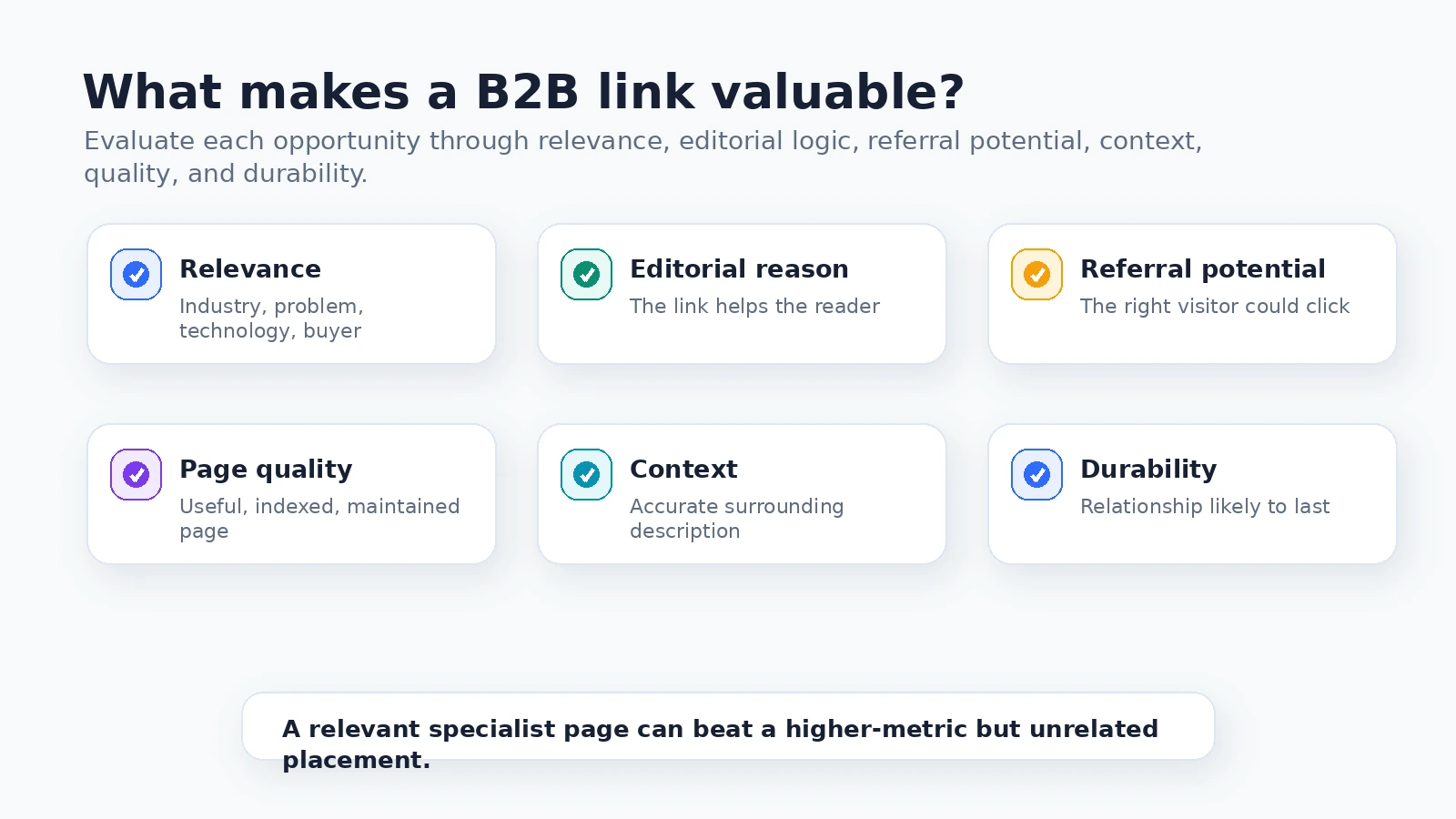
A B2B link should be evaluated through several lenses.
| Criterion | Practical question |
|---|---|
| Relevance | Is the source connected to the industry, problem, technology, or customer? |
| Editorial reason | Does the link help the reader, or was it inserted only for SEO? |
| Referral potential | Could the right buyer, partner, analyst, journalist, or specialist follow it? |
| Page quality | Is the linking page useful, indexed, maintained, and not overloaded with weak outbound links? |
| Context | Does the surrounding text accurately describe the destination? |
| Durability | Is the relationship or page likely to remain useful over time? |
| Destination quality | Does the linked page deserve to be cited? |
| Brand risk | Would you be comfortable showing this placement to a customer, investor, or partner? |
A relevant association profile or specialist article can be more valuable than a higher-metric but unrelated website.
Do backlinks still matter in AI search?
Backlinks still matter, but the role is changing.
Traditional SEO uses links as one part of the discovery and authority system. AI search and LLM-driven answers add another layer: systems may summarize, compare, cite, or ignore sources based on how clearly information can be retrieved and verified.
That does not mean “build links for AI” is a separate magic tactic.
It means B2B companies should care about the broader evidence graph around the brand:
- where the company is mentioned;
- whether the product is described consistently;
- whether experts have visible authorship;
- whether partners and customers reference the company accurately;
- whether original assets are easy to cite;
- whether important claims are supported on the page being linked to;
- whether comparison, pricing, capability, and use-case information is clear.
A backlink from a relevant source can help because it connects the company to a topic, market, or professional network. A mention without a link can also matter for buyer trust and entity clarity, even if it is not counted like a classic backlink.
For AI search, the safest assumption is practical:
Build the kind of market evidence that a human researcher, journalist, buyer, or AI system could verify without guessing.
Google’s current guidance for generative AI features still points back to familiar fundamentals: make pages crawlable, indexable, useful, accurate, and people-first. There is no substitute for clear information architecture, helpful content, and credible external evidence.
Related guide: B2B SEO KPIs: Measure Pipeline and Revenue, Not Rankings
Start with existing relationships
The fastest legitimate opportunities often already exist.
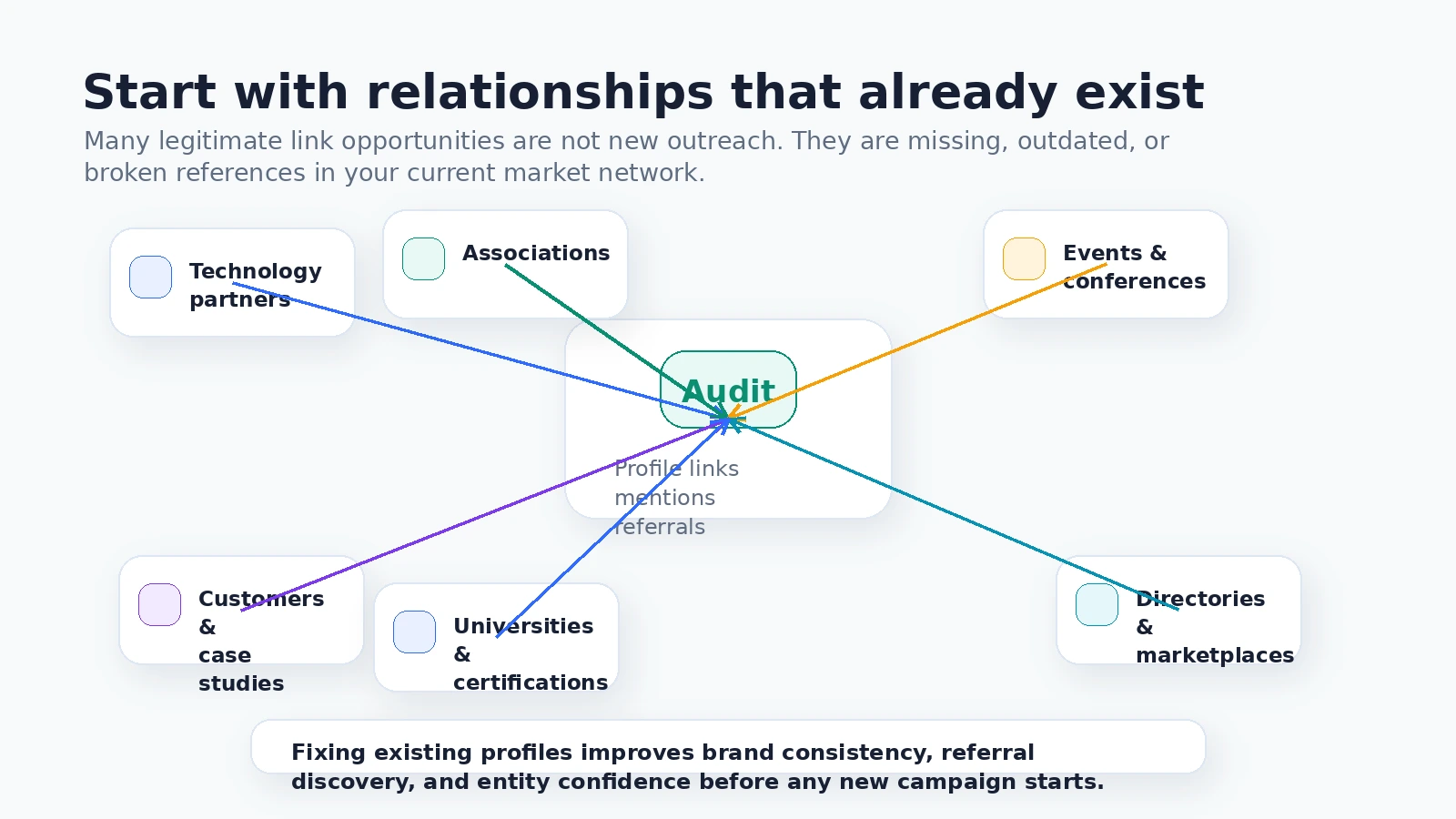
Before cold outreach, audit the professional network around the company:
- suppliers;
- technology partners;
- integration partners;
- implementation partners;
- customers with public case studies;
- distributors and regional representatives;
- professional associations;
- event and conference profiles;
- speaker pages;
- industry directories;
- marketplace listings;
- certification bodies;
- universities and research groups;
- local business profiles;
- review and comparison platforms.
For each source, check:
- is the company listed?
- is the link present?
- is the link broken?
- does the page use the correct brand name?
- does the description match the current positioning?
- does the destination URL point to the right page?
- is there a stronger destination than the homepage?
- can the page include a case study, integration page, product page, or calculator instead?
This work is not only “easy link building.”
It also improves brand consistency, referral discovery, and entity confidence.
Create assets worth referencing
Outreach becomes much easier when the destination deserves to be cited.
Weak outreach asks another publisher to link to a generic page.
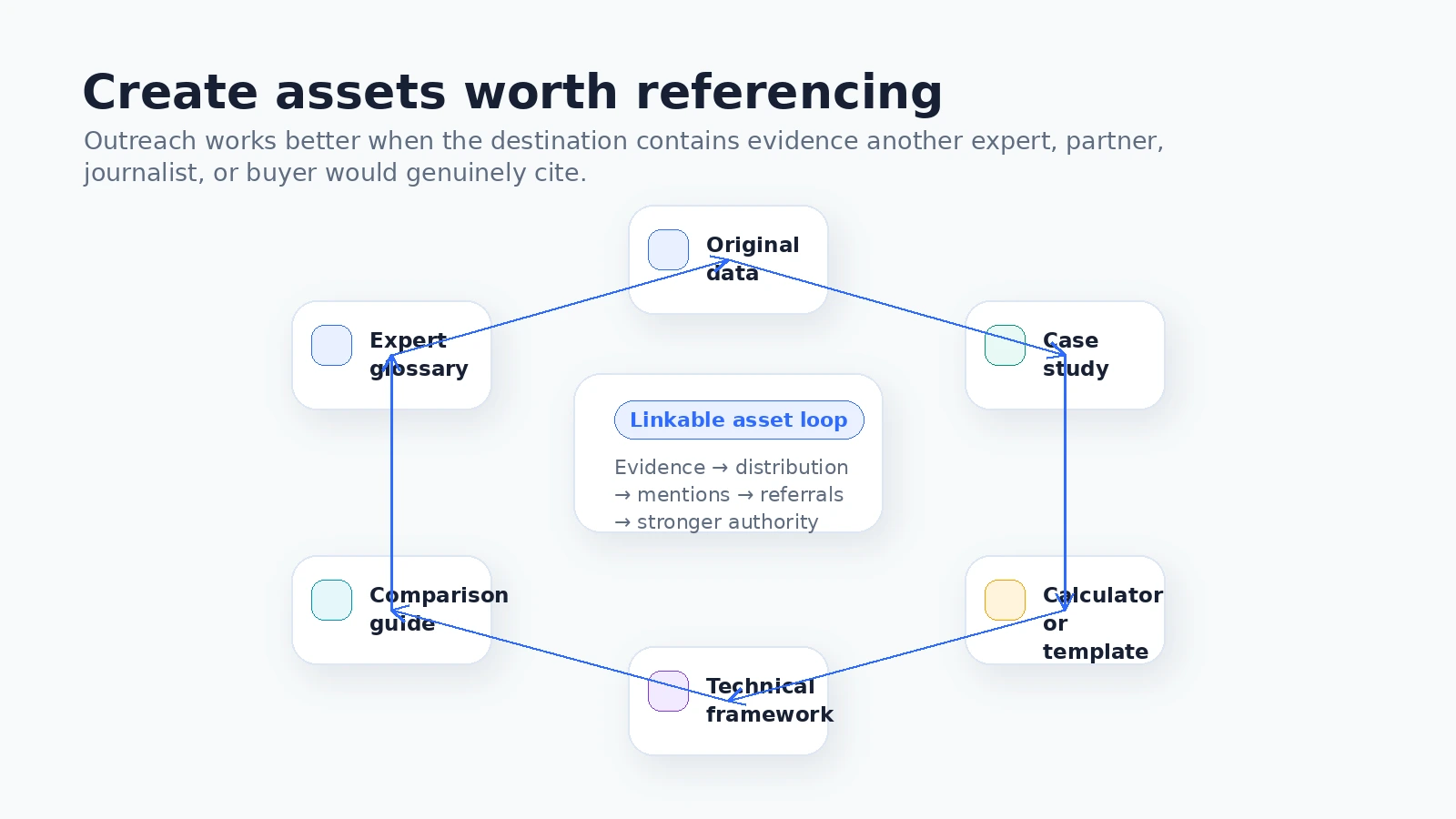
Strong outreach points to something useful:
- original industry data;
- a transparent case study;
- a diagnostic framework;
- a technical calculator;
- a practical template;
- a visual explanation of a complex process;
- a detailed comparison;
- a migration guide;
- a benchmark report;
- an expert-built glossary;
- a decision checklist;
- a dataset or methodology summary.
The best assets usually help someone else explain a problem better.
For example, a B2B SEO agency, consultant, or in-house team could earn stronger references from:
- a public SEO ROI Calculator that lets buyers test a proposed investment against CAC, LTV, ROI, and payback;
- a transparent B2B SEO case study that explains what changed and why;
- a B2B SEO audit framework that gives teams a useful diagnostic model;
- a comparison page that helps buyers understand tradeoffs;
- a research-backed guide that specialists can cite in their own work.
A weak destination cannot be repaired by more outreach.
If the page is generic, thin, inaccurate, or purely self-promotional, the outreach will either fail or attract low-quality placements.
Use expert-led digital PR
Many B2B companies already have linkable knowledge hidden inside the business.
It lives in:
- sales calls;
- implementation notes;
- product decisions;
- customer objections;
- technical support tickets;
- onboarding materials;
- internal research;
- leadership opinions;
- partner conversations.
Expert-led digital PR turns that knowledge into public evidence.
Useful formats include:
- expert commentary for journalists;
- contributed articles with original insight;
- data-led research summaries;
- responses to industry changes;
- event recaps;
- webinar summaries;
- partner interviews;
- customer collaboration pieces;
- technical explainers;
- annual or quarterly market reports.
The goal is not maximum publication volume.
The goal is repeated visibility in places the target market already trusts.
For B2B companies, a few credible placements in the right industry network can do more than dozens of generic guest posts.
Connect distribution channels
Important content should not wait passively for discovery.
Distribution increases the probability that useful content reaches people who can reference it later.
That includes:
- customers;
- subscribers;
- partners;
- analysts;
- journalists;
- association editors;
- event organizers;
- niche community members;
- internal sales and customer success teams.
Use email distribution for people who already know the company.
Use social distribution to reach peers, partners, and specialists who may discuss, challenge, save, or cite the work.
This does not mean social engagement directly becomes a ranking factor.
It means distribution creates more opportunities for discovery, conversation, and future references.
Related guide: B2B Social Distribution: Turn Content into Market Reach
Build links to strategic pages, not only the homepage
A common mistake is pointing almost every link to the homepage.
The homepage can be useful for brand validation, but it is rarely the only page that needs authority.
B2B authority should support strategic page groups:
- product pages;
- use-case pages;
- industry pages;
- comparison pages;
- alternative pages;
- integration pages;
- case studies;
- research reports;
- calculators and templates;
- technical guides;
- commercial landing pages.
The destination should match the reason for the link.
Examples:
| Source | Better destination |
|---|---|
| Partner integration page | Integration or partner landing page |
| Conference speaker profile | Expert bio, research, or event recap |
| Industry article about cost planning | Calculator or cost framework |
| Customer story | Case study or solution page |
| Technical article | Technical guide or documentation hub |
| Comparison mention | Comparison or alternative page |
This helps both buyers and search systems understand which parts of the site are authoritative for which topics.
For an article about cost planning, the SEO ROI Calculator is a stronger destination than the homepage because the reference and the buyer’s next step match.
Avoid common failure modes
Avoid these patterns:
- buying large volumes of irrelevant links;
- publishing generic guest posts on sites with no real audience;
- using the same commercial anchor text repeatedly;
- treating every backlink as equally useful;
- measuring success only through domain metrics;
- pointing every link to the homepage;
- ignoring referral quality;
- ignoring brand risk;
- building links before improving the destination page;
- separating outreach from content quality;
- creating assets without a distribution plan;
- chasing AI-search visibility with unverifiable claims.
Search engines have long treated manipulative link practices as spam risk. Even when a tactic appears to work temporarily, it can create future risk for the domain and brand.
A practical test is simple:
Would this link still be worth having if it passed no SEO value?
If the answer is yes, it may be a real market reference.
If the answer is no, the opportunity probably deserves more scrutiny.
Measure the program
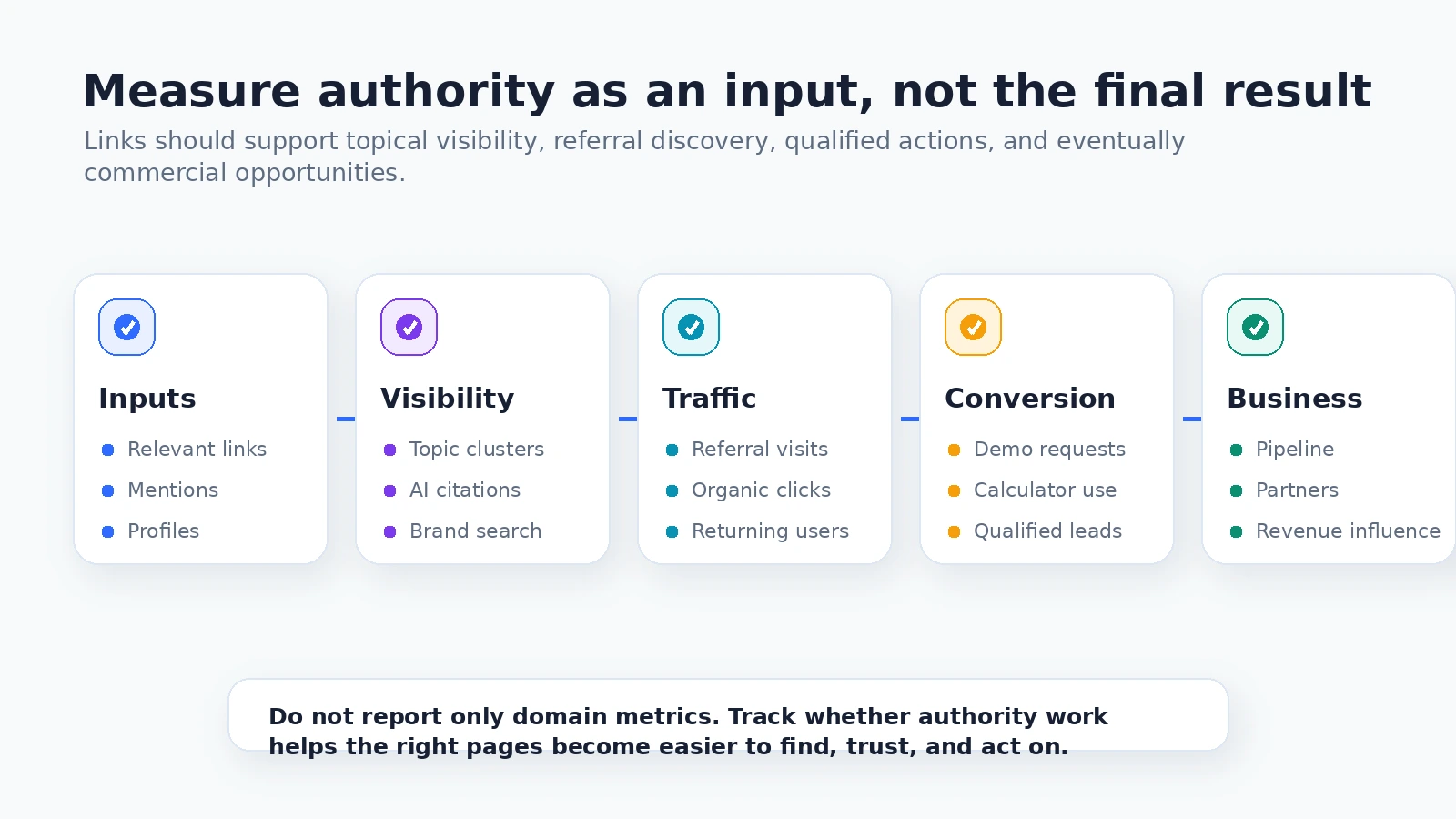
Links are not the final business result.
They are inputs into authority, discovery, referral traffic, and buyer confidence.
Track:
- relevant referring domains;
- new links to strategic pages, not only the homepage;
- mentions without links;
- corrected or reclaimed existing profiles;
- referral visits from relevant sources;
- qualified actions from referral traffic;
- new branded search demand;
- visibility changes in supported topic clusters;
- AI-search visibility where reliable reporting exists;
- opportunities created through partnerships, publications, events, or referrals;
- sales feedback about sources buyers mention during conversations.
Place these indicators inside the broader B2B SEO KPI model.
A link-building report should not say only:
We built 20 links this month.
A stronger report says:
We improved authority around the cost-planning cluster, earned 6 relevant references to the calculator and audit framework, generated 212 referral visits, influenced 9 qualified actions, and created 2 partner conversations.
A practical 90-day B2B link-building plan
A realistic first cycle should be focused.
Days 1–15: diagnose and clean up
- Export current referring domains and linked pages.
- Identify links to the homepage versus strategic pages.
- Find missing partner, customer, directory, and event links.
- Check inconsistent brand descriptions.
- Reclaim broken backlinks and outdated URLs.
- Prioritize pages that deserve more authority.
Days 16–30: prepare linkable assets
- Choose one or two strategic topics.
- Improve the destination pages.
- Add evidence, examples, data, or expert commentary.
- Create supporting visuals or templates.
- Prepare outreach angles for each audience.
- Align the assets with commercial next steps.
Days 31–60: activate relationships
- Update partner and association profiles.
- Ask for missing links where there is a real relationship.
- Publish or pitch expert commentary.
- Distribute the asset through email and social channels.
- Support sales and customer success with the asset.
- Track referral visits and qualified actions.
Days 61–90: expand what worked
- Review which sources sent useful traffic or conversations.
- Identify which asset earned natural mentions.
- Improve weak destinations before more outreach.
- Turn successful commentary into a larger content asset.
- Build the next outreach list from real market response.
- Report links, mentions, referrals, and pipeline influence together.
This is slower than buying placements, but it creates a healthier authority base.
FAQ
What is B2B link building?
B2B link building is the process of earning relevant links, citations, mentions, referrals, and professional references that help buyers and search systems trust a company’s expertise in a specific market.
Are backlinks still important for B2B SEO?
Backlinks can still support discovery and authority, but they should not be treated as a numbers game. Relevance, editorial context, referral potential, and brand risk matter more than raw link volume.
What makes a B2B backlink valuable?
A valuable B2B backlink usually comes from a relevant industry source, has a real editorial reason, sits on a useful maintained page, describes the destination accurately, and can send qualified visitors or partners.
Should B2B companies buy backlinks?
Buying links for ranking manipulation is risky and can violate search engine spam policies. B2B companies are usually better served by creating useful assets, maintaining partner profiles, earning citations, and building real market relationships.
How does link building support AI search and LLM visibility?
Links and mentions can help make a brand, entity, expert, or asset easier to discover and verify across the web. They do not guarantee AI citations, but they can improve the evidence layer around a company’s expertise.
What are good B2B linkable assets?
Strong B2B linkable assets include original industry data, case studies, diagnostic frameworks, calculators, templates, technical explainers, comparison guides, and expert-built glossaries.
How should B2B link-building success be measured?
Measure relevant referring domains, links to strategic pages, referral visits, qualified actions, brand mentions, topic visibility, AI-search visibility where available, and opportunities influenced by partnerships or publications.
Conclusion
Durable B2B link building looks less like a transaction and more like market participation.
Publish evidence. Maintain real professional relationships. Make important knowledge easy to cite. Distribute useful assets to people who can discuss, reference, and challenge them.
Search authority then becomes a by-product of genuine usefulness and relevance.
For implementation, connect this guide with the 2026 B2B SEO strategy guide, the B2B SEO audit framework, the B2B SEO checklist, the B2B SEO KPI model, and the SEO ROI Calculator.
Questions about a B2B growth system? Contact me via LinkedIn, Telegram, or email.